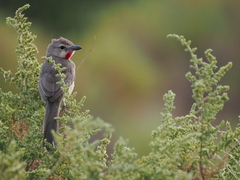
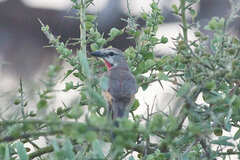
Rosy-patched Bushshrike

Rosy-patched Bushshrike

Telophorus cruentus

LCLeast ConcernNTVUENCR
Daily sighting probability ~10% · With luck
at Amboseli National Park

In 3 days ~30% in a week ~50%

111 Verified sightings at Amboseli National Park From 2019 to 2026
1,434 In all 8 parks
April Best month
☀️ Diurnal When it's spotted

About the Rosy-patched Bushshrike

The rosy-patched bushshrike (Rhodophoneus cruentus) is a species of bird in the family Malaconotidae. It is the only species placed in the genus Rhodophoneus. It is found in Djibouti, Egypt, Eritrea, Ethiopia, Kenya, Somalia, Sudan, and Tanzania. Its natural habitat is subtropical or tropical dry shrubland.

The rosy-patched bushshrike was formally described in 1828 as Lanius cruentus by the German naturalists Wilhelm Hemprich and Christian Gottfried Ehrenberg based on specimens collected at Arkiko near Massawa in Eritrea. The specific epithet is Latin meaning "bloody" or "stained with blood". It is now the only species placed in the genus Rhodophoneus which was introduced in 1871 by the German explorer and ornithologist Theodor von Heuglin to accommodate a single species, the rosy-patched bushshrike. The genus name combines the Ancient Greek ῥοδον/rhodon meaning "rose" with φονευς/phoneus meaning "murderer".

Four subspecies are recognised: Rhodophoneus cruentus kordofanicus Sclater, WL & Mackworth-Praed, CW, 1918 – west-central Sudan Rhodophoneus cruentus cruentus (Hemprich, WF & Ehrenberg, CG, 1828) – northeastern Sudan, Eritrea, and northern Ethiopia

Rhodophoneus cruentus... Wikipedia →

Sounds

Recording0:07

Tanzania · 2024

© blackdogto · iNaturalist · CC BY-NC 4.0

Recording0:03

Kenya · 2018

© Tuoichen · iNaturalist · CC BY 4.0

Global Distribution

Parks Where Found

# Park Country Daily sighting probability
1 Samburu National Reserve 🇰🇪 Kenya
~50%
2 Meru National Park 🇰🇪 Kenya
~40%
3 Tsavo East National Park 🇰🇪 Kenya
~40%
4 Awash National Park 🇪🇹 Ethiopia
~40%
5 Tsavo West National Park 🇰🇪 Kenya
~30%
6 Mkomazi National Park 🇹🇿 Tanzania
~20%
7 Amboseli National Park 🇰🇪 Kenya
~10%
8 Tarangire National Park 🇹🇿 Tanzania
<5%

Before you go

What are the chances of seeing a Rosy-patched Bushshrike in Amboseli National Park?

With luck

About 10% of wildlife watchers report a Rosy-patched Bushshrike sighting in Amboseli National Park on a given day, based on 111 verified sightings from GBIF citizen-science data from 2019 to 2026. It is the 130th most-seen of the 362 birds we can rate there. Over three days the chance rises to about 30%, and over a week to about 50%, if each day is a fresh chance.

When is the best time to see a Rosy-patched Bushshrike in Amboseli National Park?

April and December

In those months about 20% of wildlife watchers report a Rosy-patched Bushshrike in Amboseli National Park on a given day, against under 5% in September, the lowest month. Those are among Amboseli National Park's wettest months, with about 180 mm of rain a month against 10 mm in July.

What time of day is best to see a Rosy-patched Bushshrike?

Between 7 and 10 am

Across all the parks we cover, that three-hour window holds the most Rosy-patched Bushshrike sightings with a recorded time, and about 8 in 10 of them come between 6 am and 6 pm: it is a daytime animal.

Which relatives of the Rosy-patched Bushshrike live in Amboseli National Park?

Same family: Malaconotidae

The closest relatives of the Rosy-patched Bushshrike that you can see in Amboseli National Park (family Malaconotidae, Bushshrikes and Allies) are Slate-colored Boubou (about 20%), Brubru (about 10%) and Brown-crowned Tchagra (about 10%), with each one's daily chance of a sighting.

Where does the Rosy-patched Bushshrike sighting chance come from?

GBIF citizen-science records

It is estimated from how often the Rosy-patched Bushshrike is recorded against all the birds logged in Amboseli National Park (111 verified sightings from 2019 to 2026), calibrated against known sighting rates. Figures are rounded to the nearest 10% because citizen-science data supports honest approximations, not decimals, and months with records from fewer than five people show "—". How it works.

← Back to Amboseli National Park