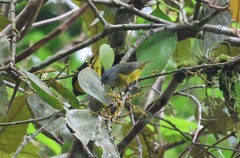
Plumbeous Euphonia

Plumbeous Euphonia

Euphonia plumbea

Silhouette: Sheatherius · PhyloPic

LCLeast ConcernNTVUENCR
Daily sighting probability <5% · Rare
at Anavilhanas National Park

In 3 days ~10% in a week ~20%

11 Verified sightings at Anavilhanas National Park From 2019 to 2026
11 In 1 park
May Best month
☀️ Diurnal When it's spotted

About the Plumbeous Euphonia

The plumbeous euphonia (Euphonia plumbea) is a species of bird in the family Fringillidae, the finches and euphonias. It is found in Brazil, Colombia, Guyana, Peru, Suriname, Venezuela, and as a vagrant to French Guiana.

The plumbeous euphonia was originally described in 1855 with its current binomial Euphonia plumbea. The genus Euphonia was long placed in the family Thraupidae, the "true" tanagers. Multiple studies in the late twentieth and early twenty-first centuries resulted in its being reassigned to its present place in the family Fringillidae.

The plumbeous euphonia is monotypic. The plumbeous euphonia is about 9 cm (3.5 in) long and weighs about 9 g (0.32 oz). The species is sexually dimorphic. Adult males have a glossy dark gray head, upper breast, and upperparts. Their tail is dusky with a wash of olivaceous gray. Their upperwing coverts and flight feathers are dusky with wide olivaceous gray edges. Their underparts from their breast to the undertail coverts are bright yellow with some gray mottling on the sides and flanks. Adult females have an overall pattern similar to the male's though duller. Their crown and nape are gray... Wikipedia →

Sounds

Song0:11

Colombia · 2022

© Frank Lambert · XC1043199 · CC BY-NC-ND 4.0

Call0:21

Colombia · 2021

© Peter Boesman · XC693510 · CC BY-NC-ND 4.0

Song0:38

Brazil · 2019

© JAYRSON ARAUJO DE OLIVEIRA · XC494045 · CC BY-NC-SA 4.0

Global Distribution

Parks Where Found

# Park Country Daily sighting probability
1 Anavilhanas National Park 🇧🇷 Brazil
<5%

More parks will be added in future updates.

Before you go

What are the chances of seeing a Plumbeous Euphonia in Anavilhanas National Park?

Rare

Under 5% of wildlife watchers report a Plumbeous Euphonia sighting in Anavilhanas National Park on a given day, based on 11 verified sightings from GBIF citizen-science data from 2019 to 2026. It is the 219th most-seen of the 291 birds we can rate there. Over three days the chance rises to about 10%, and over a week to about 20%, if each day is a fresh chance.

When is the best time to see a Plumbeous Euphonia in Anavilhanas National Park?

May

In that month about 20% of wildlife watchers report a Plumbeous Euphonia in Anavilhanas National Park on a given day, against under 5% in June to April, the lowest months.

What time of day is best to see a Plumbeous Euphonia?

Between 7 and 10 am

Across all the parks we cover, that three-hour window holds the most Plumbeous Euphonia sightings with a recorded time, and about 9 in 10 of them come between 6 am and 6 pm: it is a daytime animal.

Where else can you see a Plumbeous Euphonia?

Only Anavilhanas National Park, in our data

Anavilhanas National Park is the only park on Wallace's Line with enough records to rate Plumbeous Euphonia sightings: under 5% of wildlife watchers there report one on a given day.

Where does the Plumbeous Euphonia sighting chance come from?

GBIF citizen-science records

It is estimated from how often the Plumbeous Euphonia is recorded against all the birds logged in Anavilhanas National Park (11 verified sightings from 2019 to 2026), calibrated against known sighting rates. Figures are rounded to the nearest 10% because citizen-science data supports honest approximations, not decimals, and months with records from fewer than five people show "—". How it works.

← Back to Anavilhanas National Park