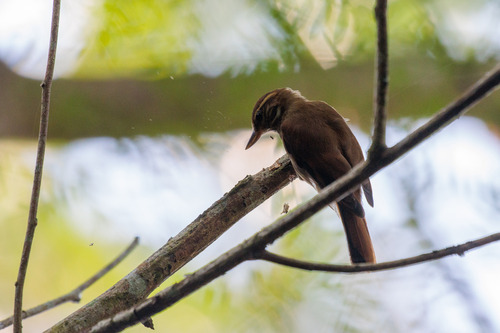
Long-billed Woodcreeper

Long-billed Woodcreeper

Nasica longirostris

Silhouette: Rebecca Groom · PhyloPic

LCLeast ConcernNTVUENCR
Daily sighting probability ~30% · Possible
at Anavilhanas National Park

In 3 days ~70% in a week ~90%

136 Verified sightings at Anavilhanas National Park From 2019 to 2026
1,070 In all 6 parks
September Best month
☀️ Diurnal When it's spotted

About the Long-billed Woodcreeper

The long-billed woodcreeper (Nasica longirostris) is a sub-oscine passerine bird in subfamily Dendrocolaptinae of the ovenbird family Furnariidae. It is found in Bolivia, Brazil, Colombia, Ecuador, French Guiana, Peru, and Venezuela.

The long-billed woodcreeper is the only member of genus Nasica. It is monotypic: No subspecies are recognized. Its closest relative is the cinnamon-throated woodcreeper (Dendrexetastes rufigula). The population south of the Amazon River has significantly longer bills than those birds north of the river, and has been treated by some authors as subspecies N. l. australis.

The long-billed woodcreeper is one of the largest woodcreepers, with a slim body, small head, long neck, long tail, and an exceptionally long, slightly decurved, bill. It is 34 to 36 cm (13 to 14 in) long and weighs 78 to 92 g (2.8 to 3.2 oz). The sexes are alike. The adult's crown, nape, and auricular area are blackish brown with whitish buff streaks. It has a white supercilium, throat, and foreneck. Its back, rump, wings, and tail are bright cinnamon-rufous to rufous-chestnut. The tips of its outermost primaries are dark brown. Its breast... Wikipedia →

Sounds

Song0:13

Brazil · 2026

© JAYRSON ARAUJO DE OLIVEIRA · XC1186085 · CC BY-NC-SA 4.0

Call0:57

Ecuador · 2023

© Barry Edmonston · XC817554 · CC BY-NC-SA 4.0

Recording0:22

Colombia · 2001

© Mauricio Álvarez-Rebolledo (Colección de Sonidos Ambientales - Instituto Humboldt) · XC525614 · CC BY-NC-SA 4.0

Global Distribution

Parks Where Found

# Park Country Daily sighting probability
1 Anavilhanas National Park 🇧🇷 Brazil
~30%
2 Cuyabeno Wildlife Reserve 🇪🇨 Ecuador
~30%
3 Amacayacu National Natural Park 🇨🇴 Colombia
~20%
4 Yasuní National Park 🇪🇨 Ecuador
~10%
5 Tambopata National Reserve 🇵🇪 Peru
<5%
6 Manu National Park 🇵🇪 Peru
<5%

Before you go

What are the chances of seeing a Long-billed Woodcreeper in Anavilhanas National Park?

Possible

About 30% of wildlife watchers report a Long-billed Woodcreeper sighting in Anavilhanas National Park on a given day, based on 136 verified sightings from GBIF citizen-science data from 2019 to 2026. It is the 23rd most-seen of the 291 birds we can rate there. Over three days the chance rises to about 70%, and over a week to about 90%, if each day is a fresh chance.

When is the best time to see a Long-billed Woodcreeper in Anavilhanas National Park?

September

In that month about 60% of wildlife watchers report a Long-billed Woodcreeper in Anavilhanas National Park on a given day, against about 20% in October and December–April, the lowest months. That is one of Anavilhanas National Park's driest months, with about 90 mm of rain against 340 mm in March.

What time of day is best to see a Long-billed Woodcreeper?

Between 8 and 11 am

Across all the parks we cover, that three-hour window holds the most Long-billed Woodcreeper sightings with a recorded time, and about 8 in 10 of them come between 6 am and 6 pm: it is a daytime animal.

Is Anavilhanas National Park the best place to see a Long-billed Woodcreeper?

Yes

Of the 6 parks where we can rate Long-billed Woodcreeper sightings, Anavilhanas National Park has the highest daily chance: about 30%. Next come Cuyabeno Wildlife Reserve (Ecuador, about 30%) and Amacayacu National Natural Park (Colombia, about 20%).

Which relatives of the Long-billed Woodcreeper live in Anavilhanas National Park?

Same family: Furnariidae

The closest relatives of the Long-billed Woodcreeper that you can see in Anavilhanas National Park (family Furnariidae, Ovenbirds and Woodcreepers) are Striped Woodcreeper (about 30%), Zimmer's Woodcreeper (about 20%) and Straight-billed Woodcreeper (about 20%), with each one's daily chance of a sighting.

Where does the Long-billed Woodcreeper sighting chance come from?

GBIF citizen-science records

It is estimated from how often the Long-billed Woodcreeper is recorded against all the birds logged in Anavilhanas National Park (136 verified sightings from 2019 to 2026), calibrated against known sighting rates. Figures are rounded to the nearest 10% because citizen-science data supports honest approximations, not decimals, and months with records from fewer than five people show "—". How it works.

← Back to Anavilhanas National Park