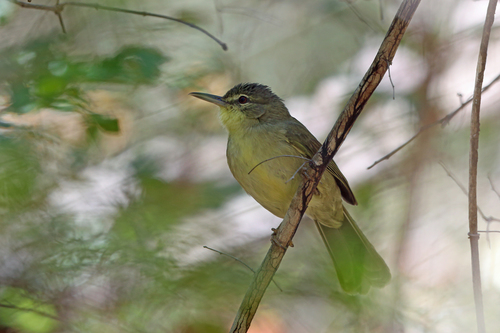
Banded Kestrel

Banded Kestrel

Falco zoniventris

Silhouette: Shyamal · PhyloPic

LCLeast ConcernNTVUENCR Endemic
Daily sighting probability ~10% · With luck
at Ankarafantsika National Park

In 3 days ~10% in a week ~30%

26 Verified sightings at Ankarafantsika National Park From 2019 to 2026
26 In 1 park
August Best month

About the Banded Kestrel

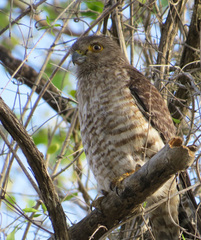
The banded kestrel (Falco zoniventris) is a bird of prey belonging to the falcon family Falconidae. It is endemic to Madagascar and is also known as the Madagascar banded kestrel, barred kestrel or Madagascar barred kestrel. Its closest relatives are the grey kestrel and Dickinson's kestrel of mainland Africa and the three are sometimes placed in the subgenus Dissodectes.

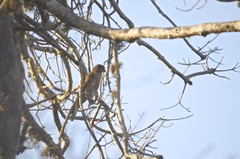
It is 27–30 cm long with a wingspan of 60–68 cm. The upperparts are grey and the tail is dark. The underparts are whitish with dark grey streaks on the throat and upper breast and dark grey barring on the lower breast and belly. The feet, eyes and cere are yellow and there is bare yellow skin around the eye. Juvenile birds are browner than the adults with darker eyes and less bare skin around the eye.

The species has a shrill, staccato, chattering call and a sharp, screaming call but is usually silent outside the breeding season. It is fairly common in the southern and western parts of Madagascar but more local in the north and east and absent from the central plateau. It occurs from sea level up to 2000 metres. It inhabits clearings and edges in forest and woodland.

It rarely hovers, preferring... Wikipedia →

Sounds

Call1:11

Madagascar · 2013

© Mike Nelson · XC162299 · CC BY-NC-SA 3.0

Global Distribution

Parks Where Found

# Park Country Daily sighting probability
1 Ankarafantsika National Park 🇲🇬 Madagascar
~10%

More parks will be added in future updates.

Before you go

What are the chances of seeing a Banded Kestrel in Ankarafantsika National Park?

With luck

About 10% of wildlife watchers report a Banded Kestrel sighting in Ankarafantsika National Park on a given day, based on 26 verified sightings from GBIF citizen-science data from 2019 to 2026. It is the 67th most-seen of the 83 birds we can rate there. Over three days the chance rises to about 10%, and over a week to about 30%, if each day is a fresh chance.

When is the best time to see a Banded Kestrel in Ankarafantsika National Park?

August and October–November

In those months about 10% of wildlife watchers report a Banded Kestrel in Ankarafantsika National Park on a given day, against under 5% in April, June–July, September and December, the lowest months. Those are among Ankarafantsika National Park's driest months, with about 65 mm of rain a month against 560 mm in January. January–March and May have too few records to rate.

Where else can you see a Banded Kestrel?

Only Ankarafantsika National Park, in our data

Ankarafantsika National Park is the only park on Wallace's Line with enough records to rate Banded Kestrel sightings: about 10% of wildlife watchers there report one on a given day.

Which relatives of the Banded Kestrel live in Ankarafantsika National Park?

Same genus: Falco

The closest relatives of the Banded Kestrel that you can see in Ankarafantsika National Park (genus Falco, Typical Falcons) are Sooty Falcon (about 10%) and Madagascan Kestrel (about 10%), with each one's daily chance of a sighting.

Where does the Banded Kestrel sighting chance come from?

GBIF citizen-science records

It is estimated from how often the Banded Kestrel is recorded against all the birds logged in Ankarafantsika National Park (26 verified sightings from 2019 to 2026), calibrated against known sighting rates. Figures are rounded to the nearest 10% because citizen-science data supports honest approximations, not decimals, and months with records from fewer than five people show "—". How it works.

← Back to Ankarafantsika National Park