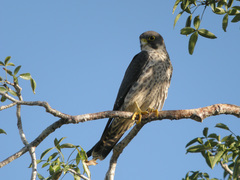

Sooty Falcon

Sooty Falcon

Falco concolor

Silhouette: Shyamal · PhyloPic

LCNTVUVulnerableENCR
Daily sighting probability ~10% · With luck
at Ankarafantsika National Park

In 3 days ~30% in a week ~50%

50 Verified sightings at Ankarafantsika National Park From 2019 to 2026
86 In all 6 parks
November Best month
☀️ Diurnal When it's spotted

About the Sooty Falcon

The sooty falcon (Falco concolor) is a medium-sized falcon, breeding from northeastern Africa to the southern Persian Gulf region, and wintering in East Africa (Mozambique, eastern South Africa) and Madagascar. The Sooty Falcon is part of the order Falconiformes, family Falconidae and genus Falco. The sooty falcon belongs to the hobby group, a rather close-knit number of similar falcons often considered a subgenus Falco. Eleonora's falcon F. eleonorae is sometimes considered its closest relative, but while they certainly belong to the same clade, they may not be direct sister species, with F. concolor possibly closer to Eurasian hobby F. subbuteo and African hobby F. cuvieri than it is to Eleonora's falcon.

This is an elegant bird of prey, 32–37 cm long with a 78–90 cm wingspan. It is shaped like a large Eurasian hobby or a small Eleonora's falcon, with its long pointed wings, long tail and slim body. The adults are blue-grey, and lack the black underwing coverts of the Eleonora's falcon. The young bird is like a large juvenile hobby, or small juvenile Eleanora's falcon. Its dark trailing edge to the wings and tail distinguish it from the former species... Wikipedia →

Sounds

Alarm call0:25

Saudi Arabia · 2021

© David Darrell-Lambert · XC739084 · CC BY-NC-SA 4.0

Global Distribution

Parks Where Found

# Park Country Daily sighting probability
1 Ankarafantsika National Park 🇲🇬 Madagascar
~10%
2 Kidepo Valley National Park 🇺🇬 Uganda
<5%
3 Mantadia National Park 🇲🇬 Madagascar
<5%
4 Arusha National Park 🇹🇿 Tanzania
<5%
5 Murchison Falls National Park 🇺🇬 Uganda
<5%
6 Serengeti National Park 🇹🇿 Tanzania
<5%

Cities Where Found

# City Country Daily sighting probability
1 Antananarivo 🇲🇬 Madagascar
<5%

Before you go

What are the chances of seeing a Sooty Falcon in Ankarafantsika National Park?

With luck

About 10% of wildlife watchers report a Sooty Falcon sighting in Ankarafantsika National Park on a given day, based on 50 verified sightings from GBIF citizen-science data from 2019 to 2026. It is the 59th most-seen of the 83 birds we can rate there. Over three days the chance rises to about 30%, and over a week to about 50%, if each day is a fresh chance.

When is the best time to see a Sooty Falcon in Ankarafantsika National Park?

November

In that month about 30% of wildlife watchers report a Sooty Falcon in Ankarafantsika National Park on a given day, against under 5% in April, July–October and December, the lowest months. January–March and May have too few records to rate.

What time of day is best to see a Sooty Falcon?

Between 7 and 10 am

Across all the parks we cover, that three-hour window holds the most Sooty Falcon sightings with a recorded time, and about 8 in 10 of them come between 6 am and 6 pm: it is a daytime animal.

Is Ankarafantsika National Park the best place to see a Sooty Falcon?

Yes

Of the 6 parks where we can rate Sooty Falcon sightings, Ankarafantsika National Park has the highest daily chance: about 10%. Next come Kidepo Valley National Park (Uganda, under 5%) and Mantadia National Park (Madagascar, under 5%).

Which relatives of the Sooty Falcon live in Ankarafantsika National Park?

Same genus: Falco

The closest relatives of the Sooty Falcon that you can see in Ankarafantsika National Park (genus Falco, Typical Falcons) are Madagascan Kestrel (about 10%) and Banded Kestrel (about 10%), with each one's daily chance of a sighting.

Where does the Sooty Falcon sighting chance come from?

GBIF citizen-science records

It is estimated from how often the Sooty Falcon is recorded against all the birds logged in Ankarafantsika National Park (50 verified sightings from 2019 to 2026), calibrated against known sighting rates. Figures are rounded to the nearest 10% because citizen-science data supports honest approximations, not decimals, and months with records from fewer than five people show "—". How it works.

← Back to Ankarafantsika National Park