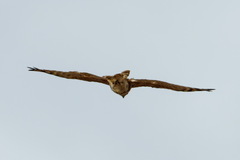

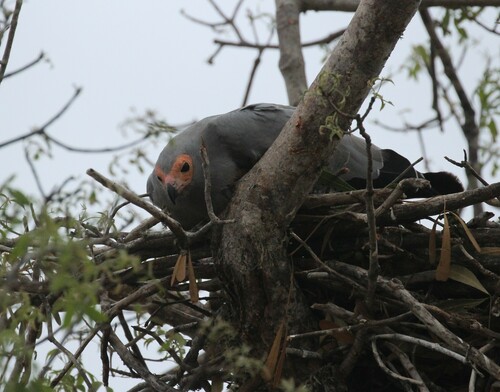
Madagascar Cuckoo-Hawk

Madagascar Cuckoo-Hawk

Aviceda madagascariensis

Silhouette: Sheatherius · PhyloPic

LCLeast ConcernNTVUENCR
Daily sighting probability <5% · Rare
at Ankarafantsika National Park

In 3 days ~10% in a week ~20%

11 Verified sightings at Ankarafantsika National Park From 2019 to 2026
89 In all 4 parks
October Best month
☀️ Diurnal When it's spotted

About the Madagascar Cuckoo-Hawk

The Madagascar cuckoo-hawk (Aviceda madagascariensis), also known as the Madagascar baza or the Madagascan cuckoo falcon, is a species of bird of prey in the family Accipitridae. It is endemic to Madagascar. The adult Madagascar cuckoo-hawk has dark brown upperparts which are paler on the head and an off white rump. The underparts are white with the breast and upper breast and sides of the lower breast are heavily streaked with brown, these streaks becoming finer on the flanks, The tail has two narrow, pale bars and a pale tip. The underwing coverts are heavily barred with brown while the flight feathers have broad dark bands on their underside. At rest there is a short crest which projects from the rear crown. The juvenile is darker than the adult with white tips to the feathers obvious against the dark upperparts. Males and females are similar in size with a length of 300 mm (12 in) and a wingspan of 850 mm (33 in).

The bird is endemic to Madagascar where it is reasonably common in the west, the north, and the east of the island. However, it is rather uncommon in the south and on the Central Plateau. In Madagascar this species is... Wikipedia →

Sounds

Call0:13

Madagascar · 2010

© Louise Jasper · XC88216 · CC BY-NC-ND 2.5

Global Distribution

Parks Where Found

# Park Country Daily sighting probability
1 Mantadia National Park 🇲🇬 Madagascar
~10%
2 Berenty Reserve 🇲🇬 Madagascar
~10%
3 Ranomafana National Park 🇲🇬 Madagascar
<5%
4 Ankarafantsika National Park 🇲🇬 Madagascar
<5%

Before you go

What are the chances of seeing a Madagascar Cuckoo-Hawk in Ankarafantsika National Park?

Rare

Under 5% of wildlife watchers report a Madagascar Cuckoo-Hawk sighting in Ankarafantsika National Park on a given day, based on 11 verified sightings from GBIF citizen-science data from 2019 to 2026. It is the 75th most-seen of the 83 birds we can rate there. Over three days the chance rises to about 10%, and over a week to about 20%, if each day is a fresh chance.

When is the best time to see a Madagascar Cuckoo-Hawk in Ankarafantsika National Park?

Any time of year

In every month with enough records, under 5% of wildlife watchers report a Madagascar Cuckoo-Hawk in Ankarafantsika National Park on a given day, so our monthly data shows no clear season. January–March and May have too few records to rate.

What time of day is best to see a Madagascar Cuckoo-Hawk?

Between 7 and 10 am

Across all the parks we cover, that three-hour window holds the most Madagascar Cuckoo-Hawk sightings with a recorded time, and about 8 in 10 of them come between 6 am and 6 pm: it is a daytime animal.

Is Ankarafantsika National Park the best place to see a Madagascar Cuckoo-Hawk?

4th of 4

Of the 4 parks where we can rate Madagascar Cuckoo-Hawk sightings, Ankarafantsika National Park ranks 4th at under 5%. The best odds are in Mantadia National Park (Madagascar, about 10%), Berenty Reserve (Madagascar, about 10%) and Ranomafana National Park (Madagascar, under 5%).

Which relatives of the Madagascar Cuckoo-Hawk live in Ankarafantsika National Park?

Same family: Accipitridae

The closest relatives of the Madagascar Cuckoo-Hawk that you can see in Ankarafantsika National Park (family Accipitridae, Hawks, Eagles, and Kites) are Madagascar Buzzard (about 50%), Madagascar Fish-Eagle (about 50%) and Black Kite (about 50%), with each one's daily chance of a sighting.

Where does the Madagascar Cuckoo-Hawk sighting chance come from?

GBIF citizen-science records

It is estimated from how often the Madagascar Cuckoo-Hawk is recorded against all the birds logged in Ankarafantsika National Park (11 verified sightings from 2019 to 2026), calibrated against known sighting rates. Figures are rounded to the nearest 10% because citizen-science data supports honest approximations, not decimals, and months with records from fewer than five people show "—". How it works.

← Back to Ankarafantsika National Park