Madagascar Scops-Owl

Madagascar Scops-Owl

Otus rutilus

Silhouette: Armelle Ansart (photograph), Maxime Dahirel (digitisation) · PhyloPic

LCLeast ConcernNTVUENCR
Daily sighting probability ~30% · Possible
at Ankarafantsika National Park

In 3 days ~60% in a week ~90%

145 Verified sightings at Ankarafantsika National Park From 2019 to 2026
322 In all 4 parks
September Best month
☀️ Diurnal When it's spotted

About the Madagascar Scops-Owl

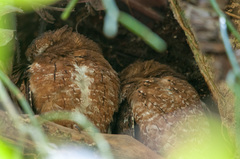
The Madagascar scops owl (Otus rutilus), also known as the Malagasy scops owl, is a species of owl in the family Strigidae. It is found throughout Madagascar, now that it has recently been lumped with the Torotoroka scops owl (O. r. madagascariensis), previously considered a separate species. The nominate O. r. rutilus is referred to as the rainforest scops owl.

The Madagascar scops owl is a relatively small owl with short, rounded wings and short erectile ear-tufts on top of the head. There are three morphs recorded of this species: a grey morph, a brown morph and a rufous morph. Features which stand out from the main plumage color are the pale eyebrows, light spots on the scapulars and the barring on the wings and outer tail feathers. Sometimes the crown and the underparts are streaked. The bill has a black tip and may be dull green through to yellowish-grey and the eyes are yellow. They measure 22–24 cm (8.7–9.4 in) in length and have a wingspan of 52–54 cm (20–21 in).

Two formerly distinct species were identified by different habitat preferences, with Torotoroka preferring drier habitats and rainforest preferring wetter forests. Some small plumage and vocal differences... Wikipedia →

Sounds

Song1:06

Madagascar · 2021

© Ken Behrens · XC629215 · CC BY-NC-SA 4.0

Call0:04

Madagascar · 2015

© Phil Gregory · XC296876 · CC BY-NC-SA 4.0

Song0:04

Madagascar · 2019

© Dries Van de Loock · XC536715 · CC BY-NC-SA 4.0

Global Distribution

Parks Where Found

# Park Country Daily sighting probability
1 Berenty Reserve 🇲🇬 Madagascar
~30%
2 Ankarafantsika National Park 🇲🇬 Madagascar
~30%
3 Mantadia National Park 🇲🇬 Madagascar
~10%
4 Ranomafana National Park 🇲🇬 Madagascar
<5%

Before you go

What are the chances of seeing a Madagascar Scops-Owl in Ankarafantsika National Park?

Possible

About 30% of wildlife watchers report a Madagascar Scops-Owl sighting in Ankarafantsika National Park on a given day, based on 145 verified sightings from GBIF citizen-science data from 2019 to 2026. It is the 43rd most-seen of the 83 birds we can rate there. Over three days the chance rises to about 60%, and over a week to about 90%, if each day is a fresh chance.

When is the best time to see a Madagascar Scops-Owl in Ankarafantsika National Park?

July and September

In those months about 50% of wildlife watchers report a Madagascar Scops-Owl in Ankarafantsika National Park on a given day, against about 10% in December, the lowest month. Those are among Ankarafantsika National Park's driest months, with almost no rain against 560 mm in January. January–March and May have too few records to rate.

What time of day is best to see a Madagascar Scops-Owl?

Between 6 and 9 am

Across all the parks we cover, that three-hour window holds the most Madagascar Scops-Owl sightings with a recorded time, and about 7 in 10 of them come between 6 am and 6 pm: it is a daytime animal.

Is Ankarafantsika National Park the best place to see a Madagascar Scops-Owl?

Among the best

Of the 4 parks where we can rate Madagascar Scops-Owl sightings, Ankarafantsika National Park ranks 2nd at about 30%, level with the leaders once rounded. The best odds are in Berenty Reserve (Madagascar, about 30%).

Where does the Madagascar Scops-Owl sighting chance come from?

GBIF citizen-science records

It is estimated from how often the Madagascar Scops-Owl is recorded against all the birds logged in Ankarafantsika National Park (145 verified sightings from 2019 to 2026), calibrated against known sighting rates. Figures are rounded to the nearest 10% because citizen-science data supports honest approximations, not decimals, and months with records from fewer than five people show "—". How it works.

← Back to Ankarafantsika National Park