Rhinoceros Chameleon

Rhinoceros Chameleon

Furcifer rhinoceratus

Silhouette: Ferran Sayol · PhyloPic

LCNTVUVulnerableENCR Endemic
Daily sighting probability ~80% · Very likely
at Ankarafantsika National Park

In 3 days >90%

44 Verified sightings at Ankarafantsika National Park From 2019 to 2026
44 In 1 park
April Best month
☀️ Diurnal When it's spotted

About the Rhinoceros Chameleon

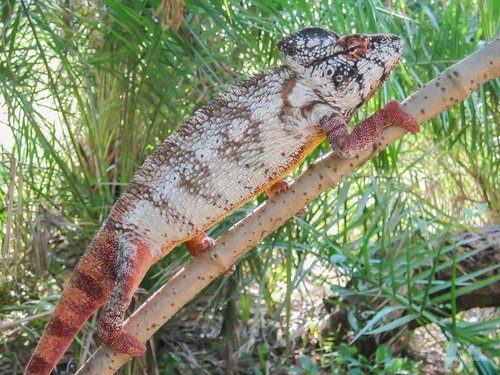
The rhinoceros chameleon (Furcifer rhinoceratus) is a species of chameleon that gets its common name from its horn-like nose which is most prominent in males. It is endemic to dry forests in Madagascar. The male rhinoceros chameleon can grow to about 27 centimetres (11 in), about twice as big as the female. The male's proboscis-like snout projects forward above its mouth and gives it its common name. The female has a smaller snout. On the top of the head there is a small crest of triangular, projecting scales, and a further crest runs part way along the spine. The general colour is grey or light brown with a few darker-coloured transverse bars. The snout is often bluish, the lips pale and a white line runs down each side of the animal. Females are similar in colour but when they are carrying eggs, they turn purple with black bands and an orange or red tail.

The rhinoceros chameleon is endemic to dry forests in western Madagascar. Its range extends from the Ankarafantsika National Park in the north west to Soalala in the south west but many of the sightings in the middle of its range were made a long time ago and it is unclear whether it is still... Wikipedia →

Global Distribution

Parks Where Found

# Park Country Daily sighting probability
1 Ankarafantsika National Park 🇲🇬 Madagascar
~80%

More parks will be added in future updates.

Closest Relatives at Ankarafantsika National Park

Before you go

What are the chances of seeing a Rhinoceros Chameleon in Ankarafantsika National Park?

Very likely

About 80% of wildlife watchers report a Rhinoceros Chameleon sighting in Ankarafantsika National Park on a given day, based on 44 verified sightings from GBIF citizen-science data from 2019 to 2026. It is the 6th most-seen of the 20 reptiles we can rate there. Over three days the chance rises to over 90%, if each day is a fresh chance.

When is the best time to see a Rhinoceros Chameleon in Ankarafantsika National Park?

April and September–November

In those months about 80% of wildlife watchers report a Rhinoceros Chameleon in Ankarafantsika National Park on a given day, against about 20% in June, the lowest month. Those are among Ankarafantsika National Park's driest months, with about 65 mm of rain a month against 560 mm in January. February and March have too few records to rate.

What time of day is best to see a Rhinoceros Chameleon?

Between 4 and 7 pm

Across all the parks we cover, that three-hour window holds the most Rhinoceros Chameleon sightings with a recorded time, and about 7 in 10 of them come between 6 am and 6 pm: it is a daytime animal.

Where else can you see a Rhinoceros Chameleon?

Only Ankarafantsika National Park, in our data

Ankarafantsika National Park is the only park on Wallace's Line with enough records to rate Rhinoceros Chameleon sightings: about 80% of wildlife watchers there report one on a given day.

Where does the Rhinoceros Chameleon sighting chance come from?

GBIF citizen-science records

It is estimated from how often the Rhinoceros Chameleon is recorded against all the reptiles logged in Ankarafantsika National Park (44 verified sightings from 2019 to 2026), calibrated against known sighting rates. Figures are rounded to the nearest 10% because citizen-science data supports honest approximations, not decimals, and months with records from fewer than five people show "—". How it works.

← Back to Ankarafantsika National Park