Giant Madagascan Hognose Snake

Giant Madagascan Hognose Snake

Leioheterodon madagascariensis

Silhouette: Ferran Sayol · PhyloPic

LCLeast ConcernNTVUENCR Endemic
Daily sighting probability ~80% · Very likely
at Ankarafantsika National Park

In 3 days >90%

44 Verified sightings at Ankarafantsika National Park From 2019 to 2026
44 In 1 park
April Best month
☀️ Diurnal When it's spotted

About the Giant Madagascan Hognose Snake

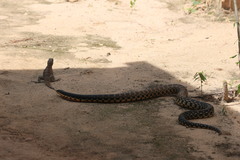
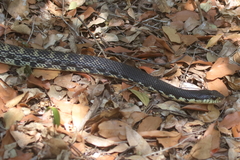
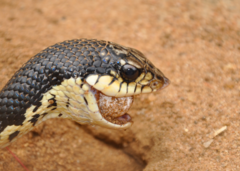
Leioheterodon madagascariensis, the Malagasy, Madagascar or Madagascan giant hognose (snake), is a harmless species of pseudoxyrhophiid snake endemic to the island nation of Madagascar. The species is also found on the country's smaller islands of Nosy Be, Nosy Mangabe, and Nosy Sakatia, as well as on the Comoros archipelago, in the Mozambique Channel. It is thought, by some, to have been introduced to the Grande Comoro. Mature giant hognose snakes can measure between 130 and 180 cm (4 ft. to nearly 6 ft., or between 1-2 meters) in length, and be roughly the thickness of an average adult human's arm.

Similarly to the Heterodon or Lystrophis genera of new-world hognoses, the Madagascar giant hognose, when threatened, will raise its head, open its mouth and inflate the skin around its neck and chin, superficially mimicking a cobra (or even a bearded dragon) in defensive posture, in an attempt to look larger and more intimidating. This snake is considered to be opisthoglyphous ("rear-fanged" or "rear-fanged venomous"), as it possess a pair of pin-like, widely spaced teeth at the back of the mouth, connected to the maxilla.

Through a funnel-like formation in each tooth, hognose snakes can inject a paralyzing saliva to subdue their prey. Studies have shown that the giant hognose does not use this "envenomation" technique to outright kill their prey, instead relying mainly on constriction. Thus the placement of these teeth at the rear of the mouth (combined with their ability to deliver a paralyzing/toxic salival fluid) aids the snake in controlling "squirmy" prey, as the animal will potentially take longer to expire by constriction, compared to a single, deadly bite from a highly-venomous snake species.

For these reasons, the physical presence of the Duvernoy's gland is unclear in this species. The toxic saliva, while effective at controlling wriggling small animals, only irritates human skin and is not deadly. Furthermore, most hognoses are not prone to bite large mammals—including humans—as their teeth are placed far in the back of the mouth, requiring the snake to exert somewhat greater effort during a bite than other, "frontal-fanged" snakes (elapids, vipers, colubrids). Typical prey consists of various small reptiles, frogs, toads, birds, and their nestlings and eggs. Other smaller snakes may be eaten occasionally, as well as small mammals, such as rodents, tenrecs or mouse lemurs and their offspring.

The primary predators of the Madagascar giant hognose snake are birds of prey and other avian species with a taste for snakes. Wikipedia →

Global Distribution

Parks Where Found

# Park Country Daily sighting probability
1 Ankarafantsika National Park 🇲🇬 Madagascar
~80%

More parks will be added in future updates.

Zoos & Centres Where Found

# Zoo / Centre Country
1 Barcelona Zoo 🇪🇸 Spain In captivity
2 Abilene Zoological Gardens 🇺🇸 United States In captivity
3 Columbus Zoo and Aquarium 🇺🇸 United States In captivity
4 Bronx Zoo 🇺🇸 United States In captivity
5 Kansas City Zoo 🇺🇸 United States In captivity
6 Oklahoma City Zoo and Botanical Garden 🇺🇸 United States In captivity
7 Catoctin Wildlife Preserve and Zoo 🇺🇸 United States In captivity
8 Virginia Zoological Park 🇺🇸 United States In captivity
9 Hogle Zoo 🇺🇸 United States In captivity
10 Aquarama Barcelona 🇪🇸 Spain In captivity
11 The Abilene Zoo 🇺🇸 United States In captivity
12 Sacramento Zoo 🇺🇸 United States In captivity
13 Cherkasy Zoo 🇺🇦 Ukraine In captivity
14 Montecasino Bird Gardens 🇿🇦 South Africa In captivity
15 Mandraka Reptile Farm 🇲🇬 Madagascar In captivity
16 Siam Serpentarium 🇹🇭 Thailand In captivity
17 Cango Wildlife Ranch 🇿🇦 South Africa In captivity
18 Croc Farm Ivato 🇲🇬 Madagascar In captivity
19 Sobela Ocean Aquarium 🇺🇸 United States In captivity

Closest Relatives at Ankarafantsika National Park

Before you go

What are the chances of seeing a Giant Madagascan Hognose Snake in Ankarafantsika National Park?

Very likely

About 80% of wildlife watchers report a Giant Madagascan Hognose Snake sighting in Ankarafantsika National Park on a given day, based on 44 verified sightings from GBIF citizen-science data from 2019 to 2026. It is the 5th most-seen of the 20 reptiles we can rate there. Over three days the chance rises to over 90%, if each day is a fresh chance.

When is the best time to see a Giant Madagascan Hognose Snake in Ankarafantsika National Park?

April and November–December

In those months about 90% of wildlife watchers report a Giant Madagascan Hognose Snake in Ankarafantsika National Park on a given day, against about 20% in September, the lowest month. February and March have too few records to rate.

What time of day is best to see a Giant Madagascan Hognose Snake?

Between 8 and 11 am

Across all the parks we cover, that three-hour window holds the most Giant Madagascan Hognose Snake sightings with a recorded time, and about 9 in 10 of them come between 6 am and 6 pm: it is a daytime animal.

Where else can you see a Giant Madagascan Hognose Snake?

Only Ankarafantsika National Park, in our data

Ankarafantsika National Park is the only park on Wallace's Line with enough records to rate Giant Madagascan Hognose Snake sightings: about 80% of wildlife watchers there report one on a given day.

Where does the Giant Madagascan Hognose Snake sighting chance come from?

GBIF citizen-science records

It is estimated from how often the Giant Madagascan Hognose Snake is recorded against all the reptiles logged in Ankarafantsika National Park (44 verified sightings from 2019 to 2026), calibrated against known sighting rates. Figures are rounded to the nearest 10% because citizen-science data supports honest approximations, not decimals, and months with records from fewer than five people show "—". How it works.

← Back to Ankarafantsika National Park