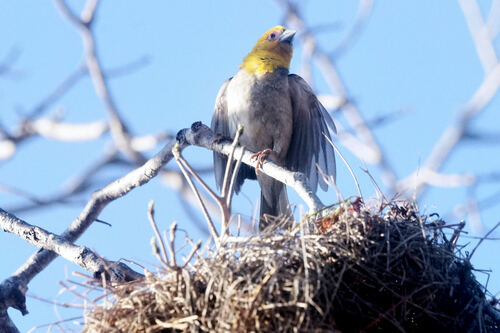
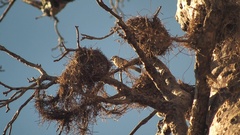

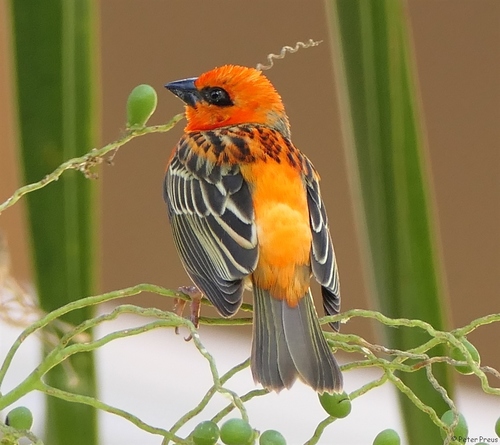
Sakalava Weaver

Sakalava Weaver

Ploceus sakalava

Silhouette: Sheatherius · PhyloPic

LCLeast ConcernNTVUENCR Endemic
Daily sighting probability ~30% · Possible
at Ankarafantsika National Park

In 3 days ~60% in a week ~90%

128 Verified sightings at Ankarafantsika National Park From 2019 to 2026
242 In all 2 parks
August Best month
☀️ Diurnal When it's spotted

About the Sakalava Weaver

The Sakalava weaver (Ploceus sakalava) sometimes known as the Sakalava fody is a species of bird in the family Ploceidae. It is endemic to Madagascar. The bird is 15 cm (5.9 in) long and weighs 20–28 g (0.71–0.99 oz). The Sakalava weaver was first described by Gustav Hartlaub in 1861, based on a specimen collected by Victor Sganzin during an expedition in 1831–32 on Madagascar. The species epithet sakalava is derived from the Sakalava, whose name means "people of the long valleys". The first English name was given to the bird only in 1891 by James Sibree, who named it Sakalava Weaver-bird. Sakalava weaver has been designated the official name by the International Ornithological Committee (IOC). Another English name that is sometimes used is Sakalava Fody. Local names in the Malagasy language include fodibeotse, fodisahy, tsiaka, draky and zaky.

Based on recent DNA-analysis, the genus Ploceus is almost certainly polyphyletic. If all species currently included in the genus would remain and the genus would be made monophyletic, it would have to encompass the entire subfamily Ploceinae. The Ploceinae can be divided into two groups. In the first group, the widowbirds and... Wikipedia →

Sounds

Call0:45

Madagascar · 2025

© Frank Lambert · XC1065567 · CC BY-NC-ND 4.0

Song0:16

Madagascar · 2020

© Ken Behrens · XC591628 · CC BY-NC-SA 4.0

Call0:51

Madagascar · 2012

© Peter Boesman · XC762944 · CC BY-NC-ND 4.0

Global Distribution

Parks Where Found

# Park Country Daily sighting probability
1 Berenty Reserve 🇲🇬 Madagascar
~50%
2 Ankarafantsika National Park 🇲🇬 Madagascar
~30%

Cities Where Found

# City Country Daily sighting probability
1 Antananarivo 🇲🇬 Madagascar
<5%

Before you go

What are the chances of seeing a Sakalava Weaver in Ankarafantsika National Park?

Possible

About 30% of wildlife watchers report a Sakalava Weaver sighting in Ankarafantsika National Park on a given day, based on 128 verified sightings from GBIF citizen-science data from 2019 to 2026. It is the 41st most-seen of the 83 birds we can rate there. Over three days the chance rises to about 60%, and over a week to about 90%, if each day is a fresh chance.

When is the best time to see a Sakalava Weaver in Ankarafantsika National Park?

August

In that month about 40% of wildlife watchers report a Sakalava Weaver in Ankarafantsika National Park on a given day, against about 20% in June and July, the lowest months. That is one of Ankarafantsika National Park's driest months, with almost no rain against 560 mm in January. January–March and May have too few records to rate.

What time of day is best to see a Sakalava Weaver?

Between 5 and 8 am

Across all the parks we cover, that three-hour window holds the most Sakalava Weaver sightings with a recorded time, and about 7 in 10 of them come between 6 am and 6 pm: it is a daytime animal.

Is Ankarafantsika National Park the best place to see a Sakalava Weaver?

2nd of 2

Of the 2 parks where we can rate Sakalava Weaver sightings, Ankarafantsika National Park ranks 2nd at about 30%. The best odds are in Berenty Reserve (Madagascar, about 50%).

Where does the Sakalava Weaver sighting chance come from?

GBIF citizen-science records

It is estimated from how often the Sakalava Weaver is recorded against all the birds logged in Ankarafantsika National Park (128 verified sightings from 2019 to 2026), calibrated against known sighting rates. Figures are rounded to the nearest 10% because citizen-science data supports honest approximations, not decimals, and months with records from fewer than five people show "—". How it works.

← Back to Ankarafantsika National Park