


White-throated Rail

White-throated Rail

Dryolimnas cuvieri

Silhouette: Sheatherius · PhyloPic

LCLeast ConcernNTVUENCR
Daily sighting probability ~10% · With luck
at Ankarafantsika National Park

In 3 days ~30% in a week ~50%

43 Verified sightings at Ankarafantsika National Park From 2019 to 2026
199 In all 3 parks
July Best month
☀️ Diurnal When it's spotted

About the White-throated Rail

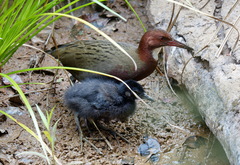
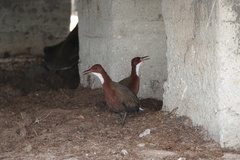
The white-throated rail (Dryolimnas cuvieri) or Cuvier's rail is a species of bird in the family Rallidae. It is a fairly large rail, and has a flightless subspecies. The white-throated rail measures 30–33 cm (12–13 in) in length. Males are larger than females. In the nominate subspecies, D. c. cuvieri, males weigh 276 g (9.7 oz) while the female weighs 258 g (9.1 oz). Another subspecies, D. c. aldabranus, is smaller and paler in coloration, weighing 176 g (6.2 oz) in females and 189 g (6.7 oz) in males. This subspecies is flightless. Generally, the white-throated rail is a fairly large rail with a dusky abdomen and thighs with white on its throat and undertail-coverts.

It is resident in Madagascar and breeds in the Seychelles, particularly on Aldabra Island. The nominate subspecies is found in Madagascar. A flightless subspecies (sometimes considered a distinct species), Dryolimnas (cuvieri) aldabranus (Aldabra rail), inhabits Aldabra, while the semi-flightless subspecies D. c. abbotti (Assumption Island rail) from Assumption Island went extinct in the early 20th century due to introduced predators. A fourth extinct flightless... Wikipedia →

Sounds

Song1:15

Madagascar · 2012

© Peter Boesman · XC762742 · CC BY-NC-ND 4.0

Duet0:09

Madagascar · 2019

© Ken Behrens · XC627479 · CC BY-NC-SA 4.0

Call0:26

Madagascar · 2018

© Barry Edmonston · XC423574 · CC BY-NC-SA 4.0

Global Distribution

Parks Where Found

# Park Country Daily sighting probability
1 Mantadia National Park 🇲🇬 Madagascar
~20%
2 Ankarafantsika National Park 🇲🇬 Madagascar
~10%
3 Ranomafana National Park 🇲🇬 Madagascar
~10%

Cities Where Found

# City Country Daily sighting probability
1 Antananarivo 🇲🇬 Madagascar
~40%

Before you go

What are the chances of seeing a White-throated Rail in Ankarafantsika National Park?

With luck

About 10% of wildlife watchers report a White-throated Rail sighting in Ankarafantsika National Park on a given day, based on 43 verified sightings from GBIF citizen-science data from 2019 to 2026. It is the 61st most-seen of the 83 birds we can rate there. Over three days the chance rises to about 30%, and over a week to about 50%, if each day is a fresh chance.

When is the best time to see a White-throated Rail in Ankarafantsika National Park?

July

In that month about 20% of wildlife watchers report a White-throated Rail in Ankarafantsika National Park on a given day, against under 5% in April, September and November–December, the lowest months. That is one of Ankarafantsika National Park's driest months, with almost no rain against 560 mm in January. January–March and May have too few records to rate.

What time of day is best to see a White-throated Rail?

Between 2 and 5 pm

Across all the parks we cover, that three-hour window holds the most White-throated Rail sightings with a recorded time, and about 8 in 10 of them come between 6 am and 6 pm: it is a daytime animal.

Is Ankarafantsika National Park the best place to see a White-throated Rail?

2nd of 3

Of the 3 parks where we can rate White-throated Rail sightings, Ankarafantsika National Park ranks 2nd at about 10%. The best odds are in Mantadia National Park (Madagascar, about 20%).

Where does the White-throated Rail sighting chance come from?

GBIF citizen-science records

It is estimated from how often the White-throated Rail is recorded against all the birds logged in Ankarafantsika National Park (43 verified sightings from 2019 to 2026), calibrated against known sighting rates. Figures are rounded to the nearest 10% because citizen-science data supports honest approximations, not decimals, and months with records from fewer than five people show "—". How it works.

← Back to Ankarafantsika National Park