Keel-billed Motmot

Keel-billed Motmot

Electron carinatum

Silhouette: Sofía Terán Sánchez · PhyloPic

LCNTVUVulnerableENCR
Daily sighting probability ~10% · With luck
at Arenal Volcano National Park

In 3 days ~20% in a week ~40%

1,170 Verified sightings at Arenal Volcano National Park From 2019 to 2026
1,838 In all 7 parks
February Best month
☀️ Diurnal When it's spotted

About the Keel-billed Motmot

The keel-billed motmot (Electron carinatum) is a Vulnerable species of bird in the motmot family Momotidae. It is found in Belize, Costa Rica, Guatemala, Honduras, Mexico, and Nicaragua. The keel-billed motmot was formally described as Pionites carinatus. It was later referred to as Prionirhynchus carinatus but eventually was renamed Electron carinatum.

The keel-billed motmot is thought to be closely related to the broad-billed motmot (E. platyrhynchum); they are the only members of the genus Electron. The two may be conspecific. Their plumage is very different but their structure and vocalizations are very similar.

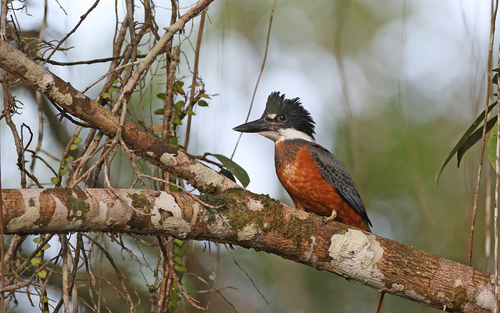
The keel-billed motmot is monotypic. The keel-billed motmot is 30.5 to 38 cm (12 to 15 in) long; one male weighed 65 g (2.3 oz). It is a smallish member of the motmot family. The sexes have the same plumage. Adults have a rufus forehead and a black "mask" with a turquoise-blue arc above it on an otherwise green face. Their upper parts are also green. Their chin is pale turquoise. Their underparts are mostly rufous in the northern part of their range becoming greenish to greenish cinnamon in the south. Their chest has a black... Wikipedia →

Sounds

Song0:17

Nicaragua · 2021

© Liliana Chavarria-Duriaux · XC642860 · CC BY-NC-SA 4.0

Call0:11

Costa Rica · 2016

© Frank Lambert · XC411221 · CC BY-NC-ND 4.0

Bill snaps0:16

Honduras · 2015

© Samuel Jones · XC297975 · CC BY-NC-ND 4.0

Global Distribution

Parks Where Found

# Park Country Daily sighting probability
1 Cerro Azul Meámbar National Park 🇭🇳 Honduras
~20%
2 Pico Bonito National Park 🇭🇳 Honduras
~10%
3 Arenal Volcano National Park 🇨🇷 Costa Rica
~10%
4 Tenorio Volcano National Park 🇨🇷 Costa Rica
~10%
5 Lago de Yojoa 🇭🇳 Honduras
<5%
6 Rincón de la Vieja National Park 🇨🇷 Costa Rica
<5%
7 Braulio Carrillo National Park 🇨🇷 Costa Rica
<5%

Before you go

What are the chances of seeing a Keel-billed Motmot in Arenal Volcano National Park?

With luck

About 10% of wildlife watchers report a Keel-billed Motmot sighting in Arenal Volcano National Park on a given day, based on 1,170 verified sightings from GBIF citizen-science data from 2019 to 2026. It is the 160th most-seen of the 503 birds we can rate there. Over three days the chance rises to about 20%, and over a week to about 40%, if each day is a fresh chance.

When is the best time to see a Keel-billed Motmot in Arenal Volcano National Park?

July and September–May

In those months about 10% of wildlife watchers report a Keel-billed Motmot in Arenal Volcano National Park on a given day, against under 5% in June and August, the lowest months.

What time of day is best to see a Keel-billed Motmot?

Between 9 am and noon

Across all the parks we cover, that three-hour window holds the most Keel-billed Motmot sightings with a recorded time, and about 9 in 10 of them come between 6 am and 6 pm: it is a daytime animal.

Is Arenal Volcano National Park the best place to see a Keel-billed Motmot?

3rd of 7

Of the 7 parks where we can rate Keel-billed Motmot sightings, Arenal Volcano National Park ranks 3rd at about 10%. The best odds are in Cerro Azul Meámbar National Park (Honduras, about 20%) and Pico Bonito National Park (Honduras, about 10%).

Where does the Keel-billed Motmot sighting chance come from?

GBIF citizen-science records

It is estimated from how often the Keel-billed Motmot is recorded against all the birds logged in Arenal Volcano National Park (1,170 verified sightings from 2019 to 2026), calibrated against known sighting rates. Figures are rounded to the nearest 10% because citizen-science data supports honest approximations, not decimals, and months with records from fewer than five people show "—". How it works.

← Back to Arenal Volcano National Park