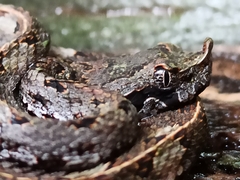
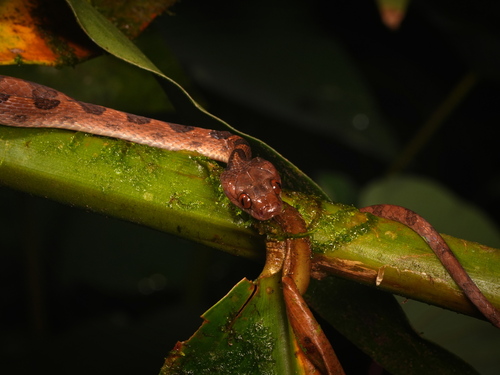
Rainforest Hog-nosed Viper

Rainforest Hog-nosed Viper

Porthidium nasutum

Silhouette: Steven Traver · PhyloPic

LCLeast ConcernNTVUENCR
Daily sighting probability ~20% · Possible
at Arenal Volcano National Park

In 3 days ~40% in a week ~70%

48 Verified sightings at Arenal Volcano National Park From 2019 to 2026
125 In all 7 parks
July Best month
☀️🌙 Day & Night When it's spotted

About the Rainforest Hog-nosed Viper

Common names: hognosed pit viper, hognosed pit viper, rainforest hognosed pit viper, horned hog-nosed viper. Porthidium nasutum is a pit viper species native to southern Mexico, Central America and northern South America. No subspecies are recognized as being valid.

Adults of Porthidium nasutum are usually less than 40 centimetres (16 in) in total length (tail included), and rarely more than 60 centimetres (24 in). Females are considerably larger than males. Both sexes are moderately stout.

Porthidium nasutum is found in southern Mexico southward through Central America to western Colombia and northwestern Ecuador in South America. Inhabits the Atlantic lowlands from Mexico (Tabasco and Chiapas) through Belize, Guatemala, Honduras, Nicaragua and Costa Rica to eastern Panama and northwestern Colombia. In the Pacific lowlands, it occurs in southwestern Costa Rica, central and eastern Panama, continuing on to northwestern Ecuador. The type locality given is "Pansos [Panzós], sur les bords du Polochic [Alta Verapaz] (Guatémala)".

The preferred natural habitat of Porthidium nasutum is mesic lowland broadleaf or rainforest from... Wikipedia →

Global Distribution

Parks Where Found

# Park Country Daily sighting probability
1 Pico Bonito National Park 🇭🇳 Honduras
~40%
2 Tenorio Volcano National Park 🇨🇷 Costa Rica
~30%
3 Darién National Park 🇵🇦 Panama
~20%
4 Gandoca-Manzanillo Wildlife Refuge 🇨🇷 Costa Rica
~20%
5 Arenal Volcano National Park 🇨🇷 Costa Rica
~20%
6 Cahuita National Park 🇨🇷 Costa Rica
~10%
7 Braulio Carrillo National Park 🇨🇷 Costa Rica
~10%

Zoos & Centres Where Found

# Zoo / Centre Country
1 La Paz Waterfall Gardens 🇨🇷 Costa Rica In captivity

Before you go

What are the chances of seeing a Rainforest Hog-nosed Viper in Arenal Volcano National Park?

Possible

About 20% of wildlife watchers report a Rainforest Hog-nosed Viper sighting in Arenal Volcano National Park on a given day, based on 48 verified sightings from GBIF citizen-science data from 2019 to 2026. It is the 18th most-seen of the 64 reptiles we can rate there. Over three days the chance rises to about 40%, and over a week to about 70%, if each day is a fresh chance.

When is the best time to see a Rainforest Hog-nosed Viper in Arenal Volcano National Park?

July

In that month about 30% of wildlife watchers report a Rainforest Hog-nosed Viper in Arenal Volcano National Park on a given day, against about 10% in March–April, September and November–January, the lowest months.

What time of day is best to see a Rainforest Hog-nosed Viper?

Between 9 am and noon

Across all the parks we cover, that three-hour window holds the most Rainforest Hog-nosed Viper sightings with a recorded time, and about 7 in 10 of them come between 6 am and 6 pm: it is seen both by day and at night.

Is Arenal Volcano National Park the best place to see a Rainforest Hog-nosed Viper?

5th of 7

Of the 7 parks where we can rate Rainforest Hog-nosed Viper sightings, Arenal Volcano National Park ranks 5th at about 20%. The best odds are in Pico Bonito National Park (Honduras, about 40%), Tenorio Volcano National Park (Costa Rica, about 30%) and Darién National Park (Panama, about 20%).

Where does the Rainforest Hog-nosed Viper sighting chance come from?

GBIF citizen-science records

It is estimated from how often the Rainforest Hog-nosed Viper is recorded against all the reptiles logged in Arenal Volcano National Park (48 verified sightings from 2019 to 2026), calibrated against known sighting rates. Figures are rounded to the nearest 10% because citizen-science data supports honest approximations, not decimals, and months with records from fewer than five people show "—". How it works.

← Back to Arenal Volcano National Park