Gray Bronzeback

Gray Bronzeback

Dendrelaphis caudolineatus

Silhouette: Alex Slavenko · PhyloPic

LCLeast ConcernNTVUENCR
Daily sighting probability ~40% · Likely
at Bako National Park

In 3 days ~80% in a week >90%

15 Verified sightings at Bako National Park From 2019 to 2026
117 In all 7 parks
July Best month
☀️ Diurnal When it's spotted

About the Gray Bronzeback

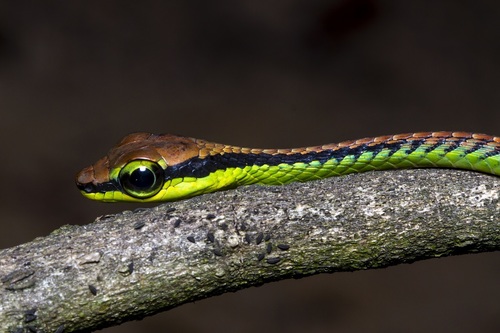
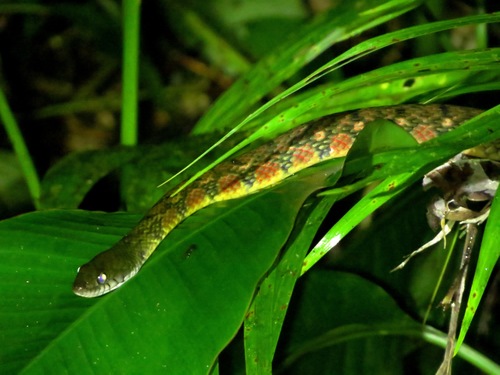
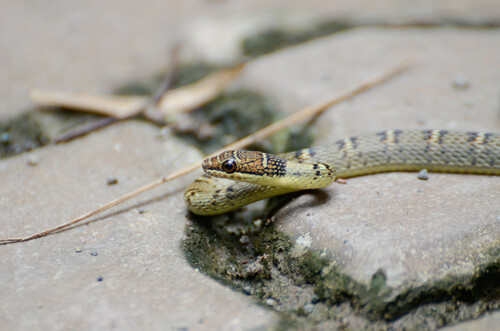
Dendrelaphis caudolineatus, commonly known as the striped bronzeback or grey bronzeback, is a species of colubrid snake found in Southeast Asia. When John Edward Gray first scientifically described the species in 1834, he did not provide the origin of the scientific name caudolineatus. However, in Latin "cauda" means tail and "linea" mean line, possibly referencing the longitudinal lines reaching from head to tail.

Dendrelaphis caudolineatus belongs to the genus Dendrelaphis, which contains 48 other described species. Prior to a 2012 study, several other species of Dendrelaphis were previously considered to be members of Dendrelaphis caudolineatus, but are now considered to be separate species: D. flavescens, D. terrificus, D. philippinensis, and D. levitoni.

Dendrelaphis is one of five genera belonging to the vine snake subfamily Ahaetuliinae, of which Dendrelaphis is most closely related to Chrysopelea, as shown in the cladogram below: Dendrelaphis caudolineatus is found in Malaysia, Thailand, Indonesia, Brunei, and Singapore. It is found in a wide variety of forested habitats, commonly seen in trees and bushes, most... Wikipedia →

Global Distribution

Parks Where Found

# Park Country Daily sighting probability
1 Bako National Park 🇲🇾 Malaysia
~40%
2 Danum Valley Conservation Area 🇲🇾 Malaysia
~40%
3 Sepilok 🇲🇾 Malaysia
~30%
4 Kinabalu Park 🇲🇾 Malaysia
~20%
5 Gunung Leuser National Park 🇮🇩 Indonesia
~20%
6 Khao Sok National Park 🇹🇭 Thailand
~10%
7 Kinabatangan Wildlife Sanctuary 🇲🇾 Malaysia
~10%

Cities Where Found

# City Country Daily sighting probability
1 Kuala Lumpur 🇲🇾 Malaysia
~10%
2 Singapore 🇸🇬 Singapore
~10%

Before you go

What are the chances of seeing a Gray Bronzeback in Bako National Park?

Likely

About 40% of wildlife watchers report a Gray Bronzeback sighting in Bako National Park on a given day, based on 15 verified sightings from GBIF citizen-science data from 2019 to 2026. It is the 12th most-seen of the 20 reptiles we can rate there. Over three days the chance rises to about 80%, and over a week to over 90%, if each day is a fresh chance.

When is the best time to see a Gray Bronzeback in Bako National Park?

July

In that month about 60% of wildlife watchers report a Gray Bronzeback in Bako National Park on a given day, against under 5% in February–March and September, the lowest months. That is one of Bako National Park's driest months, with about 160 mm of rain against 440 mm in January.

What time of day is best to see a Gray Bronzeback?

Between 2 and 5 pm

Across all the parks we cover, that three-hour window holds the most Gray Bronzeback sightings with a recorded time, and about 8 in 10 of them come between 6 am and 6 pm: it is a daytime animal.

Is Bako National Park the best place to see a Gray Bronzeback?

Yes

Of the 7 parks where we can rate Gray Bronzeback sightings, Bako National Park has the highest daily chance: about 40%. Next come Danum Valley Conservation Area (Malaysia, about 40%) and Sepilok (Malaysia, about 30%).

Which relatives of the Gray Bronzeback live in Bako National Park?

Same genus: Dendrelaphis

The closest relatives of the Gray Bronzeback that you can see in Bako National Park (genus Dendrelaphis, Bronzebacks) are Common Bronze-back (about 40%) and Elegant Bronzeback (about 20%), with each one's daily chance of a sighting.

Where does the Gray Bronzeback sighting chance come from?

GBIF citizen-science records

It is estimated from how often the Gray Bronzeback is recorded against all the reptiles logged in Bako National Park (15 verified sightings from 2019 to 2026), calibrated against known sighting rates. Figures are rounded to the nearest 10% because citizen-science data supports honest approximations, not decimals, and months with records from fewer than five people show "—". How it works.

← Back to Bako National Park