
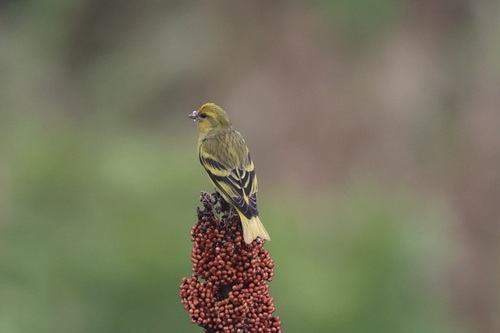
Brown-rumped Seedeater

Brown-rumped Seedeater

Crithagra tristriata

Silhouette: Sheatherius · PhyloPic

LCLeast ConcernNTVUENCR
Daily sighting probability ~20% · Possible
at Bale Mountains National Park

In 3 days ~40% in a week ~80%

34 Verified sightings at Bale Mountains National Park From 2019 to 2026
34 In 1 park
January Best month
☀️ Diurnal When it's spotted

About the Brown-rumped Seedeater

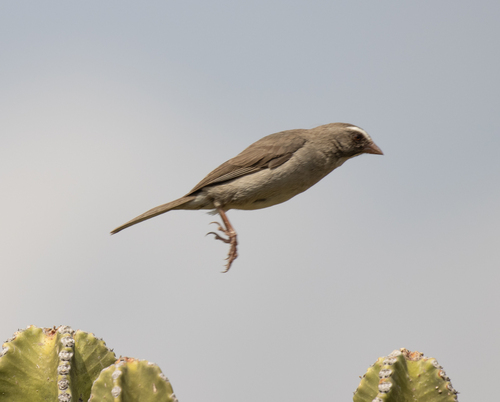
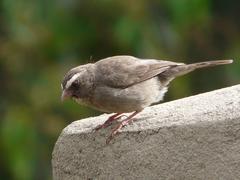
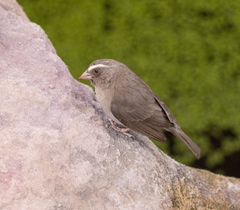
The brown-rumped seedeater (Crithagra tristriata) is a species of finch in the family Fringillidae. It is native to the Ethiopian Highlands and Karkaar (Somaliland). It is widespread in towns, villages, gardens, plantations and upland heath.

The brown-rumped seedeater was formerly placed in the genus Serinus, but phylogenetic analysis using mitochondrial and nuclear DNA sequences found that the genus was polyphyletic. The genus was therefore split and a number of species including the brown-rumped seedeater were moved to the resurrected genus Crithagra.

The brown-rumped seedeater is typically 13 cm long. It is a uniform grey-brown with a small white supercilium, and has a plain (not streaked or spotted) breast with white under the chin. Its uniformity means its eponymous 'brown rump' is often not apparent. It feeds on some small seeds and grains in plants and other small shrubs.

Sinclair, Ian & Ryan, Peter (2003) Birds of Africa south of the Sahara, Struik, Cape Town. Wikipedia →

Sounds

Song1:14

Ethiopia · 2014

© Andrew Spencer · XC268727 · CC BY-NC-ND 4.0

Call0:30

Ethiopia · 2026

© Bram Piot · XC1104939 · CC BY-NC-SA 4.0

Global Distribution

Parks Where Found

# Park Country Daily sighting probability
1 Bale Mountains National Park 🇪🇹 Ethiopia
~20%

More parks will be added in future updates.

Cities Where Found

# City Country Daily sighting probability
1 Addis Ababa 🇪🇹 Ethiopia
~80%

Before you go

What are the chances of seeing a Brown-rumped Seedeater in Bale Mountains National Park?

Possible

About 20% of wildlife watchers report a Brown-rumped Seedeater sighting in Bale Mountains National Park on a given day, based on 34 verified sightings from GBIF citizen-science data from 2019 to 2026. It is the 50th most-seen of the 117 birds we can rate there. Over three days the chance rises to about 40%, and over a week to about 80%, if each day is a fresh chance.

When is the best time to see a Brown-rumped Seedeater in Bale Mountains National Park?

January

In that month about 40% of wildlife watchers report a Brown-rumped Seedeater in Bale Mountains National Park on a given day, against about 10% in February, April, June–July and December, the lowest months. That is one of Bale Mountains National Park's driest months, with about 40 mm of rain against 230 mm in April. March and September have too few records to rate.

What time of day is best to see a Brown-rumped Seedeater?

Between 8 and 11 am

Across all the parks we cover, that three-hour window holds the most Brown-rumped Seedeater sightings with a recorded time, and about 8 in 10 of them come between 6 am and 6 pm: it is a daytime animal.

Where else can you see a Brown-rumped Seedeater?

Only Bale Mountains National Park, in our data

Bale Mountains National Park is the only park on Wallace's Line with enough records to rate Brown-rumped Seedeater sightings: about 20% of wildlife watchers there report one on a given day.

Which relatives of the Brown-rumped Seedeater live in Bale Mountains National Park?

Same genus: Crithagra

The closest relatives of the Brown-rumped Seedeater that you can see in Bale Mountains National Park (genus Crithagra, African Seedeaters, Serins, Canaries, and Citrils) are Streaky Seedeater (about 60%) and African Citril (about 10%), with each one's daily chance of a sighting.

Where does the Brown-rumped Seedeater sighting chance come from?

GBIF citizen-science records

It is estimated from how often the Brown-rumped Seedeater is recorded against all the birds logged in Bale Mountains National Park (34 verified sightings from 2019 to 2026), calibrated against known sighting rates. Figures are rounded to the nearest 10% because citizen-science data supports honest approximations, not decimals, and months with records from fewer than five people show "—". How it works.

← Back to Bale Mountains National Park