
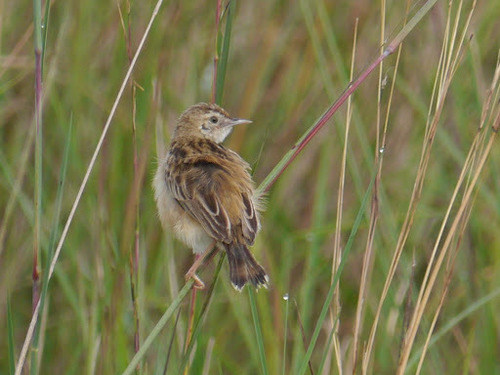
Ethiopian Cisticola

Ethiopian Cisticola

Cisticola lugubris

Silhouette: Sheatherius · PhyloPic

LCLeast ConcernNTVUENCR
Daily sighting probability ~70% · Very likely
at Bale Mountains National Park

In 3 days >90%

130 Verified sightings at Bale Mountains National Park From 2019 to 2026
130 In 1 park
May Best month
☀️ Diurnal When it's spotted

About the Ethiopian Cisticola

The Ethiopian cisticola (Cisticola lugubris) is a species of bird in the family Cisticolidae. Alternate common names are Abyssinian black-backed cisticola, and winding cisticola (Ethiopian) (eBird). The Ethiopian cisticola is monotypic. This taxon was split from the winding cisticola by the IOC and HBW, as were the rufous-winged cisticola, Luapula cisticola and coastal cisticola.

This species is found in the highlands of Ethiopia and Eritrea. Its natural habitats are tropical seasonally wet or flooded grassland and swamps. Data related to Cisticola lugubris at Wikispecies Wikipedia →

Sounds

Song0:52

Kenya · 2026

© isaac kilusu · XC1095772 · CC BY-NC-SA 4.0

Call0:16

Ethiopia · 2011

© Rolf A. de By · XC410335 · CC BY-NC-SA 4.0

Song0:14

Ethiopia · 2015

© Hans Matheve · XC305989 · CC BY-NC-ND 4.0

Global Distribution

Parks Where Found

# Park Country Daily sighting probability
1 Bale Mountains National Park 🇪🇹 Ethiopia
~70%

More parks will be added in future updates.

Cities Where Found

# City Country Daily sighting probability
1 Addis Ababa 🇪🇹 Ethiopia
~30%

Before you go

What are the chances of seeing an Ethiopian Cisticola in Bale Mountains National Park?

Very likely

About 70% of wildlife watchers report an Ethiopian Cisticola sighting in Bale Mountains National Park on a given day, based on 130 verified sightings from GBIF citizen-science data from 2019 to 2026. It is the 9th most-seen of the 117 birds we can rate there. Over three days the chance rises to over 90%, if each day is a fresh chance.

When is the best time to see an Ethiopian Cisticola in Bale Mountains National Park?

May

In that month about 90% of wildlife watchers report an Ethiopian Cisticola in Bale Mountains National Park on a given day, against about 40% in February and April, the lowest months. March and September have too few records to rate.

What time of day is best to see an Ethiopian Cisticola?

Between 8 and 11 am

Across all the parks we cover, that three-hour window holds the most Ethiopian Cisticola sightings with a recorded time, and about 9 in 10 of them come between 6 am and 6 pm: it is a daytime animal.

Where else can you see an Ethiopian Cisticola?

Only Bale Mountains National Park, in our data

Bale Mountains National Park is the only park on Wallace's Line with enough records to rate Ethiopian Cisticola sightings: about 70% of wildlife watchers there report one on a given day.

Which relatives of the Ethiopian Cisticola live in Bale Mountains National Park?

Same genus: Cisticola

The closest relatives of the Ethiopian Cisticola that you can see in Bale Mountains National Park (genus Cisticola, Cisticolas) are Singing Cisticola (about 10%) and Pectoral-patch Cisticola (about 10%), with each one's daily chance of a sighting.

Where does the Ethiopian Cisticola sighting chance come from?

GBIF citizen-science records

It is estimated from how often the Ethiopian Cisticola is recorded against all the birds logged in Bale Mountains National Park (130 verified sightings from 2019 to 2026), calibrated against known sighting rates. Figures are rounded to the nearest 10% because citizen-science data supports honest approximations, not decimals, and months with records from fewer than five people show "—". How it works.

← Back to Bale Mountains National Park