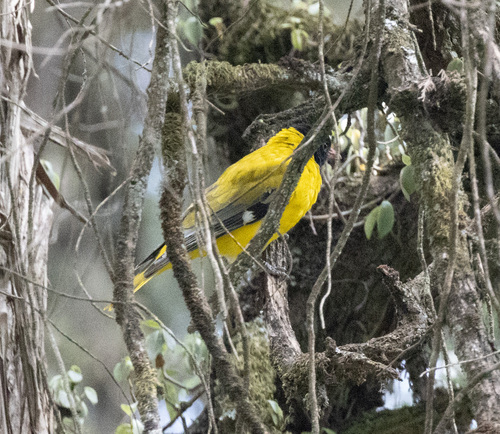
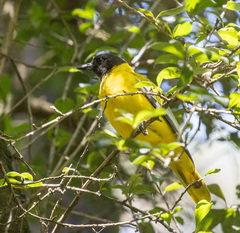
Dark-headed Oriole

Dark-headed Oriole

Oriolus monacha

Silhouette: L. Shyamal · PhyloPic

LCLeast ConcernNTVUENCR
Daily sighting probability ~10% · With luck
at Bale Mountains National Park

In 3 days ~30% in a week ~60%

25 Verified sightings at Bale Mountains National Park From 2019 to 2026
25 In 1 park
December Best month

About the Dark-headed Oriole

The Ethiopian oriole (Oriolus monacha) is a species of bird in the family Oriolidae. It is found in north-eastern Africa where its natural habitat is subtropical or tropical dry forests. The Ethiopian oriole was formally described in 1789 by the German naturalist Johann Friedrich Gmelin in his revised and expanded edition of Carl Linnaeus's Systema Naturae. He placed it with the thrushes in the genus Turdus and coined the binomial name Turdus monacha. The specific epithet monacha is from Late Latin monachus meaning "monk". Gmelin based his description on "Le Moloxita" or "La religieuse d'Abissinie" that had been described in 1775 by the French polymath Comte de Buffon in his multi-volume Histoire Naturelle des Oiseaux. The Ethiopian oriole is now one of 30 orioles placed in the genus Oriolus that was introduced in 1766 by Linnaeus. Other common names include dark-headed or black-headed forest oriole and Abyssinian oriole.

Two subspecies are recognized: Oriolus monacha meneliki Blundell and Lovat, 1899 – Originally described as a separate species. Found in southern Ethiopia Oriolus monacha monacha (Gmelin, 1789) – Found in northern Ethiopia, Eritrea... Wikipedia →

Sounds

Song0:39

Ethiopia · 2019

© Barry Edmonston · XC530961 · CC BY-NC-SA 4.0

Call0:22

Ethiopia · 2019

© Oscar Campbell · XC474478 · CC BY-NC-SA 4.0

Song0:29

Ethiopia · 2002

© Keith Blomerley · XC386544 · CC BY-NC-SA 4.0

Global Distribution

Parks Where Found

# Park Country Daily sighting probability
1 Bale Mountains National Park 🇪🇹 Ethiopia
~10%

More parks will be added in future updates.

Cities Where Found

# City Country Daily sighting probability
1 Addis Ababa 🇪🇹 Ethiopia
<5%

Before you go

What are the chances of seeing a Dark-headed Oriole in Bale Mountains National Park?

With luck

About 10% of wildlife watchers report a Dark-headed Oriole sighting in Bale Mountains National Park on a given day, based on 25 verified sightings from GBIF citizen-science data from 2019 to 2026. It is the 66th most-seen of the 117 birds we can rate there. Over three days the chance rises to about 30%, and over a week to about 60%, if each day is a fresh chance.

When is the best time to see a Dark-headed Oriole in Bale Mountains National Park?

December

In that month about 30% of wildlife watchers report a Dark-headed Oriole in Bale Mountains National Park on a given day, against about 10% in January–February, April–August and October–November, the lowest months. That is one of Bale Mountains National Park's driest months, with about 35 mm of rain against 230 mm in April. March and September have too few records to rate.

Where else can you see a Dark-headed Oriole?

Only Bale Mountains National Park, in our data

Bale Mountains National Park is the only park on Wallace's Line with enough records to rate Dark-headed Oriole sightings: about 10% of wildlife watchers there report one on a given day.

Which relatives of the Dark-headed Oriole live in Bale Mountains National Park?

Same order: Passeriformes

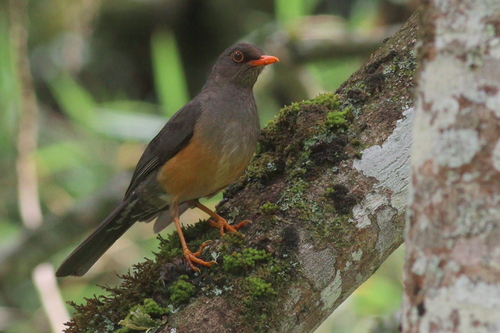
The closest relatives of the Dark-headed Oriole that you can see in Bale Mountains National Park (order Passeriformes, Perching Birds) are Moorland Chat (about 80%), Abyssinian Siskin (about 70%) and Ethiopian Cisticola (about 70%), with each one's daily chance of a sighting.

Where does the Dark-headed Oriole sighting chance come from?

GBIF citizen-science records

It is estimated from how often the Dark-headed Oriole is recorded against all the birds logged in Bale Mountains National Park (25 verified sightings from 2019 to 2026), calibrated against known sighting rates. Figures are rounded to the nearest 10% because citizen-science data supports honest approximations, not decimals, and months with records from fewer than five people show "—". How it works.

← Back to Bale Mountains National Park