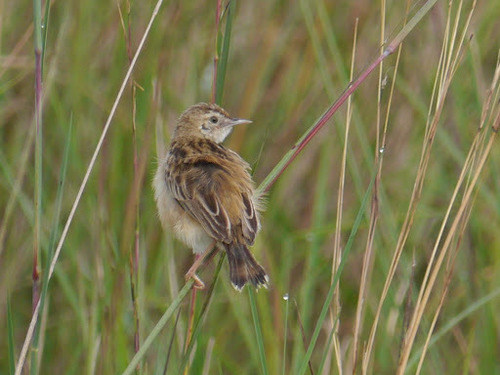
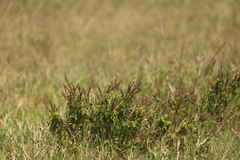
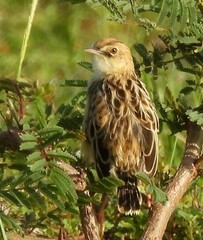

Pectoral-patch Cisticola

Pectoral-patch Cisticola

Cisticola brunnescens

Silhouette: Sheatherius · PhyloPic

LCLeast ConcernNTVUENCR
Daily sighting probability ~10% · With luck
at Bale Mountains National Park

In 3 days ~20% in a week ~30%

12 Verified sightings at Bale Mountains National Park From 2019 to 2026
1,420 In all 8 parks
May Best month
☀️ Diurnal When it's spotted

About the Pectoral-patch Cisticola

The pectoral-patch cisticola (Cisticola brunnescens) is a species of bird in the family Cisticolidae. It is native to the Adamawa Massif, Gabon, the Congo and highlands of East Africa. Its natural habitats are damp or wet areas in upland grassland.

At 9–10 cm this is a small, streak-backed cisticola with short or medium tail, which may get longer in the breeding season. It differs from the pale-crowned cisticola in having a pale rufous (not buff) crown and forehead in the breeding season. The pectoral patches become darker in the breeding season, but even then they may not be easy to see.

The voice is stonechat-like in quality with harsh tssk tssk or szisk szisk notes given in display flight. Wikipedia →

Sounds

Song0:11

Tanzania · 2024

© isaac kilusu · XC982991 · CC BY-NC-SA 4.0

Call0:05

Tanzania · 2018

© Bernard BOUSQUET · XC436898 · CC BY-NC-SA 4.0

Flight call0:14

Kenya · 2015

© Rory Nefdt · XC240822 · CC BY-NC-SA 4.0

Global Distribution

Parks Where Found

# Park Country Daily sighting probability
1 Nairobi National Park 🇰🇪 Kenya
~20%
2 Masai Mara National Reserve 🇰🇪 Kenya
~20%
3 Lake Nakuru National Park 🇰🇪 Kenya
~10%
4 Ngorongoro Conservation Area 🇹🇿 Tanzania
~10%
5 Serengeti National Park 🇹🇿 Tanzania
~10%
6 Bale Mountains National Park 🇪🇹 Ethiopia
~10%
7 Amboseli National Park 🇰🇪 Kenya
<5%
8 Tarangire National Park 🇹🇿 Tanzania
<5%

Cities Where Found

# City Country Daily sighting probability
1 Nairobi 🇰🇪 Kenya
<5%

Before you go

What are the chances of seeing a Pectoral-patch Cisticola in Bale Mountains National Park?

With luck

About 10% of wildlife watchers report a Pectoral-patch Cisticola sighting in Bale Mountains National Park on a given day, based on 12 verified sightings from GBIF citizen-science data from 2019 to 2026. It is the 94th most-seen of the 117 birds we can rate there. Over three days the chance rises to about 20%, and over a week to about 30%, if each day is a fresh chance.

When is the best time to see a Pectoral-patch Cisticola in Bale Mountains National Park?

May

In that month about 20% of wildlife watchers report a Pectoral-patch Cisticola in Bale Mountains National Park on a given day, against under 5% in June, August and October–February, the lowest months. March and September have too few records to rate.

What time of day is best to see a Pectoral-patch Cisticola?

Between 8 and 11 am

Across all the parks we cover, that three-hour window holds the most Pectoral-patch Cisticola sightings with a recorded time, and about 8 in 10 of them come between 6 am and 6 pm: it is a daytime animal.

Is Bale Mountains National Park the best place to see a Pectoral-patch Cisticola?

6th of 8

Of the 8 parks where we can rate Pectoral-patch Cisticola sightings, Bale Mountains National Park ranks 6th at about 10%. The best odds are in Nairobi National Park (Kenya, about 20%), Masai Mara National Reserve (Kenya, about 20%) and Lake Nakuru National Park (Kenya, about 10%).

Which relatives of the Pectoral-patch Cisticola live in Bale Mountains National Park?

Same genus: Cisticola

The closest relatives of the Pectoral-patch Cisticola that you can see in Bale Mountains National Park (genus Cisticola, Cisticolas) are Ethiopian Cisticola (about 70%) and Singing Cisticola (about 10%), with each one's daily chance of a sighting.

Where does the Pectoral-patch Cisticola sighting chance come from?

GBIF citizen-science records

It is estimated from how often the Pectoral-patch Cisticola is recorded against all the birds logged in Bale Mountains National Park (12 verified sightings from 2019 to 2026), calibrated against known sighting rates. Figures are rounded to the nearest 10% because citizen-science data supports honest approximations, not decimals, and months with records from fewer than five people show "—". How it works.

← Back to Bale Mountains National Park