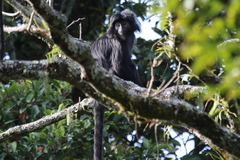
Javan Lutung

Javan Lutung

Trachypithecus auratus

Silhouette: Andy Wilson · PhyloPic

LCNTVUVulnerableENCR
Daily sighting probability ~50% · Likely
at Bali Barat National Park

In 3 days ~90% in a week >90%

89 Verified sightings at Bali Barat National Park From 2019 to 2026
89 In 1 park
July Best month
🌅 Crepuscular When it's spotted

About the Javan Lutung

The East Javan langur (Trachypithecus auratus), also known as the ebony lutung, Javan langur or Javan lutung, is an Old World monkey from the Colobinae subfamily. It is most commonly glossy black with a brownish tinge to its legs, sides, and "sideburns". It is found on the island of Java, as well as on several of the surrounding Indonesian islands. The Latin word auratus in its scientific name means "golden" and refers to a less common color variant. The common name golden langur refers to a different species.

Like all langurs, this species' tail is noticeably long, measuring up to 98 cm in length while the body is only around 55 cm long. The two subspecies of this monkey are fairly similar in appearance and are geographically separated; males and females are both usually glossy black, although the females pale, yellowish-white patch around the pubic area. Juveniles of both subspecies are orange in color. The nominate subspecies Trachypithecus auratus auratus has a rare morph that does not lose its juvenile coloration when it matures, instead, the coloration darkens slightly, with yellow tinges on its sides, limbs, and around its ears, and a black tinge on its back... Wikipedia →

Sounds

Call0:29

Indonesia · 2012

© Frank Lambert · XC1031436 · CC BY-NC-ND 4.0

Global Distribution

Parks Where Found

# Park Country Daily sighting probability
1 Bali Barat National Park 🇮🇩 Indonesia
~50%

More parks will be added in future updates.

Zoos & Centres Where Found

# Zoo / Centre Country
1 ZooParc de Beauval 🇫🇷 France In captivity
2 Lisbon Oceanarium 🇵🇹 Portugal In captivity
3 Bronx Zoo 🇺🇸 United States In captivity
4 Brookfield Zoo 🇺🇸 United States In captivity
5 Tanganyika Wildlife Park 🇺🇸 United States In captivity
6 Wilhelma 🇩🇪 Germany In captivity
7 Zoo du Bassin d'Arcachon 🇫🇷 France In captivity
8 Gembira Loka Zoo 🇮🇩 Indonesia In captivity
9 Hanover Zoo 🇩🇪 Germany In captivity
10 Bandung Zoo 🇮🇩 Indonesia In captivity
11 Johor Zoo 🇲🇾 Malaysia In captivity
12 Maharani Zoo & Goa 🇮🇩 Indonesia In captivity

Before you go

What are the chances of seeing a Javan Lutung in Bali Barat National Park?

Likely

About 50% of wildlife watchers report a Javan Lutung sighting in Bali Barat National Park on a given day, based on 89 verified sightings from GBIF citizen-science data from 2019 to 2026. It is the 4th most-seen of the 9 mammals we can rate there. Over three days the chance rises to about 90%, and over a week to over 90%, if each day is a fresh chance.

When is the best time to see a Javan Lutung in Bali Barat National Park?

July and August

In those months about 70% of wildlife watchers report a Javan Lutung in Bali Barat National Park on a given day, against about 30% in April and September–October, the lowest months. Those are among Bali Barat National Park's driest months, with about 20 mm of rain a month against 280 mm in February.

What time of day is best to see a Javan Lutung?

Between 4 and 7 am

Across all the parks we cover, that three-hour window holds the most Javan Lutung sightings with a recorded time, and about half of them come between 6 pm and 6 am: it is most active around dawn and dusk.

Where else can you see a Javan Lutung?

Only Bali Barat National Park, in our data

Bali Barat National Park is the only park on Wallace's Line with enough records to rate Javan Lutung sightings: about 50% of wildlife watchers there report one on a given day.

Where does the Javan Lutung sighting chance come from?

GBIF citizen-science records

It is estimated from how often the Javan Lutung is recorded against all the mammals logged in Bali Barat National Park (89 verified sightings from 2019 to 2026), calibrated against known sighting rates. Figures are rounded to the nearest 10% because citizen-science data supports honest approximations, not decimals, and months with records from fewer than five people show "—". How it works.

← Back to Bali Barat National Park