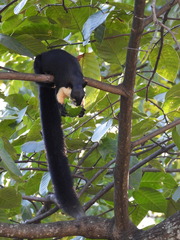
Black Giant Squirrel

Black Giant Squirrel

Ratufa bicolor

Silhouette: Joseph Smit · PhyloPic

LCNTNear ThreatenedVUENCR
Daily sighting probability ~40% · Likely
at Bali Barat National Park

In 3 days ~80% in a week >90%

50 Verified sightings at Bali Barat National Park From 2019 to 2026
544 In all 13 parks
September Best month
🌅 Crepuscular When it's spotted

About the Black Giant Squirrel

The black giant squirrel or Malayan giant squirrel (Ratufa bicolor) is a large tree squirrel in the genus Ratufa native to the Indomalayan zootope. It is found in forests from northern Bangladesh, northeast India, eastern Nepal, Bhutan, southern China, Myanmar, Laos, Thailand, West Malaysia, Cambodia, Vietnam, and western Indonesia (Java, Sumatra, Bali and nearby small islands).

The black giant squirrel is one of the largest species of squirrel in the world. On average, an adult black giant squirrel weighs around 1.05–1.25 kg (2.3–2.8 lb), has a head–and–body length of 34–37 cm (13–15 in), and the tail is 41–42 cm (16–17 in) long. The subspecies R. b. condorensis of Vietnam's Côn Sơn Island averages only c. 30 cm (12 in) in head–and–body length and the tail 32 cm (13 in), but otherwise it resembles the typical subspecies.

This species is typically distinctly bicoloured with dark upperparts and pale underparts. The back, top of the head, ears and bushy tail are deep brown to black and the underparts are light buff-coloured. In Sumatra, Java and Bali the hairs of the back and tail are light-tipped, making these sections appear relatively pale (however, the upperparts... Wikipedia →

Sounds

Uncertain0:14

Malaysia · 2018

© David Boyle · XC1069800 · CC BY-NC-SA 4.0

Call0:11

Vietnam · 2014

© Frank Lambert · XC1031379 · CC BY-NC-ND 4.0

Alarm call0:20

Thailand · 2014

© Jelle Scharringa · XC1025066 · CC BY-NC-SA 4.0

Global Distribution

Parks Where Found

# Park Country Daily sighting probability
1 Namdapha National Park 🇮🇳 India
~60%
2 Khao Yai National Park 🇹🇭 Thailand
~50%
3 Kaziranga National Park 🇮🇳 India
~50%
4 Bali Barat National Park 🇮🇩 Indonesia
~40%
5 Manas National Park 🇮🇳 India
~40%
6 Kaeng Krachan National Park 🇹🇭 Thailand
~40%
7 Taman Negara National Park 🇲🇾 Malaysia
~40%
8 Royal Manas National Park 🇧🇹 Bhutan
~30%
9 Khao Luang National Park 🇹🇭 Thailand
~30%
10 Gunung Leuser National Park 🇮🇩 Indonesia
~20%
11 Kerinci Seblat National Park 🇮🇩 Indonesia
~20%
12 Cat Tien National Park 🇻🇳 Vietnam
~20%
13 Khao Sok National Park 🇹🇭 Thailand
~20%

Zoos & Centres Where Found

# Zoo / Centre Country
1 Tashkent Zoo 🇺🇿 Uzbekistan In captivity
2 Saigon Zoo and Botanical Gardens 🇻🇳 Vietnam In captivity
3 Entopia 🇲🇾 Malaysia In captivity

Before you go

What are the chances of seeing a Black Giant Squirrel in Bali Barat National Park?

Likely

About 40% of wildlife watchers report a Black Giant Squirrel sighting in Bali Barat National Park on a given day, based on 50 verified sightings from GBIF citizen-science data from 2019 to 2026. It is the 5th most-seen of the 9 mammals we can rate there. Over three days the chance rises to about 80%, and over a week to over 90%, if each day is a fresh chance.

When is the best time to see a Black Giant Squirrel in Bali Barat National Park?

July and September

In those months about 60% of wildlife watchers report a Black Giant Squirrel in Bali Barat National Park on a given day, against about 10% in February and April, the lowest months. Those are among Bali Barat National Park's driest months, with about 30 mm of rain a month against 280 mm in February.

What time of day is best to see a Black Giant Squirrel?

Between 3 and 6 am

Across all the parks we cover, that three-hour window holds the most Black Giant Squirrel sightings with a recorded time, and about half of them come between 6 pm and 6 am: it is most active around dawn and dusk.

Where does the Black Giant Squirrel sighting chance come from?

GBIF citizen-science records

It is estimated from how often the Black Giant Squirrel is recorded against all the mammals logged in Bali Barat National Park (50 verified sightings from 2019 to 2026), calibrated against known sighting rates. Figures are rounded to the nearest 10% because citizen-science data supports honest approximations, not decimals, and months with records from fewer than five people show "—". How it works.

← Back to Bali Barat National Park