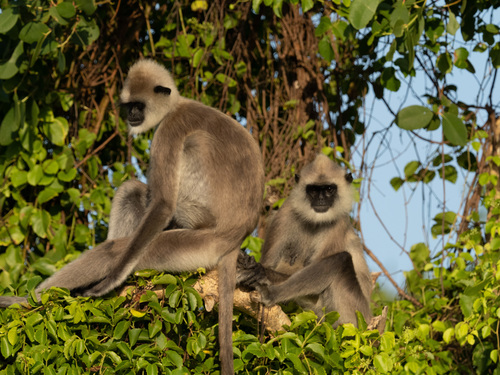
Bonnet Macaque

Bonnet Macaque

Macaca radiata

Silhouette: PhyloPic

LCNTVUVulnerableENCR Endemic
Daily sighting probability ~40% · Likely
at Bandipur National Park

In 3 days ~80% in a week >90%

25 Verified sightings at Bandipur National Park From 2019 to 2026
161 In all 5 parks
February Best month
☀️ Diurnal When it's spotted

About the Bonnet Macaque

The bonnet macaque (Macaca radiata), also known as zati, is a species of macaque endemic to southern India. Its distribution is limited by the Indian Ocean on three sides and the Godavari and Tapti rivers, along with that of the rhesus macaque, its related competitor to the north. Land use changes in the last few decades have resulted in changes in its distribution boundaries with the rhesus macaque, raising concern for its conservation status in the wild.

The bonnet macaque is diurnal, arboreal, and terrestrial. It can live up to 35 years in captivity. The bonnet macaque feeds on fruits, true nuts, seeds (culinary "nuts"), flowers, invertebrates and cereals. In southern India, this macaque has a commensal interaction with humans, feeding on food given by humans and raiding farms and houses.

The name "bonnet macaque" has been derived from the species unique and distinctive head pattern. This pattern of hair growth radiates from the center of its crown, creating a visual resemblance of a "bonnet" or a "cap" on the head of the species.

Two subspecies of the bonnet macaque have been identified: Macaca radiata radiata, dark-bellied bonnet macaque, occurs... Wikipedia →

Global Distribution

Parks Where Found

# Park Country Daily sighting probability
1 Periyar National Park 🇮🇳 India
~70%
2 Nagarhole National Park 🇮🇳 India
~70%
3 Mudumalai National Park 🇮🇳 India
~50%
4 Bandipur National Park 🇮🇳 India
~40%
5 Eravikulam National Park 🇮🇳 India
~30%

Cities Where Found

# City Country Daily sighting probability
1 Tiruchirappalli 🇮🇳 India
~40%
2 Chennai 🇮🇳 India
~30%
3 Bengaluru 🇮🇳 India
~30%
4 Mysuru 🇮🇳 India
~20%
5 Kozhikode 🇮🇳 India
~20%
6 Mumbai 🇮🇳 India
~20%

Zoos & Centres Where Found

# Zoo / Centre Country
1 Sharjah Safari Park Office 🇦🇪 United Arab Emirates In captivity
2 Sri Venkateswara Zoological Park 🇮🇳 India In captivity
3 Bondla Zoo 🇮🇳 India In captivity
4 Indira Gandhi Zoological Park 🇮🇳 India In captivity
5 Bannerghatta Zoo 🇮🇳 India In captivity
6 ZOOM Erlebniswelt 🇩🇪 Germany In captivity
7 National Zoo of Malaysia 🇲🇾 Malaysia In captivity
8 Emirates Park Zoo 🇦🇪 United Arab Emirates In captivity
9 Thrissur Zoo 🇮🇳 India In captivity

Before you go

What are the chances of seeing a Bonnet Macaque in Bandipur National Park?

Likely

About 40% of wildlife watchers report a Bonnet Macaque sighting in Bandipur National Park on a given day, based on 25 verified sightings from GBIF citizen-science data from 2019 to 2026. It is the 5th most-seen of the 15 mammals we can rate there. Over three days the chance rises to about 80%, and over a week to over 90%, if each day is a fresh chance.

When is the best time to see a Bonnet Macaque in Bandipur National Park?

February, May and July

In those months about 60% of wildlife watchers report a Bonnet Macaque in Bandipur National Park on a given day, against under 5% in January, the lowest month.

What time of day is best to see a Bonnet Macaque?

Between 11 am and 2 pm

Across all the parks we cover, that three-hour window holds the most Bonnet Macaque sightings with a recorded time, and about 7 in 10 of them come between 6 am and 6 pm: it is a daytime animal.

Which relatives of the Bonnet Macaque live in Bandipur National Park?

Same family: Cercopithecidae

The closest relatives of the Bonnet Macaque that you can see in Bandipur National Park (family Cercopithecidae, Old World Monkeys) are Tufted Langur (about 40%) and Southern Plains Gray Langur (about 30%), with each one's daily chance of a sighting.

Where does the Bonnet Macaque sighting chance come from?

GBIF citizen-science records

It is estimated from how often the Bonnet Macaque is recorded against all the mammals logged in Bandipur National Park (25 verified sightings from 2019 to 2026), calibrated against known sighting rates. Figures are rounded to the nearest 10% because citizen-science data supports honest approximations, not decimals, and months with records from fewer than five people show "—". How it works.

← Back to Bandipur National Park