March Tubic

March Tubic

Diurnea fagella

Daily sighting probability ~10% · With luck
at Bavarian Forest National Park

In 3 days ~30% in a week ~50%

24 Verified sightings at Bavarian Forest National Park From 2019 to 2026
33 In all 2 parks
April Best month
☀️🌙 Day & Night When it's spotted

About the March Tubic

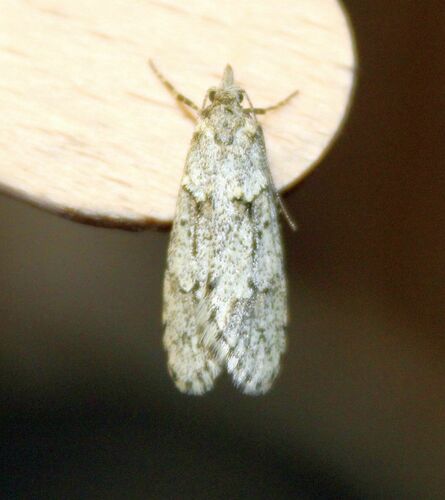
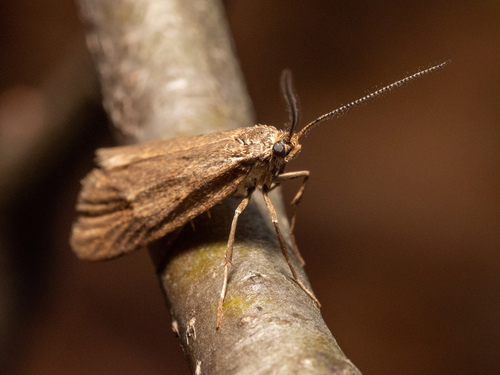
Diurnea fagella, the March dagger moth, is a moth of the subfamily Chimabachinae. It is found in Europe and was first described by Michael Denis & Ignaz Schiffermüller in 1775. The wingspan of the male is from 26–30 mm The female is smaller with reduced wings and a wingspan of 15–20 mm. The antennae of the male are

shortly and evenly ciliated. Forewings whitish or ochreous whitish, sprinkled or sometimes densely irrorated with fuscous and dark fuscous; an indistinct blackish angulated transverse line about 1/3, not reaching dorsum; stigmata black, first discal double, followed by another black dot, plical confluent with transverse line, second discal forming a transverse mark or pair of dots; often an angulated and indented blackish subterminal line. Hindwings are light grey.

The larva is grey - green; head yellowish-grey; 3rd pair of legs placed on tubercle.Melanic forms are common in both male and female and can be found in some northern and industrial areas of England. In northern Scotland only pale specimens are found and albinistic forms can be found everywhere.

The moth flies in one generation from March to May depending on the location. During the day males... Wikipedia →
Global Distribution

Parks Where Found

# Park Country Daily sighting probability
1 Bavarian Forest National Park 🇩🇪 Germany
~10%
2 Snowdonia National Park 🇬🇧 United Kingdom
~10%

Cities Where Found

# City Country Daily sighting probability
1 Liverpool 🇬🇧 United Kingdom
~10%
2 Rotterdam [The Hague] 🇳🇱 Netherlands
<5%
3 Hamburg 🇩🇪 Germany
<5%
4 London 🇬🇧 United Kingdom
<5%
5 Birmingham 🇬🇧 United Kingdom
<5%
6 Berlin 🇩🇪 Germany
<5%
7 Prague 🇨🇿 Czechia
<5%
8 Vienna 🇦🇹 Austria
<5%
9 Moscow 🇷🇺 Russia
<5%

Before you go

What are the chances of seeing a March Tubic in Bavarian Forest National Park?

With luck

About 10% of wildlife watchers report a March Tubic sighting in Bavarian Forest National Park on a given day, based on 24 verified sightings from GBIF citizen-science data from 2019 to 2026. It is the 189th most-seen of the 1115 insects we can rate there. Over three days the chance rises to about 30%, and over a week to about 50%, if each day is a fresh chance.

When is the best time to see a March Tubic in Bavarian Forest National Park?

April

In that month about 30% of wildlife watchers report a March Tubic in Bavarian Forest National Park on a given day, against under 5% in June to February, the lowest months.

What time of day is best to see a March Tubic?

Between 8 and 11 pm

Across all the parks we cover, that three-hour window holds the most March Tubic sightings with a recorded time, and about 6 in 10 of them come between 6 am and 6 pm: it is seen both by day and at night.

Is Bavarian Forest National Park the best place to see a March Tubic?

Yes

Of the 2 parks where we can rate March Tubic sightings, Bavarian Forest National Park has the highest daily chance: about 10%. Next come Snowdonia National Park (United Kingdom, about 10%).

Where does the March Tubic sighting chance come from?

GBIF citizen-science records

It is estimated from how often the March Tubic is recorded against all the insects logged in Bavarian Forest National Park (24 verified sightings from 2019 to 2026), calibrated against known sighting rates. Figures are rounded to the nearest 10% because citizen-science data supports honest approximations, not decimals, and months with records from fewer than five people show "—". How it works.

← Back to Bavarian Forest National Park