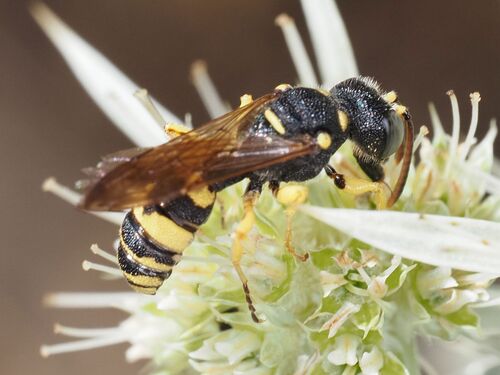
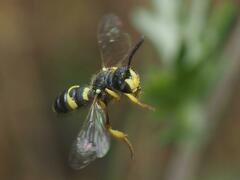

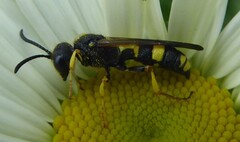
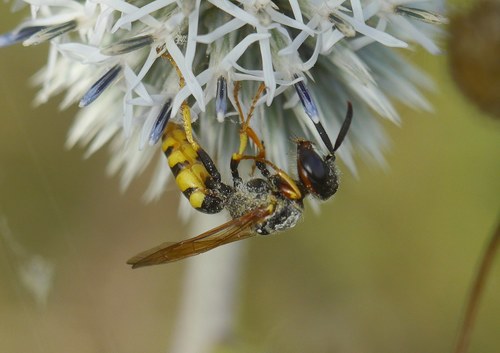

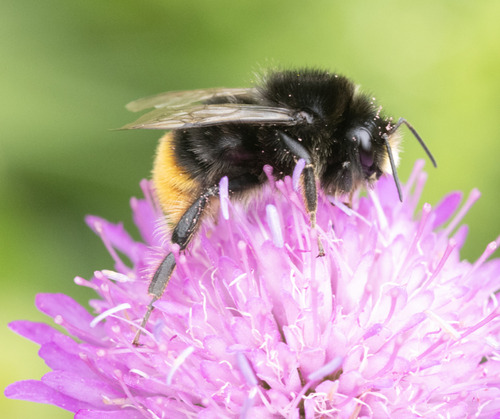
Ornate-Tailed Digger Wasp
Daily sighting probability ~10% · With luck
at Bavarian Forest National Park

In 3 days ~20% in a week ~30%

9 Verified sightings at Bavarian Forest National Park From 2019 to 2026
16 In all 2 parks
July Best month
☀️ Diurnal When it's spotted

About the Ornate-Tailed Digger Wasp

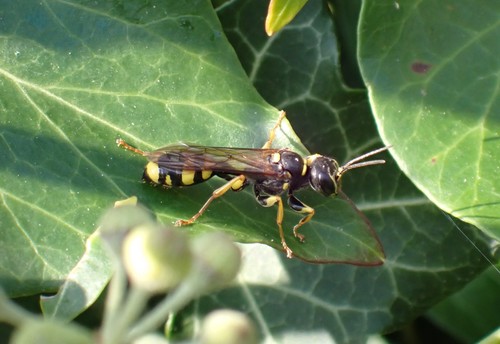
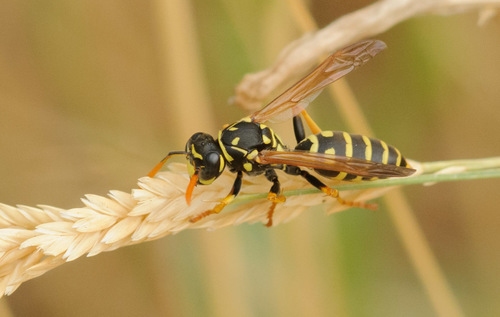
Cerceris rybyensis, the ornate tailed digger wasp, is a Palearctic species of solitary wasp from the family Philanthidae which specialised in hunting small to medium-sized mining bees. It is the type species of the genus Cerceris and was named as Sphex rybyensis by Carl Linnaeus in 1771.

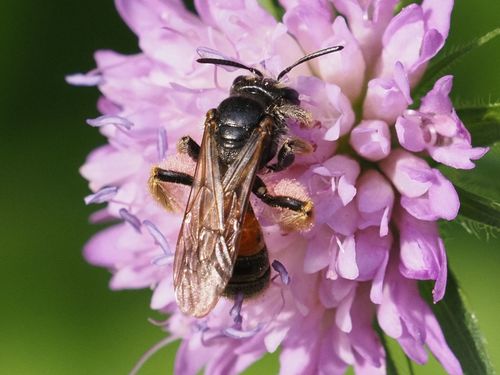
Cerceris rybyensis females measure 8-12mm in length, males measure 6-10mm. It has distinctive yellow and black bands on its abdomen, including a segment wide yellow band in the middle, and yellow tibia on the rear legs. Cerceris rybyensis is a Palearctic species which is found from southern England and the Iberian Peninsula in the west through most of Europe, including Scandinavia east to Japan.

Cerceris rybyensis occurs in areas of sandy soils, both coastal and inland, but it can also be found in areas with heavier soils and in chalk grassland. It has even been recorded from a suburban garden in London. It often nests in association with other burrowing wasps and bees including the sand tailed digger wasp (Cerceris arenaria).

Cerceris rybyensis is univoltine (one brood per year) and the adults have a flight period of June to September... Wikipedia →

Global Distribution

Parks Where Found

# Park Country Daily sighting probability
1 Bavarian Forest National Park 🇩🇪 Germany
~10%
2 Wadden Sea National Park 🇩🇪 Germany
<5%

Cities Where Found

# City Country Daily sighting probability
1 Warsaw 🇵🇱 Poland
~10%
2 Berlin 🇩🇪 Germany
~10%
3 Hamburg 🇩🇪 Germany
~10%
4 Munich 🇩🇪 Germany
~10%
5 London 🇬🇧 United Kingdom
~10%
6 Brussels 🇧🇪 Belgium
~10%
7 Essen 🇩🇪 Germany
<5%
8 Birmingham 🇬🇧 United Kingdom
<5%
9 Copenhagen 🇩🇰 Denmark
<5%
10 Paris 🇫🇷 France
<5%

Before you go

What are the chances of seeing an Ornate-Tailed Digger Wasp in Bavarian Forest National Park?

With luck

About 10% of wildlife watchers report an Ornate-Tailed Digger Wasp sighting in Bavarian Forest National Park on a given day, based on 9 verified sightings from GBIF citizen-science data from 2019 to 2026. It is the 585th most-seen of the 1115 insects we can rate there. Over three days the chance rises to about 20%, and over a week to about 30%, if each day is a fresh chance.

When is the best time to see an Ornate-Tailed Digger Wasp in Bavarian Forest National Park?

May, July and October

In those months about 10% of wildlife watchers report an Ornate-Tailed Digger Wasp in Bavarian Forest National Park on a given day, against under 5% in June, August–September and November–April, the lowest months.

What time of day is best to see an Ornate-Tailed Digger Wasp?

Between noon and 3 pm

Across all the parks we cover, that three-hour window holds the most Ornate-Tailed Digger Wasp sightings with a recorded time, and about 9 in 10 of them come between 6 am and 6 pm: it is a daytime animal.

Is Bavarian Forest National Park the best place to see an Ornate-Tailed Digger Wasp?

Yes

Of the 2 parks where we can rate Ornate-Tailed Digger Wasp sightings, Bavarian Forest National Park has the highest daily chance: about 10%. Next come Wadden Sea National Park (Germany, under 5%).

Which relatives of the Ornate-Tailed Digger Wasp live in Bavarian Forest National Park?

Same family: Crabronidae

The closest relatives of the Ornate-Tailed Digger Wasp that you can see in Bavarian Forest National Park (family Crabronidae, Square-headed Wasps, Sand Wasps, and Allies) are European Beewolf (about 10%) and Field Digger Wasp (about 10%), with each one's daily chance of a sighting.

Where does the Ornate-Tailed Digger Wasp sighting chance come from?

GBIF citizen-science records

It is estimated from how often the Ornate-Tailed Digger Wasp is recorded against all the insects logged in Bavarian Forest National Park (9 verified sightings from 2019 to 2026), calibrated against known sighting rates. Figures are rounded to the nearest 10% because citizen-science data supports honest approximations, not decimals, and months with records from fewer than five people show "—". How it works.

← Back to Bavarian Forest National Park