About the Scarce Black Arches
Nola aerugula, the scarce black arches, is a moth of the family Nolidae found in Asia and Europe. The species was first described by the German entomologist, Jacob Hübner in 1793. Nola aerugula aerugula Nola aerugula holsatica Sauber, 1916 (Denmark, the Netherlands) – many authors consider holsatica to be a full species.
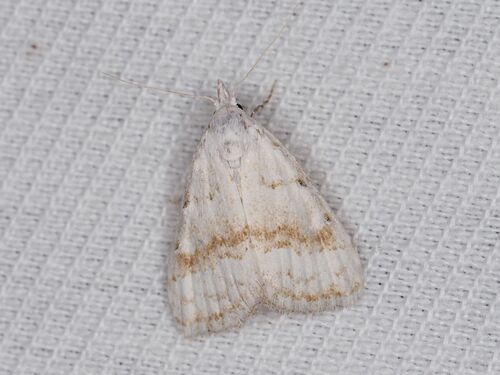
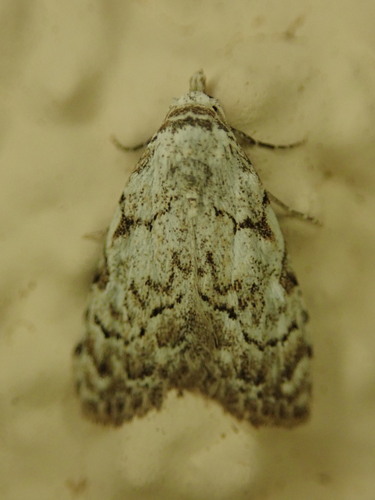
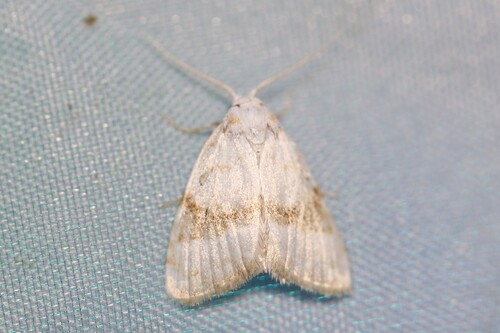
The wingspan is 15–20 mm. These small drab moths show quite variable colors and patterns. The basic color may be gray, brownish or almost white, with brown transverse bands. There are also bright and dark specimens with high-contrast patterns. Forewings are almost triangular with a rounded basal area. The rear wings are gray or brownish. The body is cylindrical. The antennas are filamentous, about half as long as forewings.
Adults are on wing from June to August in one generation. Males begin to fly just before sunset, and can sometimes be seen in swarms in search of females. The larvae mainly feed on clover (Trifolium) and common bird's-foot trefoil (Lotus corniculatus), but also birch (Betula species), willow (Salix species) and poplar (Populus species). The larvae of ssp. holsatica feed on petty whin (Genista anglica... Wikipedia →