Western Capercaillie

Western Capercaillie

Tetrao urogallus

Silhouette: Elisabeth Östman · PhyloPic

LCLeast ConcernNTVUENCR
Daily sighting probability ~10% · With luck
at Bavarian Forest National Park

In 3 days ~30% in a week ~60%

30 Verified sightings at Bavarian Forest National Park From 2019 to 2026
64 In all 3 parks
April Best month
☀️ Diurnal When it's spotted

About the Western Capercaillie

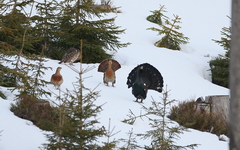
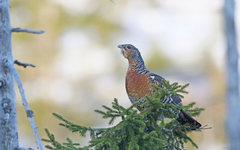
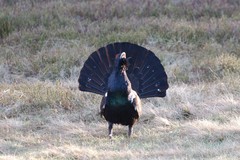
The western capercaillie (Tetrao urogallus), also known as the Eurasian capercaillie, wood grouse, heather cock, cock-of-the-woods, or simply capercaillie, is a heavy member of the grouse tribe and the largest of all extant grouse species. Found across Europe and the Palearctic, this primarily-ground-dwelling forest grouse is renowned for its courtship display. The bird shows extreme sexual dimorphism, with males nearly twice the size of females. The global population is listed as "least concern" under the IUCN, although the populations of central Europe are declining and fragmented, or possibly extirpated.

The western capercaillie is one of two living species under the genus Tetrao, which also includes the lesser-known black-billed capercaillie. The western capercaillie was formally described in 1758 by the Swedish naturalist Carl Linnaeus in the tenth edition of his Systema Naturae under its current binomial name Tetrao urogallus. Linnaeus specified the type locality as Europe but this is now restricted to Sweden. The genus name is a Latin word that was used for both the black grouse and the western capercaillie. The specific epithet urogallus is a Neo-Latin partial... Wikipedia →

Sounds

Song0:47

Poland · 2023

© Jarek Matusiak · XC883753 · CC BY-NC-ND 4.0

Call0:09

United Kingdom · 2019

© Simon Ernst · XC473720 · CC BY-NC-SA 4.0

Display1:15

Sweden · 2009

© Patrik Åberg · XC30157 · CC BY-NC-SA 3.0

Global Distribution

Parks Where Found

# Park Country Daily sighting probability
1 Bavarian Forest National Park 🇩🇪 Germany
~10%
2 Cairngorms National Park 🇬🇧 United Kingdom
~10%
3 Pyrénées National Park 🇫🇷 France
<5%

Zoos & Centres Where Found

# Zoo / Centre Country
1 Lusen National Park Centre 🇩🇪 Germany In captivity
2 Bronx Zoo 🇺🇸 United States In captivity
3 Parc animalier de Sainte-Croix 🇫🇷 France In captivity
4 Wildpark Neuhaus 🇩🇪 Germany In captivity
5 Novosibirsk Zoo 🇷🇺 Russia In captivity
6 wildlife park Feldkirch 🇦🇹 Austria In captivity
7 Wildpark Feldkirch 🇦🇹 Austria In captivity
8 Molló Parc Aventura 🇪🇸 Spain In captivity
9 Plock Zoo 🇵🇱 Poland In captivity
10 Santillana Zoo 🇪🇸 Spain In captivity
11 Alpenzoo Innsbruck 🇦🇹 Austria In captivity
12 Bois du Petit-Château 🇨🇭 Switzerland In captivity
13 akwarium warszawskiego ZOO 🇵🇱 Poland In captivity
14 Bird Park 🇷🇺 Russia In captivity

Before you go

What are the chances of seeing a Western Capercaillie in Bavarian Forest National Park?

With luck

About 10% of wildlife watchers report a Western Capercaillie sighting in Bavarian Forest National Park on a given day, based on 30 verified sightings from GBIF citizen-science data from 2019 to 2026. It is the 73rd most-seen of the 170 birds we can rate there. Over three days the chance rises to about 30%, and over a week to about 60%, if each day is a fresh chance.

When is the best time to see a Western Capercaillie in Bavarian Forest National Park?

February and April

In those months about 20% of wildlife watchers report a Western Capercaillie in Bavarian Forest National Park on a given day, against under 5% in January and June, the lowest months.

What time of day is best to see a Western Capercaillie?

Between 1 and 4 pm

Across all the parks we cover, that three-hour window holds the most Western Capercaillie sightings with a recorded time, and about 8 in 10 of them come between 6 am and 6 pm: it is a daytime animal.

Is Bavarian Forest National Park the best place to see a Western Capercaillie?

Yes

Of the 3 parks where we can rate Western Capercaillie sightings, Bavarian Forest National Park has the highest daily chance: about 10%. Next come Cairngorms National Park (United Kingdom, about 10%) and Pyrénées National Park (France, under 5%).

Where does the Western Capercaillie sighting chance come from?

GBIF citizen-science records

It is estimated from how often the Western Capercaillie is recorded against all the birds logged in Bavarian Forest National Park (30 verified sightings from 2019 to 2026), calibrated against known sighting rates. Figures are rounded to the nearest 10% because citizen-science data supports honest approximations, not decimals, and months with records from fewer than five people show "—". How it works.

← Back to Bavarian Forest National Park