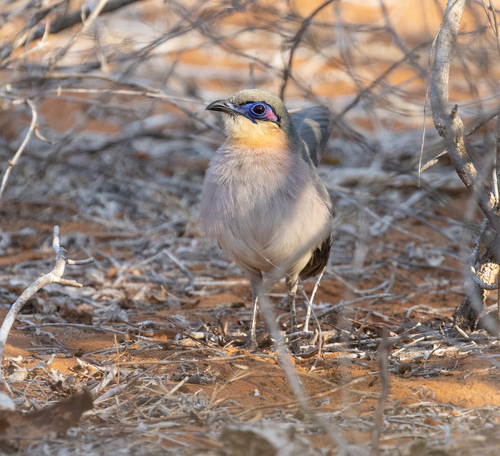
Giant Coua

Giant Coua

Coua gigas

Silhouette: Nicolas Huet le Jeune and Jean-Gabriel Prêtre (vectorized by T. Michael Keesey) · PhyloPic

LCNTVUVulnerableENCR Endemic
Daily sighting probability ~60% · Likely
at Berenty Reserve

In 3 days ~90% in a week >90%

161 Verified sightings at Berenty Reserve From 2019 to 2026
161 In 1 park
October Best month
☀️ Diurnal When it's spotted

About the Giant Coua

The giant coua (Coua gigas) is a bird species from the Coua genus in the cuckoo family that is endemic to the dry forests of western and southern Madagascar. Couas probably originated from a particular Asian ground-cuckoo. The genus Coua contains 10 species, more than any other genus in Madagascar. This species is listed as Vulnerable by the IUCN due to a rapidly decreasing population, resulting from defroestation and hunting pressures.

The giant coua was described by French polymath Georges-Louis Leclerc, Comte de Buffon in 1780 in his Histoire Naturelle des Oiseaux. The bird was also illustrated in a hand-coloured plate engraved by François-Nicolas Martinet in the Planches Enluminées D'Histoire Naturelle, which was produced under the supervision of Edme-Louis Daubenton to accompany Buffon's text. Neither the plate caption nor Buffon's description included a scientific name, but in 1783, Dutch naturalist Pieter Boddaert coined the binomial name Cuculus gigas in his catalogue of the Planches Enluminées. The giant coua is now placed in the genus Coua that was erected by the Swiss naturalist Heinrich Rudolf Schinz in 1821. The generic name is from koa, the Malagasy word... Wikipedia →

Sounds

Song0:57

Madagascar · 2012

© Peter Boesman · XC762696 · CC BY-NC-ND 4.0

Call0:15

Madagascar · 2017

© Ross Gallardy · XC418191 · CC BY-NC-SA 4.0

Song0:21

Madagascar · 2012

© Hans Matheve · XC154964 · CC BY-NC-ND 3.0

Global Distribution

Parks Where Found

# Park Country Daily sighting probability
1 Berenty Reserve 🇲🇬 Madagascar
~60%

More parks will be added in future updates.

Before you go

What are the chances of seeing a Giant Coua in Berenty Reserve?

Likely

About 60% of wildlife watchers report a Giant Coua sighting in Berenty Reserve on a given day, based on 161 verified sightings from GBIF citizen-science data from 2019 to 2026. It is the 16th most-seen of the 63 birds we can rate there. Over three days the chance rises to about 90%, and over a week to over 90%, if each day is a fresh chance.

What time of day is best to see a Giant Coua?

Between 8 and 11 am

Across all the parks we cover, that three-hour window holds the most Giant Coua sightings with a recorded time, and about 8 in 10 of them come between 6 am and 6 pm: it is a daytime animal.

Where else can you see a Giant Coua?

Only Berenty Reserve, in our data

Berenty Reserve is the only park on Wallace's Line with enough records to rate Giant Coua sightings: about 60% of wildlife watchers there report one on a given day.

Which relatives of the Giant Coua live in Berenty Reserve?

Same genus: Coua

The closest relatives of the Giant Coua that you can see in Berenty Reserve (genus Coua, Couas) are Crested Coua (about 90%), Red-capped Coua (about 20%) and Running Coua (about 20%), with each one's daily chance of a sighting.

Where does the Giant Coua sighting chance come from?

GBIF citizen-science records

It is estimated from how often the Giant Coua is recorded against all the birds logged in Berenty Reserve (161 verified sightings from 2019 to 2026), calibrated against known sighting rates. Figures are rounded to the nearest 10% because citizen-science data supports honest approximations, not decimals, and months with records from fewer than five people show "—". How it works.

← Back to Berenty Reserve