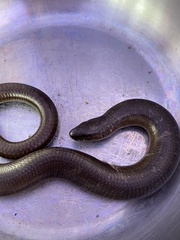
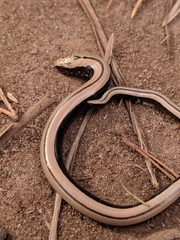
Eastern Slow-worm

Eastern Slow-worm

Anguis colchica

Silhouette: Steven Traver · PhyloPic

Daily sighting probability ~30% · Possible
at Biebrza National Park

In 3 days ~60% in a week ~90%

8 Verified sightings at Biebrza National Park From 2019 to 2026
67 In all 3 parks
May Best month
☀️ Diurnal When it's spotted

About the Eastern Slow-worm

Anguis colchica, the eastern slow worm, is a species of legless lizard in the family Anguidae found in eastern and northern Europe and Asia. It is easily confused with the common slow worm, due to their physical similarities, and the proximity of their distribution.

The eastern slow worm is part of the slow worm species complex. It was traditionally written as A. f. colchica, a subspecies of the common slow worm, but was later distinguished as a separate species, along with Anguis graeca, Anguis veronensis and Anguis cephalonnica.

Eastern slow worms live primarily in areas with partially closed, forest or shrub vegetation. They can be found most often on the edges of forests, forest clearings, and sometimes on tourist trails, where they can lie down to bask in the sun. They utilise stone piles, stone fences, coarse woody debris, and even the burrows of some rodents as hiding places. They commonly venture into gardens close to their habitat.

Eastern slow worms are mostly crepuscular animals, but are sometimes found to be active during the daytime, especially after rain. Their diet consists of small, slow moving invertebrates such as earthworms... Wikipedia →

Sounds

Recording0:04

Russia · 2024

© fedascheva · iNaturalist · CC BY-NC 4.0

Global Distribution

Parks Where Found

# Park Country Daily sighting probability
1 Białowieża National Park 🇵🇱 Poland
~50%
2 Biebrza National Park 🇵🇱 Poland
~30%
3 Tatra National Park 🇸🇰 Slovakia
~20%

Cities Where Found

# City Country Daily sighting probability
1 Istanbul 🇹🇷 Turkey
~20%
2 Helsinki 🇫🇮 Finland
~10%
3 Kyiv 🇺🇦 Ukraine
~10%
4 Kazan 🇷🇺 Russia
<5%

Zoos & Centres Where Found

# Zoo / Centre Country
1 Minsk Zoo 🇧🇾 Belarus In captivity
2 Дэльфінарый 🇧🇾 Belarus In captivity

Before you go

What are the chances of seeing an Eastern Slow-worm in Biebrza National Park?

Possible

About 30% of wildlife watchers report an Eastern Slow-worm sighting in Biebrza National Park on a given day, based on 8 verified sightings from GBIF citizen-science data from 2019 to 2026. It is the 4th most-seen of the 5 reptiles we can rate there. Over three days the chance rises to about 60%, and over a week to about 90%, if each day is a fresh chance.

When is the best time to see an Eastern Slow-worm in Biebrza National Park?

May

In that month about 40% of wildlife watchers report an Eastern Slow-worm in Biebrza National Park on a given day, against under 5% in March–April, July and September, the lowest months. December has too few records to rate.

What time of day is best to see an Eastern Slow-worm?

Between noon and 3 pm

Across all the parks we cover, that three-hour window holds the most Eastern Slow-worm sightings with a recorded time, and about 9 in 10 of them come between 6 am and 6 pm: it is a daytime animal.

Is Biebrza National Park the best place to see an Eastern Slow-worm?

2nd of 3

Of the 3 parks where we can rate Eastern Slow-worm sightings, Biebrza National Park ranks 2nd at about 30%. The best odds are in Białowieża National Park (Poland, about 50%).

Where does the Eastern Slow-worm sighting chance come from?

GBIF citizen-science records

It is estimated from how often the Eastern Slow-worm is recorded against all the reptiles logged in Biebrza National Park (8 verified sightings from 2019 to 2026), calibrated against known sighting rates. Figures are rounded to the nearest 10% because citizen-science data supports honest approximations, not decimals, and months with records from fewer than five people show "—". How it works.

← Back to Biebrza National Park