Chihuahuan Nightsnake

Chihuahuan Nightsnake

Hypsiglena jani

Silhouette: Jose Carlos Arenas-Monroy · PhyloPic

LCLeast ConcernNTVUENCR
Daily sighting probability ~20% · Possible
at Big Bend National Park

In 3 days ~50% in a week ~80%

52 Verified sightings at Big Bend National Park From 2019 to 2026
52 In 1 park
September Best month
🌙 Nocturnal When it's spotted

About the Chihuahuan Nightsnake

Hypsiglena jani, commonly known as the Texas night snake or the Chihuahuan night snake, is a small species of mildly venomous snake in the subfamily Dipsadinae of the family Colubridae. The species is native to the southwestern United States and adjacent northeastern Mexico.

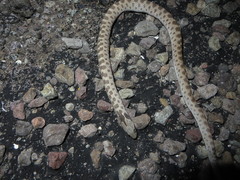
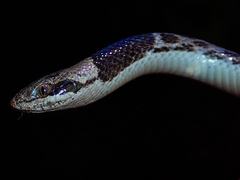
The epithet, jani, is in honor of Italian taxonomist Giorgio Jan. H. jani grows from 10 to 16 inches (25 to 41 centimetres) in total length (including tail), record 20 inches (51 cm). It is typically a light gray or tan in color, with dark brown or dark gray blotching down the back, and has an unmarked underside. It has smooth dorsal scales. The eye has a vertically elliptical pupil. H. jani is rear-fanged, and is considered to be venomous, though it is not dangerous to humans.

As the common names imply, H. jani is a primarily nocturnal snake. The diet of H. jani consists of primarily lizards, but it will also eat smaller snakes and occasionally soft bodied insects. H. jani prefers semi-arid habitats with rocky soils.

H. jani is an oviparous species that breeds in the spring rainy season, laying 4–6 eggs that take approximately... Wikipedia →

Global Distribution

Parks Where Found

# Park Country Daily sighting probability
1 Big Bend National Park 🇺🇸 United States
~20%

More parks will be added in future updates.

Before you go

What are the chances of seeing a Chihuahuan Nightsnake in Big Bend National Park?

Possible

About 20% of wildlife watchers report a Chihuahuan Nightsnake sighting in Big Bend National Park on a given day, based on 52 verified sightings from GBIF citizen-science data from 2019 to 2026. It is the 19th most-seen of the 48 reptiles we can rate there. Over three days the chance rises to about 50%, and over a week to about 80%, if each day is a fresh chance.

When is the best time to see a Chihuahuan Nightsnake in Big Bend National Park?

September

In that month about 40% of wildlife watchers report a Chihuahuan Nightsnake in Big Bend National Park on a given day, against under 5% in February and November–December, the lowest months. That is one of Big Bend National Park's wettest months, with about 50 mm of rain against 10 mm in April.

What time of day is best to see a Chihuahuan Nightsnake?

Between 9 pm and midnight

Across all the parks we cover, that three-hour window holds the most Chihuahuan Nightsnake sightings with a recorded time, and about 8 in 10 of them come between 6 pm and 6 am: it is mostly seen at night.

Where else can you see a Chihuahuan Nightsnake?

Only Big Bend National Park, in our data

Big Bend National Park is the only park on Wallace's Line with enough records to rate Chihuahuan Nightsnake sightings: about 20% of wildlife watchers there report one on a given day.

Which relatives of the Chihuahuan Nightsnake live in Big Bend National Park?

Same family: Colubridae

The closest relatives of the Chihuahuan Nightsnake that you can see in Big Bend National Park (family Colubridae, Colubrid Snakes) are Trans-pecos Ratsnake (about 30%), Coachwhip (about 20%) and Long-nosed Snake (about 20%), with each one's daily chance of a sighting.

Where does the Chihuahuan Nightsnake sighting chance come from?

GBIF citizen-science records

It is estimated from how often the Chihuahuan Nightsnake is recorded against all the reptiles logged in Big Bend National Park (52 verified sightings from 2019 to 2026), calibrated against known sighting rates. Figures are rounded to the nearest 10% because citizen-science data supports honest approximations, not decimals, and months with records from fewer than five people show "—". How it works.

← Back to Big Bend National Park