Common Hog-nosed Skunk

Common Hog-nosed Skunk

Conepatus leuconotus

Silhouette: Margot Michaud · PhyloPic

LCLeast ConcernNTVUENCR
Daily sighting probability ~10% · With luck
at Big Bend National Park

In 3 days ~20% in a week ~40%

11 Verified sightings at Big Bend National Park From 2019 to 2026
45 In all 3 parks
August Best month
☀️🌙 Day & Night When it's spotted

About the Common Hog-nosed Skunk

The American hog-nosed skunk (Conepatus leuconotus) is a species of hog-nosed skunk from Central and North America, and is one of the largest skunks in the world, growing to lengths of up to 2.7 feet (82 cm). Recent work has concluded the western hog-nosed skunk (formerly Conepatus mesoleucus) is the same species, and Conepatus leuconotus is the correct name of the merged populations.

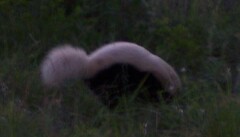
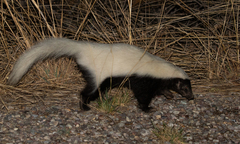
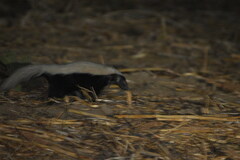
In Texas, it is commonly known as the rooter skunk for its habit of rooting and overturning rocks and debris in search of food. The distinguishing feature of the American hog-nosed skunk is it has a single, broad white stripe from the top of the head to the base of the tail, with the tail itself being completely white. It is the only skunk that lacks a white dot or medial bar between the eyes and has primarily black body fur. The snout of C. leuconotus is relatively long, with a naked nose pad, and resembles the nose of a small hog. The nose pad (20 mm wide by 25 mm long) is about three times wider than that of Mephitis mephitis. The ears are small and rounded, and the eyes are relatively small. The fur is short and coarse.

The American hog-nosed skunk has stocky legs and plantigrade... Wikipedia →

Sounds

Recording0:24

United States · 2025

© donna2112 · iNaturalist · CC BY-NC 4.0

Global Distribution

Parks Where Found

# Park Country Daily sighting probability
1 Cerro Azul Meámbar National Park 🇭🇳 Honduras
~20%
2 Big Bend National Park 🇺🇸 United States
~10%
3 Saguaro National Park 🇺🇸 United States
<5%

Before you go

What are the chances of seeing a Common Hog-nosed Skunk in Big Bend National Park?

With luck

About 10% of wildlife watchers report a Common Hog-nosed Skunk sighting in Big Bend National Park on a given day, based on 11 verified sightings from GBIF citizen-science data from 2019 to 2026. It is the 18th most-seen of the 21 mammals we can rate there. Over three days the chance rises to about 20%, and over a week to about 40%, if each day is a fresh chance.

When is the best time to see a Common Hog-nosed Skunk in Big Bend National Park?

August

In that month about 20% of wildlife watchers report a Common Hog-nosed Skunk in Big Bend National Park on a given day, against under 5% in January to May, the lowest months. That is one of Big Bend National Park's wettest months, with about 45 mm of rain against 10 mm in April.

What time of day is best to see a Common Hog-nosed Skunk?

Between 8 and 11 pm

Across all the parks we cover, that three-hour window holds the most Common Hog-nosed Skunk sightings with a recorded time, and about half of them come between 6 am and 6 pm: it is seen both by day and at night.

Is Big Bend National Park the best place to see a Common Hog-nosed Skunk?

2nd of 3

Of the 3 parks where we can rate Common Hog-nosed Skunk sightings, Big Bend National Park ranks 2nd at about 10%. The best odds are in Cerro Azul Meámbar National Park (Honduras, about 20%).

Which relatives of the Common Hog-nosed Skunk live in Big Bend National Park?

Same order: Carnivora

The closest relatives of the Common Hog-nosed Skunk that you can see in Big Bend National Park (order Carnivora, Carnivorans) are American Black Bear (about 40%), Coyote (about 40%) and Gray Fox (about 20%), with each one's daily chance of a sighting.

Where does the Common Hog-nosed Skunk sighting chance come from?

GBIF citizen-science records

It is estimated from how often the Common Hog-nosed Skunk is recorded against all the mammals logged in Big Bend National Park (11 verified sightings from 2019 to 2026), calibrated against known sighting rates. Figures are rounded to the nearest 10% because citizen-science data supports honest approximations, not decimals, and months with records from fewer than five people show "—". How it works.

← Back to Big Bend National Park