Aoudad

Aoudad

Ammotragus lervia

Silhouette: [unknown] · PhyloPic

LCNTVUVulnerableENCR
Daily sighting probability ~30% · Possible
at Big Bend National Park

In 3 days ~60% in a week ~90%

111 Verified sightings at Big Bend National Park From 2019 to 2026
129 In all 2 parks
January Best month
☀️ Diurnal When it's spotted

About the Aoudad

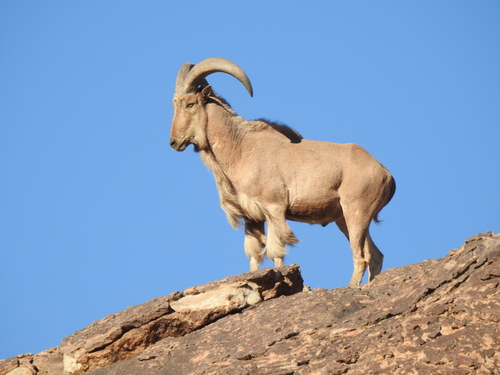
The Barbary sheep (Ammotragus lervia), also known as aoudad (pronounced [ˈɑʊdæd]), is a species of caprine native to rocky mountains in North Africa and parts of West Africa. While this is the only species in genus Ammotragus, six subspecies have been described. Although it is rare in its native North Africa, it has been introduced to North America, southern Europe, and elsewhere. It is also known in Berber languages as waddan or arwi, and in former French territories as the mouflon.

Barbary sheep stand 75 to 110 cm (2 ft 6 in to 3 ft 7 in) tall at the shoulder, with a length around 1.5 m (5 ft), and weigh 30 to 145 kg (66 to 320 lb). They are sandy-brown, darkening with age, with a slightly lighter underbelly and a darker line along the back. Upper parts and the outer parts of the legs are a uniform reddish- or grayish-brown. Some shaggy hair is on the throat (extending down to the chest in males) with a sparse mane. Their horns have a triangular cross-section. The horns curve outward, backward, then inward, and can exceed 76 cm (30 in) in length. The horns are fairly smooth, with slight wrinkles evident at the base as the animal matures. Wikipedia →

Global Distribution

Parks Where Found

# Park Country Daily sighting probability
1 Big Bend National Park 🇺🇸 United States
~30%
2 Guadalupe Mountains National Park 🇺🇸 United States
~30%

Zoos & Centres Where Found

# Zoo / Centre Country
1 Prague Zoo 🇨🇿 Czechia In captivity
2 Barcelona Zoo 🇪🇸 Spain In captivity
3 Réserve africaine de Sigean 🇫🇷 France In captivity
4 Muséum de Besançon 🇫🇷 France In captivity
5 Zoobotánico Jerez 🇪🇸 Spain In captivity
6 Monarto Zoo 🇦🇺 Australia In captivity
7 Taronga Western Plains Zoo 🇦🇺 Australia In captivity
8 Bioparque Estrella 🇲🇽 Mexico In captivity
9 Natural Bridge Wildlife Ranch 🇺🇸 United States In captivity
10 San Diego Zoo Safari Park 🇺🇸 United States In captivity
11 Taman Safari Indonesia 🇮🇩 Indonesia In captivity
12 Al Ain Zoo 🇦🇪 United Arab Emirates In captivity
13 African Lion Safari 🇨🇦 Canada In captivity
14 Taipei Zoo 🇹🇼 Taiwan In captivity
15 Safari West 🇺🇸 United States In captivity
16 Khao Kheow Open Zoo 🇹🇭 Thailand In captivity
17 Badoca Safari Park 🇵🇹 Portugal In captivity
18 Tallinn Zoo 🇪🇪 Estonia In captivity
19 Auto Safari Chapin 🇬🇹 Guatemala In captivity
20 Ecological Center of Sonora 🇲🇽 Mexico In captivity
21 Zoofari 🇲🇽 Mexico In captivity
22 Parc zoologique de Montpellier 🇫🇷 France In captivity
23 Beijing Zoo 🇨🇳 China In captivity
24 Wild Animal Safari 🇺🇸 United States In captivity
25 The Exotic Resort Zoo 🇺🇸 United States In captivity
26 Nuremberg Zoo 🇩🇪 Germany In captivity
27 Tiergarten Am Tiergarten 28 in Nürnberg 🇩🇪 Germany In captivity
28 Fuji Safari Park 🇯🇵 Japan In captivity
29 National Zoological Garden of South Africa 🇿🇦 South Africa In captivity
30 Tier-, Freizeit- und Saurierpark Germendorf 🇩🇪 Germany In captivity
31 Greater Vancouver Zoo 🇨🇦 Canada In captivity
32 Silesian Zoological Garden 🇵🇱 Poland In captivity
33 São Paulo Zoo 🇧🇷 Brazil In captivity
34 Selwo Aventura 🇪🇸 Spain In captivity
35 حديقة الحيوانات والتسلية برابطية القالة 🇩🇿 Algeria In captivity
36 Africam Safari 🇲🇽 Mexico In captivity
37 Tuzoofari 🇲🇽 Mexico In captivity
38 Out of Africa Wildlife Park 🇺🇸 United States In captivity
39 Guadalajara Zoo 🇲🇽 Mexico In captivity
40 Safari Niagara 🇨🇦 Canada In captivity
41 Yerevan Zoo 🇦🇲 Armenia In captivity
42 Zoo La Barben 🇫🇷 France In captivity
43 Adirondack Animal Land 🇺🇸 United States In captivity
44 Friguia Park 🇹🇳 Tunisia In captivity
45 Wrocław Zoological Garden 🇵🇱 Poland In captivity
46 Zoológico de Goiânia 🇧🇷 Brazil In captivity
47 Darling Downs Zoo 🇦🇺 Australia In captivity
48 Eudora Wildlife Safari Park 🇺🇸 United States In captivity
49 Zacango Zoo 🇲🇽 Mexico In captivity
50 National Zoo & Aquarium 🇦🇺 Australia In captivity

Before you go

What are the chances of seeing an Aoudad in Big Bend National Park?

Possible

About 30% of wildlife watchers report an Aoudad sighting in Big Bend National Park on a given day, based on 111 verified sightings from GBIF citizen-science data from 2019 to 2026. It is the 6th most-seen of the 21 mammals we can rate there. Over three days the chance rises to about 60%, and over a week to about 90%, if each day is a fresh chance.

When is the best time to see an Aoudad in Big Bend National Park?

March and December–January

In those months about 40% of wildlife watchers report an Aoudad in Big Bend National Park on a given day, against under 5% in August, the lowest month.

What time of day is best to see an Aoudad?

Between 1 and 4 pm

Across all the parks we cover, that three-hour window holds the most Aoudad sightings with a recorded time, and about 8 in 10 of them come between 6 am and 6 pm: it is a daytime animal.

Is Big Bend National Park the best place to see an Aoudad?

Yes

Of the 2 parks where we can rate Aoudad sightings, Big Bend National Park has the highest daily chance: about 30%. Next come Guadalupe Mountains National Park (United States, about 30%).

Which relatives of the Aoudad live in Big Bend National Park?

Same order: Artiodactyla

The closest relatives of the Aoudad that you can see in Big Bend National Park (order Artiodactyla, Even-toed Ungulates and Cetaceans) are White-tailed Deer (about 60%), Collared Peccary (about 40%) and Mule Deer (about 20%), with each one's daily chance of a sighting.

Where does the Aoudad sighting chance come from?

GBIF citizen-science records

It is estimated from how often the Aoudad is recorded against all the mammals logged in Big Bend National Park (111 verified sightings from 2019 to 2026), calibrated against known sighting rates. Figures are rounded to the nearest 10% because citizen-science data supports honest approximations, not decimals, and months with records from fewer than five people show "—". How it works.

← Back to Big Bend National Park