

Mexican Jay

Mexican Jay

Aphelocoma wollweberi

Silhouette: Sheatherius · PhyloPic

LCLeast ConcernNTVUENCR
Daily sighting probability ~50% · Likely
at Big Bend National Park

In 3 days ~90% in a week >90%

4,201 Verified sightings at Big Bend National Park From 2019 to 2026
5,716 In all 3 parks
July Best month
☀️ Diurnal When it's spotted

About the Mexican Jay

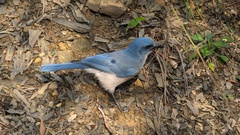
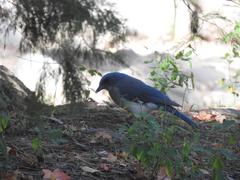
The Mexican jay (Aphelocoma wollweberi) formerly known as the gray-breasted jay, is a New World jay native to the Sierra Madre Oriental, Sierra Madre Occidental, and Central Plateau of Mexico and parts of the southwestern United States. In May 2011, the American Ornithologists' Union voted to split the Mexican jay into two species, one retaining the common name Mexican jay and one called the Transvolcanic jay. The Mexican jay is a medium-sized jay with blue upper parts and pale gray underparts. It resembles the Woodhouse's scrub-jay, but has an unstreaked throat and breast. It feeds largely on acorns and pine nuts, but includes many other plant and animal foods in its diet. It has a cooperative breeding system where the parents are assisted by other birds to raise their young. This is a common species with a wide range and the International Union for Conservation of Nature has rated its conservation status as being of "least concern".

A recent decision by the American Ornithologists' Union Check-list Committee elevated some populations of the Mexican jay to a separate species, called the Transvolcanic jay (A. ultramarina), based on diagnosable phenotypic... Wikipedia →

Sounds

Call1:09

Mexico · 2026

© Richard E. Webster · XC1183202 · CC BY-NC-SA 4.0

Alarm call1:26

United States · 2024

© Janine McCabe · XC919589 · CC BY-NC-SA 4.0

Begging call0:45

United States · 2013

© Lauren Harter · XC237174 · CC BY-NC-SA 4.0

Global Distribution

Parks Where Found

# Park Country Daily sighting probability
1 Big Bend National Park 🇺🇸 United States
~50%
2 Cumbres de Monterrey National Park 🇲🇽 Mexico
~40%
3 Saguaro National Park 🇺🇸 United States
<5%

Before you go

What are the chances of seeing a Mexican Jay in Big Bend National Park?

Likely

About 50% of wildlife watchers report a Mexican Jay sighting in Big Bend National Park on a given day, based on 4,201 verified sightings from GBIF citizen-science data from 2019 to 2026. It is the 12th most-seen of the 270 birds we can rate there. Over three days the chance rises to about 90%, and over a week to over 90%, if each day is a fresh chance.

When is the best time to see a Mexican Jay in Big Bend National Park?

May and July

In those months about 60% of wildlife watchers report a Mexican Jay in Big Bend National Park on a given day, against about 30% in January and November, the lowest months.

What time of day is best to see a Mexican Jay?

Between 9 am and noon

Across all the parks we cover, that three-hour window holds the most Mexican Jay sightings with a recorded time, and about 9 in 10 of them come between 6 am and 6 pm: it is a daytime animal.

Is Big Bend National Park the best place to see a Mexican Jay?

Yes

Of the 3 parks where we can rate Mexican Jay sightings, Big Bend National Park has the highest daily chance: about 50%. Next come Cumbres de Monterrey National Park (Mexico, about 40%) and Saguaro National Park (United States, under 5%).

Where does the Mexican Jay sighting chance come from?

GBIF citizen-science records

It is estimated from how often the Mexican Jay is recorded against all the birds logged in Big Bend National Park (4,201 verified sightings from 2019 to 2026), calibrated against known sighting rates. Figures are rounded to the nearest 10% because citizen-science data supports honest approximations, not decimals, and months with records from fewer than five people show "—". How it works.

← Back to Big Bend National Park