
Pyrrhuloxia

Pyrrhuloxia

Cardinalis sinuatus

Silhouette: Scott Hartman · PhyloPic

LCLeast ConcernNTVUENCR
Daily sighting probability ~50% · Likely
at Big Bend National Park

In 3 days ~90% in a week >90%

3,147 Verified sightings at Big Bend National Park From 2019 to 2026
6,820 In all 6 parks
January Best month
☀️ Diurnal When it's spotted

About the Pyrrhuloxia

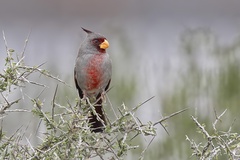
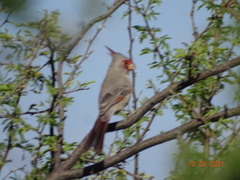
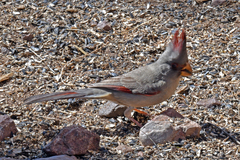
The pyrrhuloxia or desert cardinal (Cardinalis sinuatus) is a medium-sized North American songbird found in the American southwest and northern Mexico. This distinctive species with a short, stout bill, red crest, and red wings closely resembles the northern cardinal and the vermilion cardinal, which are in the same genus.

The desert cardinal is one of three birds in the genus Cardinalis in the family Cardinalidae, a group of passerine birds found in North and South America. Its name of pyrrhuloxia was suggested as a new genus by ornithologist Charles Lucien Bonaparte. He conceived it as portmanteau of the bullfinch genus Pyrrhula and the crossbill genus Loxia as he imagined the bird was an intermediate between the two. The common name, desert cardinal, refers to it inhabiting the southwest, and often arid regions, of the North American continent.

The desert cardinal is a medium-sized song bird; the length for both sexes is about 8.3 in (21 cm), while the typical weight is 0.8–1.5 oz (24–43 g). The most obvious differences between the male desert cardinal and the northern cardinal are in their coloring. The desert cardinal is predominantly brownish... Wikipedia →

Sounds

Call1:04

United States · 2026

© Scott Olmstead · XC1105146 · CC BY-NC-SA 4.0

Song0:40

Mexico · 2022

© Ivann Romero · XC739135 · CC BY-NC-SA 4.0

Song1:14

United States · 2022

© Scott Crabtree · XC714058 · CC BY-NC-SA 4.0

Global Distribution

Parks Where Found

# Park Country Daily sighting probability
1 Big Bend National Park 🇺🇸 United States
~50%
2 Cabo Pulmo National Park 🇲🇽 Mexico
~50%
3 Saguaro National Park 🇺🇸 United States
~40%
4 Guadalupe Mountains National Park 🇺🇸 United States
~20%
5 Bahía de Loreto National Park 🇲🇽 Mexico
~10%
6 Cumbres de Monterrey National Park 🇲🇽 Mexico
<5%

Cities Where Found

# City Country Daily sighting probability
1 Denver 🇺🇸 United States
<5%
2 Houston 🇺🇸 United States
<5%
3 Torreón 🇲🇽 México
<5%
4 Monterrey 🇲🇽 México
<5%
5 Austin 🇺🇸 United States
<5%
6 San Antonio 🇺🇸 United States
<5%

Zoos & Centres Where Found

# Zoo / Centre Country
1 Burgers' Ocean 🇳🇱 Netherlands In captivity
2 Royal Burgers' Zoo 🇳🇱 Netherlands In captivity
3 Arizona-Sonora Desert Museum 🇺🇸 United States In captivity

Before you go

What are the chances of seeing a Pyrrhuloxia in Big Bend National Park?

Likely

About 50% of wildlife watchers report a Pyrrhuloxia sighting in Big Bend National Park on a given day, based on 3,147 verified sightings from GBIF citizen-science data from 2019 to 2026. It is the 13th most-seen of the 270 birds we can rate there. Over three days the chance rises to about 90%, and over a week to over 90%, if each day is a fresh chance.

When is the best time to see a Pyrrhuloxia in Big Bend National Park?

January

In that month about 70% of wildlife watchers report a Pyrrhuloxia in Big Bend National Park on a given day, against about 40% in June and November–December, the lowest months. That is one of Big Bend National Park's driest months, with about 10 mm of rain against 50 mm in September.

What time of day is best to see a Pyrrhuloxia?

Between 7 and 10 am

Across all the parks we cover, that three-hour window holds the most Pyrrhuloxia sightings with a recorded time, and about 9 in 10 of them come between 6 am and 6 pm: it is a daytime animal.

Is Big Bend National Park the best place to see a Pyrrhuloxia?

Yes

Of the 6 parks where we can rate Pyrrhuloxia sightings, Big Bend National Park has the highest daily chance: about 50%. Next come Cabo Pulmo National Park (Mexico, about 50%) and Saguaro National Park (United States, about 40%). All parks ranked.

Where does the Pyrrhuloxia sighting chance come from?

GBIF citizen-science records

It is estimated from how often the Pyrrhuloxia is recorded against all the birds logged in Big Bend National Park (3,147 verified sightings from 2019 to 2026), calibrated against known sighting rates. Figures are rounded to the nearest 10% because citizen-science data supports honest approximations, not decimals, and months with records from fewer than five people show "—". How it works.

← Back to Big Bend National Park