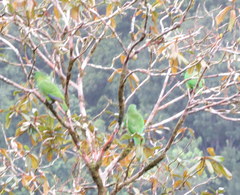
Black-billed Parrot

Black-billed Parrot

Amazona agilis

Silhouette: Ferran Sayol · PhyloPic

LCNTVUENEndangeredCR Endemic
Daily sighting probability ~40% · Likely
at Blue and John Crow Mountains National Park

In 3 days ~80% in a week >90%

385 Verified sightings at Blue and John Crow Mountains National Park From 2019 to 2026
385 In 1 park
October Best month
☀️ Diurnal When it's spotted

About the Black-billed Parrot

The black-billed amazon (Amazona agilis) is a parrot endemic to Jamaica. Sometimes called the black-billed parrot, this amazon parrot is mostly green with small patches of red on the wing and sometimes flecked on the head. Its bill makes it easy to separate from most other amazons, including the yellow-billed amazon, which also lives in Jamaica. It is the smallest Amazona parrot at 25 cm (10 in).

In 1751 the English naturalist George Edwards included an illustration and a description of the black-billed amazon in the fourth volume of his A Natural History of Uncommon Birds. He used the English name "The little green parrot". Edwards based his hand-coloured etching on a live bird that he had bought from a dealer in London. He was uncertain of the origin but assumed that it had come from the West Indies. When in 1758 the Swedish naturalist Carl Linnaeus updated his Systema Naturae for the tenth edition, he placed the black-billed amazon with the other parrots in the genus Psittacus. Linnaeus included a brief description, coined the binomial name Psittacus agilis and cited Edwards' work. The black-billed amazon is now one of 33 parrots placed in the genus Amazona that was... Wikipedia →

Sounds

Call0:21

Jamaica · 2016

© Ross Gallardy · XC308431 · CC BY-NC-SA 4.0

Flight call0:10

Jamaica · 2018

© Nick Komar · XC426017 · CC BY-NC-SA 4.0

Call0:50

Jamaica · 2012

© Richard C. Hoyer · XC97904 · CC BY-NC-ND 2.5

Global Distribution

Parks Where Found

# Park Country Daily sighting probability
1 Blue and John Crow Mountains National Park 🇯🇲 Jamaica
~40%

More parks will be added in future updates.

Before you go

What are the chances of seeing a Black-billed Parrot in Blue and John Crow Mountains National Park?

Likely

About 40% of wildlife watchers report a Black-billed Parrot sighting in Blue and John Crow Mountains National Park on a given day, based on 385 verified sightings from GBIF citizen-science data from 2019 to 2026. It is the 35th most-seen of the 91 birds we can rate there. Over three days the chance rises to about 80%, and over a week to over 90%, if each day is a fresh chance.

When is the best time to see a Black-billed Parrot in Blue and John Crow Mountains National Park?

July and October

In those months about 50% of wildlife watchers report a Black-billed Parrot in Blue and John Crow Mountains National Park on a given day, against about 20% in September, the lowest month. June has too few records to rate.

What time of day is best to see a Black-billed Parrot?

Between 7 and 10 am

Across all the parks we cover, that three-hour window holds the most Black-billed Parrot sightings with a recorded time, and about 9 in 10 of them come between 6 am and 6 pm: it is a daytime animal.

Where else can you see a Black-billed Parrot?

Only Blue and John Crow Mountains National Park, in our data

Blue and John Crow Mountains National Park is the only park on Wallace's Line with enough records to rate Black-billed Parrot sightings: about 40% of wildlife watchers there report one on a given day.

Where does the Black-billed Parrot sighting chance come from?

GBIF citizen-science records

It is estimated from how often the Black-billed Parrot is recorded against all the birds logged in Blue and John Crow Mountains National Park (385 verified sightings from 2019 to 2026), calibrated against known sighting rates. Figures are rounded to the nearest 10% because citizen-science data supports honest approximations, not decimals, and months with records from fewer than five people show "—". How it works.

← Back to Blue and John Crow Mountains National Park