Yellow-billed Parrot

Yellow-billed Parrot

Amazona collaria

Silhouette: Ferran Sayol · PhyloPic

LCNTVUVulnerableENCR Endemic
Daily sighting probability ~40% · Likely
at Blue and John Crow Mountains National Park

In 3 days ~80% in a week >90%

503 Verified sightings at Blue and John Crow Mountains National Park From 2019 to 2026
503 In 1 park
February Best month
☀️🌙 Day & Night When it's spotted

About the Yellow-billed Parrot

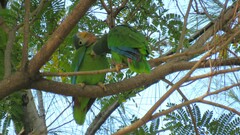
The yellow-billed amazon (Amazona collaria), also called the yellow-billed parrot or Jamaican amazon, is a species of parrot in the family Psittacidae. It is a predominantly green parrot with a short tail and pink throat and neck. It is endemic to Jamaica, where its natural habitats are subtropical or tropical moist lowland forests, subtropical or tropical mangrove forests, subtropical or tropical moist montane forests, plantations, and rural gardens. It is threatened by habitat loss and illegal trapping of wild birds for the pet trade.

The yellow-billed amazon was one of the many species originally described by Carl Linnaeus in his landmark 1758 10th edition of Systema Naturae. The yellow-billed was formally described in 1758 by the Swedish naturalist Carl Linnaeus in the tenth edition of his Systema Naturae. He placed it with all the other parrots in the genus Psittacus and coined the binomial name Psittacus collarius. Linnaeus based his description on an account by the Irish naturalist and collector Hans Sloane that was published in 1725 in his The Natural History of Jamaica. Sloan reported that the parrots "are eaten bak'd in pyes and taste as pigeons." Linnaeus mistaken... Wikipedia →

Sounds

Call0:36

Jamaica · 2023

© Bobby Wilcox · XC795528 · CC BY-NC-SA 4.0

Call0:11

Jamaica · 2016

© Ross Gallardy · XC308444 · CC BY-NC-SA 4.0

Global Distribution

Parks Where Found

# Park Country Daily sighting probability
1 Blue and John Crow Mountains National Park 🇯🇲 Jamaica
~40%

More parks will be added in future updates.

Zoos & Centres Where Found

# Zoo / Centre Country
1 Loro Parque 🇪🇸 Spain In captivity

Before you go

What are the chances of seeing a Yellow-billed Parrot in Blue and John Crow Mountains National Park?

Likely

About 40% of wildlife watchers report a Yellow-billed Parrot sighting in Blue and John Crow Mountains National Park on a given day, based on 503 verified sightings from GBIF citizen-science data from 2019 to 2026. It is the 31st most-seen of the 91 birds we can rate there. Over three days the chance rises to about 80%, and over a week to over 90%, if each day is a fresh chance.

When is the best time to see a Yellow-billed Parrot in Blue and John Crow Mountains National Park?

February–March and November–December

In those months about 50% of wildlife watchers report a Yellow-billed Parrot in Blue and John Crow Mountains National Park on a given day, against about 30% in January, April–May, July and September, the lowest months. June has too few records to rate.

What time of day is best to see a Yellow-billed Parrot?

Between 4 and 7 am

Across all the parks we cover, that three-hour window holds the most Yellow-billed Parrot sightings with a recorded time, and about 6 in 10 of them come between 6 am and 6 pm: it is seen both by day and at night.

Where else can you see a Yellow-billed Parrot?

Only Blue and John Crow Mountains National Park, in our data

Blue and John Crow Mountains National Park is the only park on Wallace's Line with enough records to rate Yellow-billed Parrot sightings: about 40% of wildlife watchers there report one on a given day.

Where does the Yellow-billed Parrot sighting chance come from?

GBIF citizen-science records

It is estimated from how often the Yellow-billed Parrot is recorded against all the birds logged in Blue and John Crow Mountains National Park (503 verified sightings from 2019 to 2026), calibrated against known sighting rates. Figures are rounded to the nearest 10% because citizen-science data supports honest approximations, not decimals, and months with records from fewer than five people show "—". How it works.

← Back to Blue and John Crow Mountains National Park