Crested Quail-Dove

Crested Quail-Dove

Geotrygon versicolor

Silhouette: Sheatherius · PhyloPic

LCNTNear ThreatenedVUENCR Endemic
Daily sighting probability ~60% · Likely
at Blue and John Crow Mountains National Park

In 3 days >90%

658 Verified sightings at Blue and John Crow Mountains National Park From 2019 to 2026
658 In 1 park
March Best month
☀️ Diurnal When it's spotted

About the Crested Quail-Dove

The crested quail-dove (Geotrygon versicolor) is a species of bird in the family Columbidae. It is endemic to Jamaica. At one time the crested quail-dove was the sole member of genus Geotrygon. Most of what are now the other species in the genus were previously in genus Oreopeleia, which was merged into Geotrygon. The crested quail-dove is monotypic.

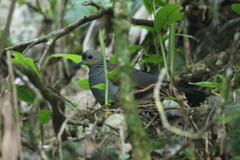
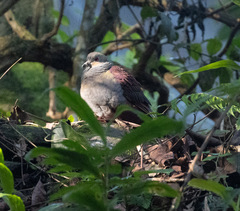
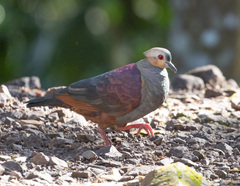
Male crested quail-doves are 27 to 31 cm (11 to 12 in) long; females are 27 to 30 cm (11 to 12 in). They weigh about 225 g (7.9 oz). Males have a black forehead and a drab brown crown. The nape is gray and has elongated feathers producing the eponymous crest. The back and sides of the neck are metallic bronze or bronze-green. The face is mostly gray with a broad reddish buff malar stripe. The gray continues to the belly; the belly and flanks are chestnut. The upper back and wing coverts are iridescent reddish purple, the mid-back bluish purple, and the lower back and tail greenish black with purple iridescence. The eye is red, surrounded by bare gray skin. Many females look the same as the male, but sometimes they are paler overall and browner on the neck and belly. Juveniles are duller than... Wikipedia →

Sounds

Song0:57

Jamaica · 2010

© Richard C. Hoyer · XC48120 · CC BY-NC-ND 2.5

Global Distribution

Parks Where Found

# Park Country Daily sighting probability
1 Blue and John Crow Mountains National Park 🇯🇲 Jamaica
~60%

More parks will be added in future updates.

Zoos & Centres Where Found

# Zoo / Centre Country
1 Walsrode World Bird Park 🇩🇪 Germany In captivity
2 Burgers' Ocean 🇳🇱 Netherlands In captivity
3 Tanganyika Wildlife Park 🇺🇸 United States In captivity
4 Bioparc Fuengirola 🇪🇸 Spain In captivity
5 Johor Zoo 🇲🇾 Malaysia In captivity
6 Aquarium Barcelona 🇪🇸 Spain In captivity
7 Kung Fu Corals 🇺🇸 United States In captivity

Before you go

What are the chances of seeing a Crested Quail-Dove in Blue and John Crow Mountains National Park?

Likely

About 60% of wildlife watchers report a Crested Quail-Dove sighting in Blue and John Crow Mountains National Park on a given day, based on 658 verified sightings from GBIF citizen-science data from 2019 to 2026. It is the 17th most-seen of the 91 birds we can rate there. Over three days the chance rises to over 90%, if each day is a fresh chance.

When is the best time to see a Crested Quail-Dove in Blue and John Crow Mountains National Park?

March

In that month about 80% of wildlife watchers report a Crested Quail-Dove in Blue and John Crow Mountains National Park on a given day, against about 40% in August and October, the lowest months. June has too few records to rate.

What time of day is best to see a Crested Quail-Dove?

Between 6 and 9 am

Across all the parks we cover, that three-hour window holds the most Crested Quail-Dove sightings with a recorded time, and about 9 in 10 of them come between 6 am and 6 pm: it is a daytime animal.

Where else can you see a Crested Quail-Dove?

Only Blue and John Crow Mountains National Park, in our data

Blue and John Crow Mountains National Park is the only park on Wallace's Line with enough records to rate Crested Quail-Dove sightings: about 60% of wildlife watchers there report one on a given day.

Where does the Crested Quail-Dove sighting chance come from?

GBIF citizen-science records

It is estimated from how often the Crested Quail-Dove is recorded against all the birds logged in Blue and John Crow Mountains National Park (658 verified sightings from 2019 to 2026), calibrated against known sighting rates. Figures are rounded to the nearest 10% because citizen-science data supports honest approximations, not decimals, and months with records from fewer than five people show "—". How it works.

← Back to Blue and John Crow Mountains National Park