Jamaican Blackbird

Jamaican Blackbird

Nesopsar nigerrimus

Silhouette: Sheatherius · PhyloPic

LCNTVUENEndangeredCR Endemic
Daily sighting probability ~30% · Possible
at Blue and John Crow Mountains National Park

In 3 days ~70% in a week ~90%

342 Verified sightings at Blue and John Crow Mountains National Park From 2019 to 2026
342 In 1 park
November Best month
☀️ Diurnal When it's spotted

About the Jamaican Blackbird

The Jamaican blackbird (Nesopsar nigerrimus) is a species of bird in the New World blackbird and oriole family Icteridae. It is the only species (monotypic) in the genus Nesopsar. The species has sometimes been included in the genus Agelaius, but molecular systematics have shown it not be closely related to any living New World blackbird or grackle. The species is endemic to Jamaica, where it is restricted to Cockpit Country, some central areas and the Blue and John Crow Mountains.

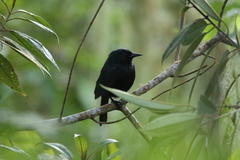
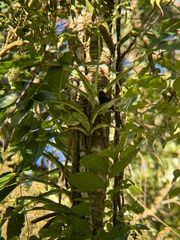
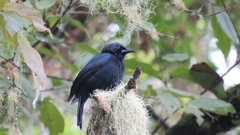
The Jamaican blackbird is a small icterid with all black plumage. It has a short tail that is often flayed. It is strictly arboreal and has a wheezing call. Pairs occupy large territories in a variety of wet montane forest types, including elfin and mist forests, that have substantial epiphytes and mosses on the trees. The Jamaican blackbird's habitats are confined to areas of above 575m and are rarely seen in lowland areas.

In the absence of specialised tree probers such as the woodcreepers, ovenbirds and woodpeckers (Jamaica does have a species of woodpecker, the Jamaican woodpecker, but it is a generalist that typically feeds away from tree trunks), which... Wikipedia →

Sounds

Song0:06

Jamaica · 2018

© George Wagner · XC438063 · CC BY-NC-SA 4.0

Call0:36

Jamaica · 2016

© Ross Gallardy · XC308443 · CC BY-NC-SA 4.0

Call0:29

Jamaica · 2025

© Brendan Sloan · XC1050365 · CC BY-NC-ND 4.0

Global Distribution

Parks Where Found

# Park Country Daily sighting probability
1 Blue and John Crow Mountains National Park 🇯🇲 Jamaica
~30%

More parks will be added in future updates.

Before you go

What are the chances of seeing a Jamaican Blackbird in Blue and John Crow Mountains National Park?

Possible

About 30% of wildlife watchers report a Jamaican Blackbird sighting in Blue and John Crow Mountains National Park on a given day, based on 342 verified sightings from GBIF citizen-science data from 2019 to 2026. It is the 41st most-seen of the 91 birds we can rate there. Over three days the chance rises to about 70%, and over a week to about 90%, if each day is a fresh chance.

When is the best time to see a Jamaican Blackbird in Blue and John Crow Mountains National Park?

November

In that month about 60% of wildlife watchers report a Jamaican Blackbird in Blue and John Crow Mountains National Park on a given day, against about 20% in January and September–October, the lowest months. June has too few records to rate.

What time of day is best to see a Jamaican Blackbird?

Between 7 and 10 am

Across all the parks we cover, that three-hour window holds the most Jamaican Blackbird sightings with a recorded time, and about 8 in 10 of them come between 6 am and 6 pm: it is a daytime animal.

Where else can you see a Jamaican Blackbird?

Only Blue and John Crow Mountains National Park, in our data

Blue and John Crow Mountains National Park is the only park on Wallace's Line with enough records to rate Jamaican Blackbird sightings: about 30% of wildlife watchers there report one on a given day.

Which relatives of the Jamaican Blackbird live in Blue and John Crow Mountains National Park?

Same family: Icteridae

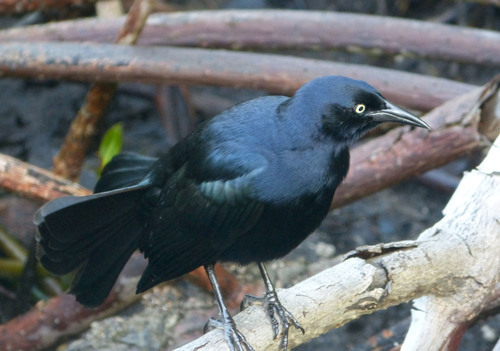
The closest relatives of the Jamaican Blackbird that you can see in Blue and John Crow Mountains National Park (family Icteridae, New World Blackbirds and Orioles) are Jamaican Oriole (about 80%), Greater Antillean Grackle (about 20%) and Shiny Cowbird (about 10%), with each one's daily chance of a sighting.

Where does the Jamaican Blackbird sighting chance come from?

GBIF citizen-science records

It is estimated from how often the Jamaican Blackbird is recorded against all the birds logged in Blue and John Crow Mountains National Park (342 verified sightings from 2019 to 2026), calibrated against known sighting rates. Figures are rounded to the nearest 10% because citizen-science data supports honest approximations, not decimals, and months with records from fewer than five people show "—". How it works.

← Back to Blue and John Crow Mountains National Park