Greater Antillean Grackle

Greater Antillean Grackle

Quiscalus niger

Silhouette: Ferran Sayol · PhyloPic

LCLeast ConcernNTVUENCR
Daily sighting probability ~20% · Possible
at Blue and John Crow Mountains National Park

In 3 days ~60% in a week ~90%

227 Verified sightings at Blue and John Crow Mountains National Park From 2019 to 2026
1,524 In all 4 parks
July Best month
☀️ Diurnal When it's spotted

About the Greater Antillean Grackle

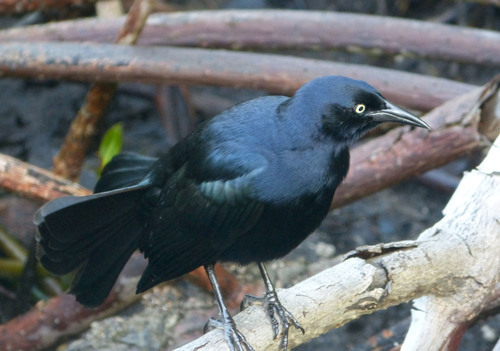
The Greater Antillean grackle (Quiscalus niger) is a species of bird in the family Icteridae, the oropendolas, New World orioles, and New World blackbirds. It is found in the Greater Antilles from Cuba to Puerto Rico and in the Cayman Islands southwest of Cuba.

The Irish physician, naturalist and collector Hans Sloane stayed in Jamaica between 1687 and 1689. During his visit, he collected specimens and made notes on the plants and animals. Based on these notes, the ornithologist John Ray published a short description of the Greater Antillean grackle in 1713, using the Latin name Monedula tota nigra but it was not until 1725, more than 35 years after his visit, that Sloane himself published a description of the grackle. He reported that it was common on the road between St. Jago de la Vega (Spanish Town) and Passage-Fort (Portmore).

In 1775 the French polymath Georges-Louis Leclerc, Comte de Buffon described the Greater Antillean grackle in his Histoire Naturelle des Oiseaux. The bird was also illustrated in a hand-colored plate engraved by François-Nicolas Martinet in the Planches Enluminées D'Histoire Naturelle which was produced under the supervision... Wikipedia →
Sounds

Call0:45

Cuba · 2025

© FREDERIC Lionel · XC999847 · CC BY-NC-SA 4.0

Flight call0:04

Jamaica · 2016

© Ross Gallardy · XC308445 · CC BY-NC-SA 4.0

Song1:09

Cuba · 2015

© Hans Matheve · XC256816 · CC BY-NC-ND 4.0

Global Distribution

Parks Where Found

# Park Country Daily sighting probability
1 Ciénaga de Zapata 🇨🇺 Cuba
~50%
2 Los Haitises National Park 🇩🇴 Dominican Republic
~40%
3 Blue and John Crow Mountains National Park 🇯🇲 Jamaica
~20%
4 Jaragua National Park 🇩🇴 Dominican Republic
~10%

Cities Where Found

# City Country Daily sighting probability
1 Santo Domingo 🇩🇴 Dominican Republic
~70%
2 Havana 🇨🇺 Cuba
~50%

Zoos & Centres Where Found

# Zoo / Centre Country
1 Animal - Bird Collection 🇬🇷 Greece In captivity

Before you go

What are the chances of seeing a Greater Antillean Grackle in Blue and John Crow Mountains National Park?

Possible

About 20% of wildlife watchers report a Greater Antillean Grackle sighting in Blue and John Crow Mountains National Park on a given day, based on 227 verified sightings from GBIF citizen-science data from 2019 to 2026. It is the 48th most-seen of the 91 birds we can rate there. Over three days the chance rises to about 60%, and over a week to about 90%, if each day is a fresh chance.

When is the best time to see a Greater Antillean Grackle in Blue and John Crow Mountains National Park?

March and July

In those months about 40% of wildlife watchers report a Greater Antillean Grackle in Blue and John Crow Mountains National Park on a given day, against about 10% in November, the lowest month. June has too few records to rate.

What time of day is best to see a Greater Antillean Grackle?

Between 3 and 6 pm

Across all the parks we cover, that three-hour window holds the most Greater Antillean Grackle sightings with a recorded time, and about 9 in 10 of them come between 6 am and 6 pm: it is a daytime animal.

Is Blue and John Crow Mountains National Park the best place to see a Greater Antillean Grackle?

3rd of 4

Of the 4 parks where we can rate Greater Antillean Grackle sightings, Blue and John Crow Mountains National Park ranks 3rd at about 20%. The best odds are in Ciénaga de Zapata (Cuba, about 50%) and Los Haitises National Park (Dominican Republic, about 40%).

Which relatives of the Greater Antillean Grackle live in Blue and John Crow Mountains National Park?

Same family: Icteridae

The closest relatives of the Greater Antillean Grackle that you can see in Blue and John Crow Mountains National Park (family Icteridae, New World Blackbirds and Orioles) are Jamaican Oriole (about 80%), Jamaican Blackbird (about 30%) and Shiny Cowbird (about 10%), with each one's daily chance of a sighting.

Where does the Greater Antillean Grackle sighting chance come from?

GBIF citizen-science records

It is estimated from how often the Greater Antillean Grackle is recorded against all the birds logged in Blue and John Crow Mountains National Park (227 verified sightings from 2019 to 2026), calibrated against known sighting rates. Figures are rounded to the nearest 10% because citizen-science data supports honest approximations, not decimals, and months with records from fewer than five people show "—". How it works.

← Back to Blue and John Crow Mountains National Park