Capuchinbird

Capuchinbird

Perissocephalus tricolor

Silhouette: Edwin Price · PhyloPic

LCLeast ConcernNTVUENCR
Daily sighting probability <5% · Rare
at Brownsberg Nature Park

In 3 days ~10% in a week ~20%

10 Verified sightings at Brownsberg Nature Park From 2019 to 2026
18 In all 2 parks
March Best month
☀️ Diurnal When it's spotted

About the Capuchinbird

The capuchinbird or calfbird (Perissocephalus tricolor) is a large passerine bird of the family Cotingidae. It is monotypic within the genus Perissocephalus. It is found in humid forests (up to 1,400 metres (4,600 ft) but mostly below 600 m) in north-eastern South America, almost entirely north of the Amazon River and east of Rio Negro (Colombia, Venezuela, Brazil and The Guianas).

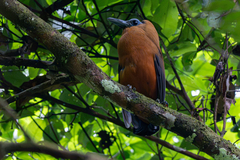
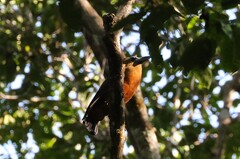
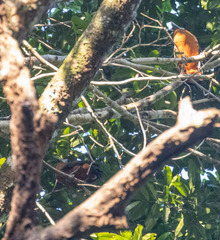
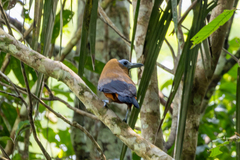
The capuchinbird is a large thick-set suboscine passerine with a relatively heavy bill. Adults weigh between 340 and 420 grams (12 and 15 oz) and are typically around 40 centimetres (16 in) long, making it the largest suboscine passerine, apart from the Amazonian and long-wattled umbrellabirds – indeed, females average larger than any female umbrellabird. Its plumage is overall rich brown, approaching orange on the belly and undertail coverts, and the remiges and short tail are black. The most distinctive feature is its bare, almost vulture-like head covered in dull blue skin. Juveniles resemble adults, with the exception of some downy feathers on the head.

They gather in leks where they "sing". The "song" is very odd and difficult to describe accurately, although some have... Wikipedia →

Sounds

Call0:34

French Guiana · 2024

© Tristan Guillebot de Nerville · XC1162538 · CC BY-NC-SA 4.0

Song0:38

Brazil · 2020

© Felipe Arantes · XC600460 · CC BY-NC-SA 4.0

Lek0:31

French Guiana · 2009

© Alexandre Renaudier · XC44070 · CC BY-NC-ND 2.5

Global Distribution

Parks Where Found

# Park Country Daily sighting probability
1 Brownsberg Nature Park 🇸🇷 Suriname
<5%
2 Anavilhanas National Park 🇧🇷 Brazil
<5%

Zoos & Centres Where Found

# Zoo / Centre Country
1 San Diego Zoo 🇺🇸 United States In captivity
2 Zlín-Lešná Zoo 🇨🇿 Czechia In captivity
3 Walsrode World Bird Park 🇩🇪 Germany In captivity
4 Parc des oiseaux 🇫🇷 France In captivity
5 Bird Paradise 🇸🇬 Singapore In captivity
6 Rainforest Wild Asia 🇸🇬 Singapore In captivity
7 National Aviary 🇺🇸 United States In captivity
8 Dallas World Aquarium 🇺🇸 United States In captivity

Before you go

What are the chances of seeing a Capuchinbird in Brownsberg Nature Park?

Rare

Under 5% of wildlife watchers report a Capuchinbird sighting in Brownsberg Nature Park on a given day, based on 10 verified sightings from GBIF citizen-science data from 2019 to 2026. It is the 182nd most-seen of the 221 birds we can rate there. Over three days the chance rises to about 10%, and over a week to about 20%, if each day is a fresh chance.

When is the best time to see a Capuchinbird in Brownsberg Nature Park?

January to March

In those months about 10% of wildlife watchers report a Capuchinbird in Brownsberg Nature Park on a given day, against under 5% in April and August–December, the lowest months. May to July have too few records to rate.

What time of day is best to see a Capuchinbird?

Between 7 and 10 am

Across all the parks we cover, that three-hour window holds the most Capuchinbird sightings with a recorded time, and about 9 in 10 of them come between 6 am and 6 pm: it is a daytime animal.

Is Brownsberg Nature Park the best place to see a Capuchinbird?

Yes

Of the 2 parks where we can rate Capuchinbird sightings, Brownsberg Nature Park has the highest daily chance: under 5%. Next come Anavilhanas National Park (Brazil, under 5%).

Which relatives of the Capuchinbird live in Brownsberg Nature Park?

Same family: Cotingidae

The closest relatives of the Capuchinbird that you can see in Brownsberg Nature Park (family Cotingidae, Cotingas) are Screaming Piha (about 50%), Wing-barred Piprites (about 30%) and Russet-winged Schiffornis (about 20%), with each one's daily chance of a sighting.

Where does the Capuchinbird sighting chance come from?

GBIF citizen-science records

It is estimated from how often the Capuchinbird is recorded against all the birds logged in Brownsberg Nature Park (10 verified sightings from 2019 to 2026), calibrated against known sighting rates. Figures are rounded to the nearest 10% because citizen-science data supports honest approximations, not decimals, and months with records from fewer than five people show "—". How it works.

← Back to Brownsberg Nature Park