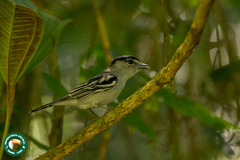
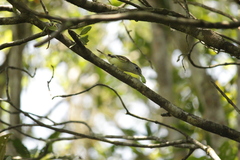
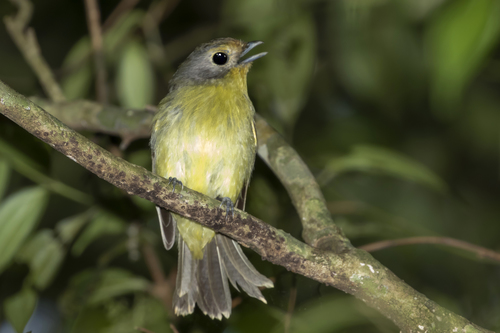
Black-capped Becard

Black-capped Becard

Pachyramphus marginatus

Silhouette: Sheatherius · PhyloPic

LCLeast ConcernNTVUENCR
Daily sighting probability <5% · Rare
at Brownsberg Nature Park

In 3 days ~10%

6 Verified sightings at Brownsberg Nature Park From 2019 to 2026
377 In all 7 parks
January Best month
☀️ Diurnal When it's spotted

About the Black-capped Becard

The black-capped becard (Pachyramphus marginatus) is a species of bird in the family Tityridae, the tityras, becards, and allies. It is found in Bolivia, Brazil, Colombia, Ecuador, French Guiana, Guyana, Peru, Suriname, and Venezuela.

The black-capped becard was originally described in 1823 as Todus marginatus, mistakenly placing it among the todies. It was eventually placed in its present genus Pachyramphus. That genus has variously been assigned to the tyrant flycatcher family Tyrannidae and the cotinga family Cotingidae. Several early twenty-first century studies confirmed the placement of Pachyramphus in Tityridae and taxonomic systems made the reassignment.

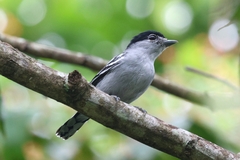
The black-capped becard is 13 to 14 cm (5.1 to 5.5 in) long and weighs about 18 g (0.63 oz). Adult males of the nominate subspecies have a glossy black crown that has a blue sheen and a scaly appearance. They have a pale spot above the lores and a thin whitish eye-ring on an otherwise light gray face. The gray of their face wraps around their... Wikipedia →

Sounds

Call0:09

Brazil · 2026

© JAYRSON ARAUJO DE OLIVEIRA · XC1150845 · CC BY-NC-SA 4.0

Recording1:22

Brazil · 2015

© Jerome Fischer · XC283752 · CC BY-NC-SA 4.0

Song1:04

Brazil · 2004

© Jeremy Minns · XC282680 · CC BY-NC-SA 4.0

Global Distribution

Parks Where Found

# Park Country Daily sighting probability
1 Serra dos Órgãos National Park 🇧🇷 Brazil
~20%
2 Amacayacu National Natural Park 🇨🇴 Colombia
~10%
3 Tambopata National Reserve 🇵🇪 Peru
<5%
4 Brownsberg Nature Park 🇸🇷 Suriname
<5%
5 Yasuní National Park 🇪🇨 Ecuador
<5%
6 Anavilhanas National Park 🇧🇷 Brazil
<5%
7 Manu National Park 🇵🇪 Peru
<5%

Before you go

What are the chances of seeing a Black-capped Becard in Brownsberg Nature Park?

Rare

Under 5% of wildlife watchers report a Black-capped Becard sighting in Brownsberg Nature Park on a given day, based on 6 verified sightings from GBIF citizen-science data from 2019 to 2026. It is the 205th most-seen of the 221 birds we can rate there. Over three days the chance rises to about 10%, if each day is a fresh chance.

When is the best time to see a Black-capped Becard in Brownsberg Nature Park?

January

In that month about 10% of wildlife watchers report a Black-capped Becard in Brownsberg Nature Park on a given day, against under 5% in February–April and August–December, the lowest months. May to July have too few records to rate.

What time of day is best to see a Black-capped Becard?

Between 9 am and noon

Across all the parks we cover, that three-hour window holds the most Black-capped Becard sightings with a recorded time, and about 8 in 10 of them come between 6 am and 6 pm: it is a daytime animal.

Where does the Black-capped Becard sighting chance come from?

GBIF citizen-science records

It is estimated from how often the Black-capped Becard is recorded against all the birds logged in Brownsberg Nature Park (6 verified sightings from 2019 to 2026), calibrated against known sighting rates. Figures are rounded to the nearest 10% because citizen-science data supports honest approximations, not decimals, and months with records from fewer than five people show "—". How it works.

← Back to Brownsberg Nature Park