Chapman's Swift

Chapman's Swift

Chaetura chapmani

Silhouette: Aviceda (vectorized by T. Michael Keesey) · PhyloPic

LCLeast ConcernNTVUENCR
Daily sighting probability ~10% · With luck
at Brownsberg Nature Park

In 3 days ~30% in a week ~50%

25 Verified sightings at Brownsberg Nature Park From 2019 to 2026
60 In all 3 parks
April Best month
🌅 Crepuscular When it's spotted

About the Chapman's Swift

Chapman's swift (Chaetura chapmani) is a species of bird in subfamily Apodinae of the swift family Apodidae. It is found in Bolivia, Brazil, Colombia, French Guiana, Guyana, Panama, Peru, Suriname, Trinidad, Venezuela, and possibly Ecuador.

For a time in the late 20th century viridipennis was treated as a separate species, the "Amazonian" or "Mato Grosso" swift but taxonomic systems soon returned to the previous two-subspecies model. Long ago, Chapman's swift, chimney swift (C. pelagica), and Vaux's swift (C. vauxi) were treated as a single species.

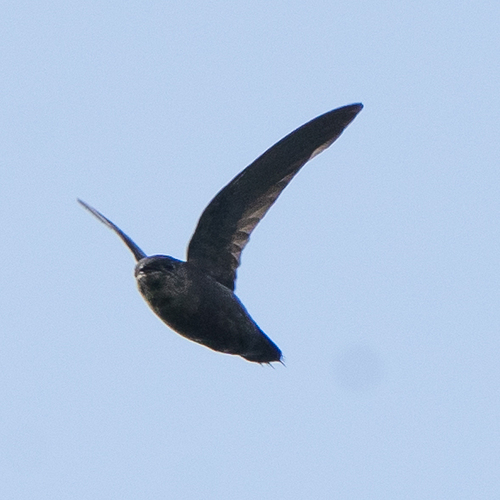
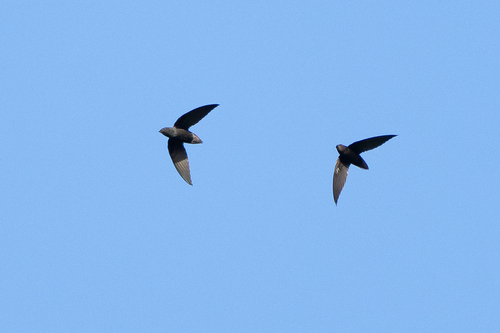
The species' English name and specific epithet honor "that famous student of Neotropical birds, Frank M. Chapman". Chapman's swift is 13 to 14 cm (5.1 to 5.5 in) long and weighs 20.75 to 28 g (0.73 to 0.99 oz). It has a protruding head, a short square tail, and wings that bulge in the middle and somewhat hook at the end. The sexes are alike. The nominate subspecies has glossy black upperparts with a dark gray rump and uppertail coverts. Its underparts are entirely dark brown. Wikipedia →


Sounds

Call0:28

Brazil · 2025

© JAYRSON ARAUJO DE OLIVEIRA · XC1035791 · CC BY-NC-SA 4.0

Song0:31

Bolivia · 2021

© Jacob Wijpkema · XC676077 · CC BY-NC-SA 4.0

Flight call0:05

French Guiana · 2010

© Alexandre Renaudier · XC64026 · CC BY-NC-ND 2.5

Global Distribution

Parks Where Found

# Park Country Daily sighting probability
1 Brownsberg Nature Park 🇸🇷 Suriname
~10%
2 Anavilhanas National Park 🇧🇷 Brazil
~10%
3 Manu National Park 🇵🇪 Peru
<5%

Before you go

What are the chances of seeing a Chapman's Swift in Brownsberg Nature Park?

With luck

About 10% of wildlife watchers report a Chapman's Swift sighting in Brownsberg Nature Park on a given day, based on 25 verified sightings from GBIF citizen-science data from 2019 to 2026. It is the 129th most-seen of the 221 birds we can rate there. Over three days the chance rises to about 30%, and over a week to about 50%, if each day is a fresh chance.

When is the best time to see a Chapman's Swift in Brownsberg Nature Park?

April

In that month about 20% of wildlife watchers report a Chapman's Swift in Brownsberg Nature Park on a given day, against under 5% in August and November, the lowest months. That is one of Brownsberg Nature Park's wettest months, with about 300 mm of rain against 55 mm in October. May to July have too few records to rate.

What time of day is best to see a Chapman's Swift?

Between 4 and 7 pm

Across all the parks we cover, that three-hour window holds the most Chapman's Swift sightings with a recorded time, and about 6 in 10 of them come between 6 am and 6 pm: it is most active around dawn and dusk.

Is Brownsberg Nature Park the best place to see a Chapman's Swift?

Yes

Of the 3 parks where we can rate Chapman's Swift sightings, Brownsberg Nature Park has the highest daily chance: about 10%. Next come Anavilhanas National Park (Brazil, about 10%) and Manu National Park (Peru, under 5%).

Which relatives of the Chapman's Swift live in Brownsberg Nature Park?

Same genus: Chaetura

The closest relatives of the Chapman's Swift that you can see in Brownsberg Nature Park (genus Chaetura, Chaetura Swifts) are Band-rumped Swift (about 40%) and Short-tailed Swift (about 10%), with each one's daily chance of a sighting.

Where does the Chapman's Swift sighting chance come from?

GBIF citizen-science records

It is estimated from how often the Chapman's Swift is recorded against all the birds logged in Brownsberg Nature Park (25 verified sightings from 2019 to 2026), calibrated against known sighting rates. Figures are rounded to the nearest 10% because citizen-science data supports honest approximations, not decimals, and months with records from fewer than five people show "—". How it works.

← Back to Brownsberg Nature Park