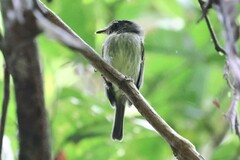
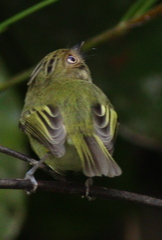
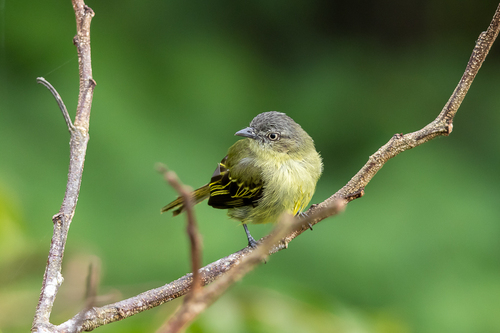
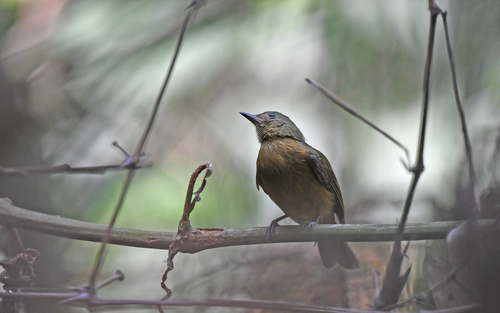
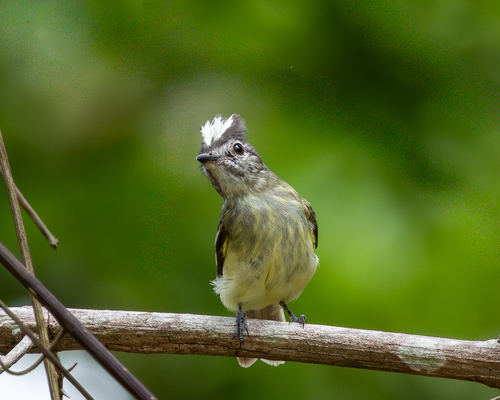
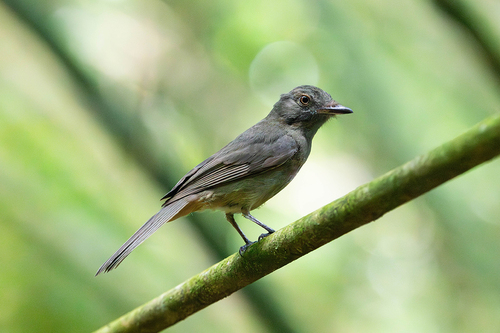
Double-banded Pygmy-Tyrant

Double-banded Pygmy-Tyrant

Lophotriccus vitiosus

Silhouette: Emily Willoughby · PhyloPic

LCLeast ConcernNTVUENCR
Daily sighting probability <5% · Rare
at Brownsberg Nature Park

In 3 days ~10%

6 Verified sightings at Brownsberg Nature Park From 2019 to 2026
524 In all 5 parks
April Best month
☀️ Diurnal When it's spotted

About the Double-banded Pygmy-Tyrant

The double-banded pygmy tyrant (Lophotriccus vitiosus) is a species of bird in the family Tyrannidae, the tyrant flycatchers. It is found in Brazil, Colombia, Ecuador, French Guiana, Guyana, Peru, and Suriname. The double-banded pygmy tyrant was originally described in 1921 as Cometornis vitiosus. The authors erected genus Cometornis for it and some other newly described species and subspecies. They soon recognized that by the principle of priority Cometornis had to be replaced by Lophotriccus.

The double-banded pygmy tyrant has these four subspecies: Subspecies L. v. congener was originally described as a full species and was treated that way by some authors until the mid-twentieth century. In addition, several authors have suggested that genus Lophotriccus should be merged into genus Hemitriccus.

The double-banded pygmy tyrant is about 10 cm (3.9 in) long and weighs 6 to 8.5 g (0.21 to 0.30 oz). It has long crown feathers that form a crest and that it occasionally erects and fans; the feathers extend... Wikipedia →
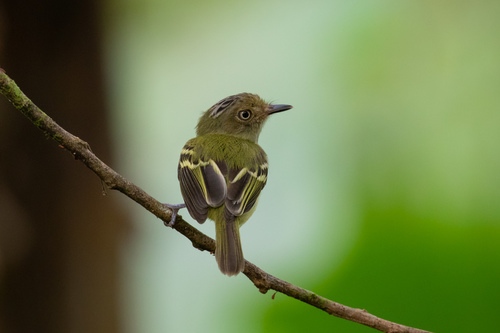
Sounds

Song0:28

Brazil · 2026

© JAYRSON ARAUJO DE OLIVEIRA · XC1183861 · CC BY-NC-SA 4.0

Call0:11

Ecuador · 2026

© Daan van der Hoeven · XC1165276 · CC BY-NC-SA 4.0

Song0:21

Ecuador · 2026

© Manuel Sánchez-Nivicela · XC1182300 · CC BY-NC-ND 4.0

Global Distribution

Parks Where Found

# Park Country Daily sighting probability
1 Amacayacu National Natural Park 🇨🇴 Colombia
~20%
2 Yasuní National Park 🇪🇨 Ecuador
~10%
3 Cuyabeno Wildlife Reserve 🇪🇨 Ecuador
<5%
4 Brownsberg Nature Park 🇸🇷 Suriname
<5%
5 Sierra de la Macarena National Park 🇨🇴 Colombia
<5%

Before you go

What are the chances of seeing a Double-banded Pygmy-Tyrant in Brownsberg Nature Park?

Rare

Under 5% of wildlife watchers report a Double-banded Pygmy-Tyrant sighting in Brownsberg Nature Park on a given day, based on 6 verified sightings from GBIF citizen-science data from 2019 to 2026. It is the 205th most-seen of the 221 birds we can rate there. Over three days the chance rises to about 10%, if each day is a fresh chance.

When is the best time to see a Double-banded Pygmy-Tyrant in Brownsberg Nature Park?

April

In that month about 10% of wildlife watchers report a Double-banded Pygmy-Tyrant in Brownsberg Nature Park on a given day, against under 5% in August to March, the lowest months. That is one of Brownsberg Nature Park's wettest months, with about 300 mm of rain against 55 mm in October. May to July have too few records to rate.

What time of day is best to see a Double-banded Pygmy-Tyrant?

Between 8 and 11 am

Across all the parks we cover, that three-hour window holds the most Double-banded Pygmy-Tyrant sightings with a recorded time, and about 9 in 10 of them come between 6 am and 6 pm: it is a daytime animal.

Where does the Double-banded Pygmy-Tyrant sighting chance come from?

GBIF citizen-science records

It is estimated from how often the Double-banded Pygmy-Tyrant is recorded against all the birds logged in Brownsberg Nature Park (6 verified sightings from 2019 to 2026), calibrated against known sighting rates. Figures are rounded to the nearest 10% because citizen-science data supports honest approximations, not decimals, and months with records from fewer than five people show "—". How it works.

← Back to Brownsberg Nature Park