
Emerald Tree Boa

Emerald Tree Boa

Corallus caninus

Silhouette: T. Michael Keesey (from a photo by Maximilian Paradiz) · PhyloPic

LCLeast ConcernNTVUENCR
Daily sighting probability ~30% · Possible
at Brownsberg Nature Park

In 3 days ~70% in a week ~90%

6 Verified sightings at Brownsberg Nature Park From 2019 to 2026
6 In 1 park
May Best month
☀️🌙 Day & Night When it's spotted

About the Emerald Tree Boa

The emerald tree boa (Corallus caninus) is a boa species found in the rainforests of South America. Since 2009, the species Corallus batesii has been distinguished from the emerald tree boa. Like all other boas, it is nonvenomous. Trade of the species is controlled internationally under CITES Appendix II.

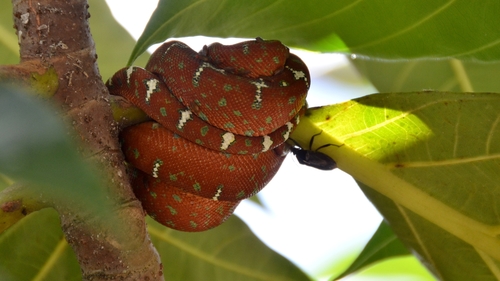
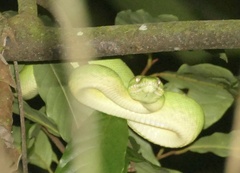
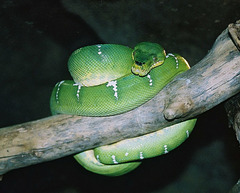
Adults grow to about 6 feet (1.8 m) in length. They have highly developed front teeth that are likely proportionately larger than those of any other non-venomous snake. The color pattern typically consists of an emerald green ground color with a white irregular interrupted zigzag stripe or so-called 'lightning bolts' down the back and a yellow belly. The bright coloration and markings are very distinctive among South American snakes. Juveniles vary in color between various shades of light and dark orange or brick-red before ontogenetic coloration sets in and the animals turn emerald green (after 9–12 months of age). This also occurs in green tree python (Morelia viridis), a python species in which hatchlings and juveniles may also be canary yellow or brick-red. As opposed to popular belief, yellow juveniles (as in the green tree python) do not occur in the emerald... Wikipedia →

Global Distribution

Parks Where Found

# Park Country Daily sighting probability
1 Brownsberg Nature Park 🇸🇷 Suriname
~30%

More parks will be added in future updates.

Zoos & Centres Where Found

# Zoo / Centre Country
1 San Diego Zoo 🇺🇸 United States In captivity
2 National Zoological Park 🇺🇸 United States In captivity
3 Shedd Aquarium 🇺🇸 United States In captivity
4 ZooParc de Beauval 🇫🇷 France In captivity
5 Skansen 🇸🇪 Sweden In captivity
6 Cleveland Metroparks Zoo 🇺🇸 United States In captivity
7 Cincinnati Zoo and Botanical Garden 🇺🇸 United States In captivity
8 Paris Zoological Park 🇫🇷 France In captivity
9 Greensboro Science Center 🇺🇸 United States In captivity
10 Zoo Miami 🇺🇸 United States In captivity
11 Toronto Zoo 🇨🇦 Canada In captivity
12 Bronx Zoo 🇺🇸 United States In captivity
13 Parc zoologique de Montpellier 🇫🇷 France In captivity
14 Omaha’s Henry Doorly Zoo and Aquarium 🇺🇸 United States In captivity
15 Chester Zoo 🇬🇧 United Kingdom In captivity
16 Lake Tobias Wildlife Park 🇺🇸 United States In captivity
17 Banham Zoo 🇬🇧 United Kingdom In captivity
18 Toledo Zoo 🇺🇸 United States In captivity
19 Detroit Zoo 🇺🇸 United States In captivity
20 Cape May County Park & Zoo 🇺🇸 United States In captivity
21 São Paulo Zoo 🇧🇷 Brazil In captivity
22 Central Florida Zoo and Botanical Gardens 🇺🇸 United States In captivity
23 Birmingham Zoo 🇺🇸 United States In captivity
24 Africam Safari 🇲🇽 Mexico In captivity
25 Louisville Zoo 🇺🇸 United States In captivity
26 Nanning Zoo 🇨🇳 China In captivity
27 Oklahoma City Zoo and Botanical Garden 🇺🇸 United States In captivity
28 Saint Louis Zoo 🇺🇸 United States In captivity
29 Terra Natura Benidorm 🇪🇸 Spain In captivity
30 Woodland Park Zoo 🇺🇸 United States In captivity
31 San Francisco Zoo 🇺🇸 United States In captivity
32 Moody Gardens 🇺🇸 United States In captivity
33 Brevard Zoo 🇺🇸 United States In captivity
34 Franklin Park Zoo 🇺🇸 United States In captivity
35 Night Safari 🇸🇬 Singapore In captivity
36 Memphis Zoo 🇺🇸 United States In captivity
37 Zoológico Benito Juárez 🇲🇽 Mexico In captivity
38 Singapore Zoo 🇸🇬 Singapore In captivity
39 Virginia Zoological Park 🇺🇸 United States In captivity
40 Wilhelma 🇩🇪 Germany In captivity
41 Houston Zoo 🇺🇸 United States In captivity
42 Melbourne Zoo 🇦🇺 Australia In captivity
43 ABQ BioPark Zoo 🇺🇸 United States In captivity
44 Simba Safari 🇧🇷 Brazil In captivity
45 Cameron Park Zoo 🇺🇸 United States In captivity
46 Philadelphia Zoo 🇺🇸 United States In captivity
47 Potter Park Zoo 🇺🇸 United States In captivity
48 Mesker Park Zoo and Botanic Garden 🇺🇸 United States In captivity
49 Chapultepec Zoo 🇲🇽 Mexico In captivity
50 Zoo Atlanta 🇺🇸 United States In captivity

Closest Relatives at Brownsberg Nature Park

No species of the same family or order lives in Brownsberg Nature Park, so these are its closest relatives here: other reptiles.

Before you go

What are the chances of seeing an Emerald Tree Boa in Brownsberg Nature Park?

Possible

About 30% of wildlife watchers report an Emerald Tree Boa sighting in Brownsberg Nature Park on a given day, based on 6 verified sightings from GBIF citizen-science data from 2019 to 2026. It is the 15th most-seen of the 22 reptiles we can rate there. Over three days the chance rises to about 70%, and over a week to about 90%, if each day is a fresh chance.

When is the best time to see an Emerald Tree Boa in Brownsberg Nature Park?

May

In that month about 60% of wildlife watchers report an Emerald Tree Boa in Brownsberg Nature Park on a given day, against under 5% in January and March, the lowest months. That is one of Brownsberg Nature Park's wettest months, with about 490 mm of rain against 55 mm in October. June and August–September have too few records to rate.

What time of day is best to see an Emerald Tree Boa?

Between 10 pm and 1 am

Across all the parks we cover, that three-hour window holds the most Emerald Tree Boa sightings with a recorded time, and about 6 in 10 of them come between 6 pm and 6 am: it is seen both by day and at night.

Where else can you see an Emerald Tree Boa?

Only Brownsberg Nature Park, in our data

Brownsberg Nature Park is the only park on Wallace's Line with enough records to rate Emerald Tree Boa sightings: about 30% of wildlife watchers there report one on a given day.

Where does the Emerald Tree Boa sighting chance come from?

GBIF citizen-science records

It is estimated from how often the Emerald Tree Boa is recorded against all the reptiles logged in Brownsberg Nature Park (6 verified sightings from 2019 to 2026), calibrated against known sighting rates. Figures are rounded to the nearest 10% because citizen-science data supports honest approximations, not decimals, and months with records from fewer than five people show "—". How it works.

← Back to Brownsberg Nature Park