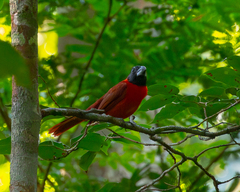
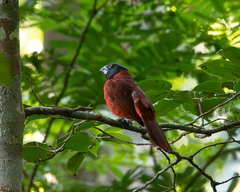
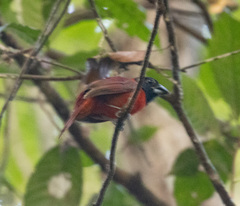
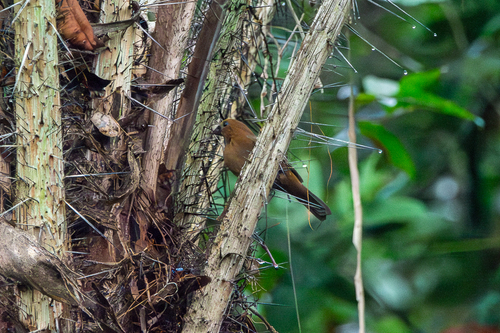
Red-and-black Grosbeak

Red-and-black Grosbeak

Periporphyrus erythromelas

Silhouette: Sheatherius · PhyloPic

Daily sighting probability ~10% · With luck
at Brownsberg Nature Park

In 3 days ~20% in a week ~40%

20 Verified sightings at Brownsberg Nature Park From 2019 to 2026
20 In 1 park
February Best month
☀️ Diurnal When it's spotted

About the Red-and-black Grosbeak

The red-and-black grosbeak (Periporphyrus erythromelas) is a species of bird in the family Cardinalidae, the cardinals, grosbeaks, and “tanager” allies. It is found in Brazil, French Guiana, Guyana, Suriname, and Venezuela.

The red-and-black grosbeak was formally described in 1789 by the German naturalist Johann Friedrich Gmelin in his revised and expanded edition of Carl Linnaeus's Systema Naturae. He placed it in the genus Loxia and coined the binomial Loxia erythromelas. The specific epithet is from Ancient Greek and means "blackish-red" or "red and

black"; eruthros means "red" and melas means "black". Gmelin based his description on the "black-headed grosbeak" that had been described and illustrated in 1783 by the English ornithologist John Latham in his book A General Synopsis of Birds. Latham had examined specimens from Cayenne at the Leverian Museum in London.

The red-and-black grosbeak's further taxonomy is unsettled. By 2026 most taxonomic systems had placed it in genus Periporphyrus with the crimson-collared grosbeak (P. celaeno). However, BirdLife International's Handbook of the Birds of the World (HBW) places it in genus Caryothraustes.

The... Wikipedia →

Sounds

Song0:53

Brazil · 2026

© Pritam Baruah · XC1151346 · CC BY-NC-SA 4.0

Call0:43

Brazil · 2024

© Flávio Kulaif Ubaid · XC943576 · CC BY-NC-SA 4.0

Song0:11

Guyana · 2015

© Fabrice Schmitt · XC612247 · CC BY-NC-SA 4.0

Global Distribution

Parks Where Found

# Park Country Daily sighting probability
1 Brownsberg Nature Park 🇸🇷 Suriname
~10%

More parks will be added in future updates.

Before you go

What are the chances of seeing a Red-and-black Grosbeak in Brownsberg Nature Park?

With luck

About 10% of wildlife watchers report a Red-and-black Grosbeak sighting in Brownsberg Nature Park on a given day, based on 20 verified sightings from GBIF citizen-science data from 2019 to 2026. It is the 139th most-seen of the 221 birds we can rate there. Over three days the chance rises to about 20%, and over a week to about 40%, if each day is a fresh chance.

When is the best time to see a Red-and-black Grosbeak in Brownsberg Nature Park?

January–April, September and November

In those months about 10% of wildlife watchers report a Red-and-black Grosbeak in Brownsberg Nature Park on a given day, against under 5% in August, October and December, the lowest months. May to July have too few records to rate.

What time of day is best to see a Red-and-black Grosbeak?

Between 7 and 10 am

Across all the parks we cover, that three-hour window holds the most Red-and-black Grosbeak sightings with a recorded time, and about 8 in 10 of them come between 6 am and 6 pm: it is a daytime animal.

Where else can you see a Red-and-black Grosbeak?

Only Brownsberg Nature Park, in our data

Brownsberg Nature Park is the only park on Wallace's Line with enough records to rate Red-and-black Grosbeak sightings: about 10% of wildlife watchers there report one on a given day.

Where does the Red-and-black Grosbeak sighting chance come from?

GBIF citizen-science records

It is estimated from how often the Red-and-black Grosbeak is recorded against all the birds logged in Brownsberg Nature Park (20 verified sightings from 2019 to 2026), calibrated against known sighting rates. Figures are rounded to the nearest 10% because citizen-science data supports honest approximations, not decimals, and months with records from fewer than five people show "—". How it works.

← Back to Brownsberg Nature Park