
Amazonian Grosbeak

Amazonian Grosbeak

Cyanoloxia rothschildii

Silhouette: Sheatherius · PhyloPic

LCLeast ConcernNTVUENCR
Daily sighting probability ~10% · With luck
at Brownsberg Nature Park

In 3 days ~30% in a week ~50%

26 Verified sightings at Brownsberg Nature Park From 2019 to 2026
583 In all 6 parks
December Best month
☀️ Diurnal When it's spotted

About the Amazonian Grosbeak

The Amazonian grosbeak or Rothschild's grosbeak (Cyanoloxia rothschildii) is a species of grosbeak in the family Cardinalidae, the cardinals or cardinal grosbeaks. It is found in much of the Amazon Basin, in Bolivia, Brazil, Colombia, French Guiana, Guyana, Peru, Suriname, and Venezuela.

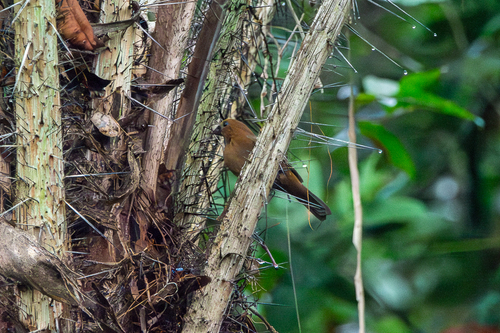
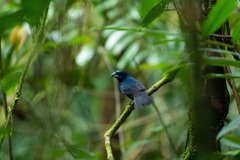
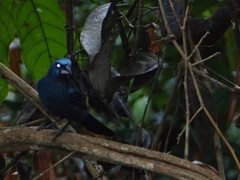
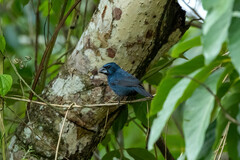
The Amazonian grosbeak is monotypic. It was formerly considered a subspecies of blue-black grosbeak (Cyanoloxia cyanoides) and following 2014 and 2016 publications it was elevated to species status. The Amazonian grosbeak is 14.5 to 15 cm (5.7 to 5.9 in) long and weighs 21.5 to 31 g (0.76 to 1.09 oz). The adult male is mostly dark blue. Its forecrown and part of the wings are light blue and the underparts are blackish on the belly. It has a bit of black on the face. The female's upperparts are dark brown and the underparts a paler brown. Juveniles are similar to the female.

The Amazonian grosbeak is the most widely distributed grosbeak in the Amazon Basin. It is found from eastern Colombia south through eastern Ecuador and Peru to central Bolivia, from southern and eastern Venezuela east through the Guianas, and in all... Wikipedia →

Sounds

Call0:40

Ecuador · 2025

© Manuel Sánchez-Nivicela · XC1140512 · CC BY-NC-ND 4.0

Song1:27

Ecuador · 2025

© Marc Anderson · XC986386 · CC BY-NC-ND 4.0

Canto0:24

Brazil · 2019

© Caio Brito · XC556263 · CC BY-NC-SA 4.0

Global Distribution

Parks Where Found

# Park Country Daily sighting probability
1 Brownsberg Nature Park 🇸🇷 Suriname
~10%
2 Amacayacu National Natural Park 🇨🇴 Colombia
~10%
3 Manu National Park 🇵🇪 Peru
~10%
4 Tambopata National Reserve 🇵🇪 Peru
<5%
5 Yasuní National Park 🇪🇨 Ecuador
<5%
6 Podocarpus National Park 🇪🇨 Ecuador
<5%

Cities Where Found

# City Country Daily sighting probability
1 Belém 🇧🇷 Brazil
<5%

Before you go

What are the chances of seeing an Amazonian Grosbeak in Brownsberg Nature Park?

With luck

About 10% of wildlife watchers report an Amazonian Grosbeak sighting in Brownsberg Nature Park on a given day, based on 26 verified sightings from GBIF citizen-science data from 2019 to 2026. It is the 129th most-seen of the 221 birds we can rate there. Over three days the chance rises to about 30%, and over a week to about 50%, if each day is a fresh chance.

When is the best time to see an Amazonian Grosbeak in Brownsberg Nature Park?

December

In that month about 30% of wildlife watchers report an Amazonian Grosbeak in Brownsberg Nature Park on a given day, against under 5% in January, the lowest month. May to July have too few records to rate.

What time of day is best to see an Amazonian Grosbeak?

Between 7 and 10 am

Across all the parks we cover, that three-hour window holds the most Amazonian Grosbeak sightings with a recorded time, and about 8 in 10 of them come between 6 am and 6 pm: it is a daytime animal.

Is Brownsberg Nature Park the best place to see an Amazonian Grosbeak?

Yes

Of the 6 parks where we can rate Amazonian Grosbeak sightings, Brownsberg Nature Park has the highest daily chance: about 10%. Next come Amacayacu National Natural Park (Colombia, about 10%) and Manu National Park (Peru, about 10%).

Where does the Amazonian Grosbeak sighting chance come from?

GBIF citizen-science records

It is estimated from how often the Amazonian Grosbeak is recorded against all the birds logged in Brownsberg Nature Park (26 verified sightings from 2019 to 2026), calibrated against known sighting rates. Figures are rounded to the nearest 10% because citizen-science data supports honest approximations, not decimals, and months with records from fewer than five people show "—". How it works.

← Back to Brownsberg Nature Park