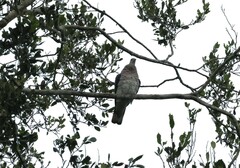
Afep Pigeon

Afep Pigeon

Columba unicincta

Silhouette: Steven Traver · PhyloPic

LCLeast ConcernNTVUENCR
Daily sighting probability <5% · Rare
at Bwindi Impenetrable National Park

In 3 days <5% in a week ~10%

15 Verified sightings at Bwindi Impenetrable National Park From 2019 to 2026
233 In all 5 parks
March Best month
☀️ Diurnal When it's spotted

About the Afep Pigeon

The afep pigeon (Columba unicincta), also known as the African woodpigeon or grey woodpigeon, is a member of the family Columbidae, native to the African tropical rainforest from Sierra Leone east to Uganda. The afep pigeon was described by the American ornithologist John Cassin in 1860 from a specimen collected in West Africa from the Ogooué River, Gabon. He coined the binomial name Columba unicincta. The specific epithet combines the Latin uni- "one-" and cinctus "banded". The English name "afep" is the word for a pigeon in the Bulu language of Cameroon. The species is monotypic.

Its genetic relationship to other species in the genus has not yet been tested; morphological traits suggest it belongs to the woodpigeon group comprising the common wood pigeon C. palumbus, Bolle's pigeon C. bollii, and Trocaz pigeon C. trocaz.

The afep pigeon is 35–36 cm (13.8–14.2 in) length and weighs between 356–490 g (12.6–17.3 oz). The sexes are similar. It has a pale grey hind neck, pinkish-grey body, and dark grey wings; the tail has a broad white bar and a blackish tip. The throat and belly are white. The eyes and orbital rings are red.

This pigeon has a loud call... Wikipedia →

Sounds

Song0:19

Gabon · 2024

© Paul Lenrumé · XC939880 · CC BY-NC-SA 4.0

Song0:15

Gabon · 2024

© Étienne Leroy · XC878466 · CC BY-NC-SA 4.0

Song0:15

Ghana · 2022

© Peter Boesman · XC719043 · CC BY-NC-ND 4.0

Global Distribution

Parks Where Found

# Park Country Daily sighting probability
1 Odzala-Kokoua National Park 🇨🇬 Republic of the Congo
~20%
2 Kibale National Park 🇺🇬 Uganda
~10%
3 Semuliki National Park 🇺🇬 Uganda
<5%
4 Bwindi Impenetrable National Park 🇺🇬 Uganda
<5%
5 Nyungwe National Park 🇷🇼 Rwanda
<5%

Before you go

What are the chances of seeing an Afep Pigeon in Bwindi Impenetrable National Park?

Rare

Under 5% of wildlife watchers report an Afep Pigeon sighting in Bwindi Impenetrable National Park on a given day, based on 15 verified sightings from GBIF citizen-science data from 2019 to 2026. It is the 302nd most-seen of the 400 birds we can rate there. Over three days the chance rises to under 5%, and over a week to about 10%, if each day is a fresh chance.

When is the best time to see an Afep Pigeon in Bwindi Impenetrable National Park?

March

In that month about 10% of wildlife watchers report an Afep Pigeon in Bwindi Impenetrable National Park on a given day, against under 5% in April to February, the lowest months.

What time of day is best to see an Afep Pigeon?

Between 7 and 10 am

Across all the parks we cover, that three-hour window holds the most Afep Pigeon sightings with a recorded time, and about 9 in 10 of them come between 6 am and 6 pm: it is a daytime animal.

Is Bwindi Impenetrable National Park the best place to see an Afep Pigeon?

4th of 5

Of the 5 parks where we can rate Afep Pigeon sightings, Bwindi Impenetrable National Park ranks 4th at under 5%. The best odds are in Odzala-Kokoua National Park (Republic of the Congo, about 20%), Kibale National Park (Uganda, about 10%) and Semuliki National Park (Uganda, under 5%).

Which relatives of the Afep Pigeon live in Bwindi Impenetrable National Park?

Same genus: Columba

The closest relatives of the Afep Pigeon that you can see in Bwindi Impenetrable National Park (genus Columba, Typical Old World Pigeons) are Rameron Pigeon (about 20%) and Western Bronze-naped Pigeon (about 10%), with each one's daily chance of a sighting.

Where does the Afep Pigeon sighting chance come from?

GBIF citizen-science records

It is estimated from how often the Afep Pigeon is recorded against all the birds logged in Bwindi Impenetrable National Park (15 verified sightings from 2019 to 2026), calibrated against known sighting rates. Figures are rounded to the nearest 10% because citizen-science data supports honest approximations, not decimals, and months with records from fewer than five people show "—". How it works.

← Back to Bwindi Impenetrable National Park