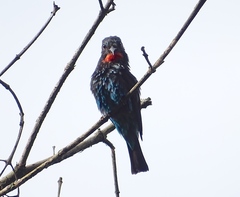
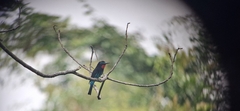
Black Bee-eater

Black Bee-eater

Merops gularis

Silhouette: Sheatherius · PhyloPic

LCLeast ConcernNTVUENCR
Daily sighting probability ~20% · Possible
at Bwindi Impenetrable National Park

In 3 days ~50% in a week ~80%

427 Verified sightings at Bwindi Impenetrable National Park From 2019 to 2026
748 In all 5 parks
November Best month
☀️ Diurnal When it's spotted

About the Black Bee-eater

The black bee-eater (Merops gularis) is a species of bird in the family Meropidae. It is native to the African tropical rainforest where it is found at the edges of the rainforest and in secondary woodland. The black bee-eater grows to a length of about 20 cm (8 in). It is a predominantly black bird, with a scarlet chin and throat, a streaked breast, a pale blue eyebrow, blue belly, undertail-coverts and rump, and rufous primaries.

It is native to the intra-tropical rainforest of Sub-Saharan Africa. There are two subspecies: M. g. gularis, which is found from Sierra Leone to southeast Nigeria. It has the forehead blue, and a distinct bright cobalt-blue superciliary stripe. Some southeast Nigerian and west Cameroon birds are intermediate between this and M. g. australis, which is found from southeast Nigeria to northeast Democratic Republic of the Congo, south to northern Angola. This sub-species has no superciliary stripe; forehead black, sometimes with a few blue feathers; the light azure-blue streaks on breast and even the belly are sometimes scarlet-tipped. Wing slightly longer than the nominate subspecies.

The black... Wikipedia →

Sounds

Call0:17

Uganda · 2022

© Peter Boesman · XC739813 · CC BY-NC-ND 4.0

Song0:22

Uganda · 2020

© Magnus Wadstein · XC548131 · CC BY-NC-SA 4.0

Call0:43

Central African Republic · 2021

© Rod Cassidy · XC615123 · CC BY-NC-SA 4.0

Global Distribution

Parks Where Found

# Park Country Daily sighting probability
1 Bwindi Impenetrable National Park 🇺🇬 Uganda
~20%
2 Odzala-Kokoua National Park 🇨🇬 Republic of the Congo
~20%
3 Semuliki National Park 🇺🇬 Uganda
~20%
4 Kibale National Park 🇺🇬 Uganda
~10%
5 Queen Elizabeth National Park 🇺🇬 Uganda
<5%

Before you go

What are the chances of seeing a Black Bee-eater in Bwindi Impenetrable National Park?

Possible

About 20% of wildlife watchers report a Black Bee-eater sighting in Bwindi Impenetrable National Park on a given day, based on 427 verified sightings from GBIF citizen-science data from 2019 to 2026. It is the 69th most-seen of the 400 birds we can rate there. Over three days the chance rises to about 50%, and over a week to about 80%, if each day is a fresh chance.

When is the best time to see a Black Bee-eater in Bwindi Impenetrable National Park?

November and December

In those months about 30% of wildlife watchers report a Black Bee-eater in Bwindi Impenetrable National Park on a given day, against about 10% in January and October, the lowest months.

What time of day is best to see a Black Bee-eater?

Between 8 and 11 am

Across all the parks we cover, that three-hour window holds the most Black Bee-eater sightings with a recorded time, and about 9 in 10 of them come between 6 am and 6 pm: it is a daytime animal.

Is Bwindi Impenetrable National Park the best place to see a Black Bee-eater?

Yes

Of the 5 parks where we can rate Black Bee-eater sightings, Bwindi Impenetrable National Park has the highest daily chance: about 20%. Next come Odzala-Kokoua National Park (Republic of the Congo, about 20%) and Semuliki National Park (Uganda, about 20%).

Where does the Black Bee-eater sighting chance come from?

GBIF citizen-science records

It is estimated from how often the Black Bee-eater is recorded against all the birds logged in Bwindi Impenetrable National Park (427 verified sightings from 2019 to 2026), calibrated against known sighting rates. Figures are rounded to the nearest 10% because citizen-science data supports honest approximations, not decimals, and months with records from fewer than five people show "—". How it works.

← Back to Bwindi Impenetrable National Park