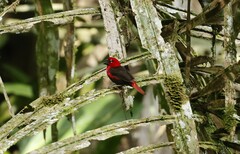

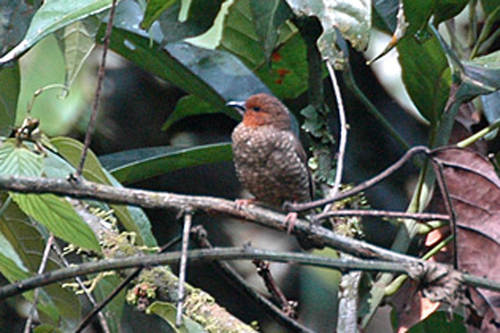
Black-bellied Seedcracker

Black-bellied Seedcracker

Pyrenestes ostrinus

Silhouette: Sheatherius · PhyloPic

LCLeast ConcernNTVUENCR
Daily sighting probability <5% · Rare
at Bwindi Impenetrable National Park

In 3 days <5%

5 Verified sightings at Bwindi Impenetrable National Park From 2019 to 2026
131 In all 3 parks
November Best month
☀️ Diurnal When it's spotted

About the Black-bellied Seedcracker

The black-bellied seedcracker (Pyrenestes ostrinus) is a bird species of the family Estrildidae. They live in most Central African countries and inhabit tropical rainforest. The species comprises individuals with different physical appearance which are grouped into three categories (small, large and mega bill size). Adults are mainly granivorous but diet preference varies with bill size and food availability. Black-bellied seedcrackers also exhibit very distinctive colorations with bright patches of black and red, making them easy to identify in the field. Overall, little is known about this species apart from its range, but intensive studies are currently looking at bill size variations among individuals and their effects on behaviors.

Black-bellied seedcracker is one of the 27 African species of finch out of 141 worldwide. They are thought to originate from India and South Asia and would have expanded in Africa over time with continental dynamics and tectonic activities. Finches belong to the family Estrilidae, within the order Passeriformes. They are considered a monophyletic clade, meaning that from an evolutionary perspective, finches in the family Estrilidae constitute... Wikipedia →

Sounds

Song0:19

Congo (Democratic Republic) · 2025

© Deville Tanguy · XC1182139 · CC BY-NC-SA 4.0

Global Distribution

Parks Where Found

# Park Country Daily sighting probability
1 Semuliki National Park 🇺🇬 Uganda
~10%
2 Kibale National Park 🇺🇬 Uganda
~10%
3 Bwindi Impenetrable National Park 🇺🇬 Uganda
<5%

Before you go

What are the chances of seeing a Black-bellied Seedcracker in Bwindi Impenetrable National Park?

Rare

Under 5% of wildlife watchers report a Black-bellied Seedcracker sighting in Bwindi Impenetrable National Park on a given day, based on 5 verified sightings from GBIF citizen-science data from 2019 to 2026. It is the 382nd most-seen of the 400 birds we can rate there. Over three days the chance rises to under 5%, if each day is a fresh chance.

When is the best time to see a Black-bellied Seedcracker in Bwindi Impenetrable National Park?

Any time of year

In every month with enough records, under 5% of wildlife watchers report a Black-bellied Seedcracker in Bwindi Impenetrable National Park on a given day, so our monthly data shows no clear season.

What time of day is best to see a Black-bellied Seedcracker?

Between 7 and 10 am

Across all the parks we cover, that three-hour window holds the most Black-bellied Seedcracker sightings with a recorded time, and about 9 in 10 of them come between 6 am and 6 pm: it is a daytime animal.

Is Bwindi Impenetrable National Park the best place to see a Black-bellied Seedcracker?

3rd of 3

Of the 3 parks where we can rate Black-bellied Seedcracker sightings, Bwindi Impenetrable National Park ranks 3rd at under 5%. The best odds are in Semuliki National Park (Uganda, about 10%) and Kibale National Park (Uganda, about 10%).

Which relatives of the Black-bellied Seedcracker live in Bwindi Impenetrable National Park?

Same family: Estrildidae

The closest relatives of the Black-bellied Seedcracker that you can see in Bwindi Impenetrable National Park (family Estrildidae, Waxbills and Allies) are White-breasted Negrofinch (about 30%), Gray-headed Negrofinch (about 20%) and Dusky Crimson-wing (about 10%), with each one's daily chance of a sighting.

Where does the Black-bellied Seedcracker sighting chance come from?

GBIF citizen-science records

It is estimated from how often the Black-bellied Seedcracker is recorded against all the birds logged in Bwindi Impenetrable National Park (5 verified sightings from 2019 to 2026), calibrated against known sighting rates. Figures are rounded to the nearest 10% because citizen-science data supports honest approximations, not decimals, and months with records from fewer than five people show "—". How it works.

← Back to Bwindi Impenetrable National Park