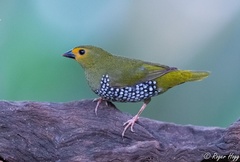
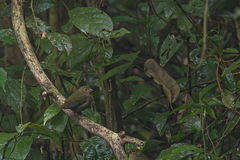

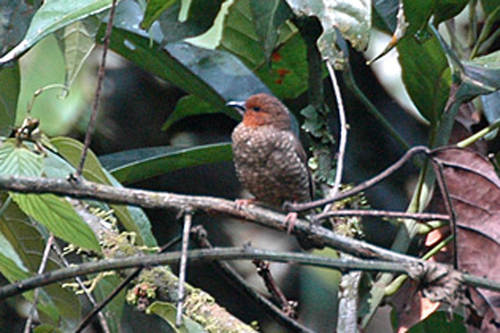
Green-backed Twinspot

Green-backed Twinspot

Mandingoa nitidula

Silhouette: Sheatherius · PhyloPic

LCLeast ConcernNTVUENCR
Daily sighting probability <5% · Rare
at Bwindi Impenetrable National Park

In 3 days ~10%

42 Verified sightings at Bwindi Impenetrable National Park From 2019 to 2026
255 In all 8 parks
March Best month
☀️ Diurnal When it's spotted

About the Green-backed Twinspot

The green-backed twinspot or green twinspot (Mandingoa nitidula) is an estrildid finch found in many parts of Sub-Saharan Africa. The IUCN has classified the species as being of least concern. The green-backed twinspot has four sub-species:

Mandingoa nitidula chubbi Mandingoa nitidula nitidula Mandingoa nitidula schlegeli Mandingoa nitidula virginiae The green-backed twinspot inhabits lowland moist forests of the tropical region. It may also be found in grassland and shrubland habitats.

Males are distinguished from females by their bright red facial feathers. Females have an olive-green face and darker (almost black) beak. The green backed twinspot prefers its privacy in regards to breeding. Males in the breeding season will raise their heads, looking straight up while "dancing" on the perch next to the female, moving in a side-stepping fashion. The female, if receptive, will crouch down and point her tail to the male. Green backed twinspots tend to pair with one female and care for her and the young while breeding. Up to four eggs are laid about five days after mating, usually one daily. The female will go in and out of the nest frequently... Wikipedia →

Sounds

Call1:10

Uganda · 2022

© Peter Boesman · XC739800 · CC BY-NC-ND 4.0

Call0:47

Ethiopia · 2015

© Hans Matheve · XC306011 · CC BY-NC-ND 4.0

Call1:14

Ethiopia · 2014

© Andrew Spencer · XC266087 · CC BY-NC-SA 4.0

Global Distribution

Parks Where Found

# Park Country Daily sighting probability
1 iSimangaliso Wetland Park 🇿🇦 South Africa
~10%
2 uMkhuze Game Reserve 🇿🇦 South Africa
<5%
3 Bwindi Impenetrable National Park 🇺🇬 Uganda
<5%
4 Arusha National Park 🇹🇿 Tanzania
<5%
5 Kibale National Park 🇺🇬 Uganda
<5%
6 Semuliki National Park 🇺🇬 Uganda
<5%
7 Tsavo West National Park 🇰🇪 Kenya
<5%
8 Kruger National Park 🇿🇦 South Africa
<5%

Cities Where Found

# City Country Daily sighting probability
1 Durban 🇿🇦 South Africa
<5%

Before you go

What are the chances of seeing a Green-backed Twinspot in Bwindi Impenetrable National Park?

Rare

Under 5% of wildlife watchers report a Green-backed Twinspot sighting in Bwindi Impenetrable National Park on a given day, based on 42 verified sightings from GBIF citizen-science data from 2019 to 2026. It is the 237th most-seen of the 400 birds we can rate there. Over three days the chance rises to about 10%, if each day is a fresh chance.

When is the best time to see a Green-backed Twinspot in Bwindi Impenetrable National Park?

March and May

In those months about 10% of wildlife watchers report a Green-backed Twinspot in Bwindi Impenetrable National Park on a given day, against under 5% in April and June–February, the lowest months.

What time of day is best to see a Green-backed Twinspot?

Between 7 and 10 am

Across all the parks we cover, that three-hour window holds the most Green-backed Twinspot sightings with a recorded time, and about 9 in 10 of them come between 6 am and 6 pm: it is a daytime animal.

Is Bwindi Impenetrable National Park the best place to see a Green-backed Twinspot?

3rd of 8

Of the 8 parks where we can rate Green-backed Twinspot sightings, Bwindi Impenetrable National Park ranks 3rd at under 5%. The best odds are in iSimangaliso Wetland Park (South Africa, about 10%) and uMkhuze Game Reserve (South Africa, under 5%).

Which relatives of the Green-backed Twinspot live in Bwindi Impenetrable National Park?

Same family: Estrildidae

The closest relatives of the Green-backed Twinspot that you can see in Bwindi Impenetrable National Park (family Estrildidae, Waxbills and Allies) are White-breasted Negrofinch (about 30%), Gray-headed Negrofinch (about 20%) and Dusky Crimson-wing (about 10%), with each one's daily chance of a sighting.

Where does the Green-backed Twinspot sighting chance come from?

GBIF citizen-science records

It is estimated from how often the Green-backed Twinspot is recorded against all the birds logged in Bwindi Impenetrable National Park (42 verified sightings from 2019 to 2026), calibrated against known sighting rates. Figures are rounded to the nearest 10% because citizen-science data supports honest approximations, not decimals, and months with records from fewer than five people show "—". How it works.

← Back to Bwindi Impenetrable National Park