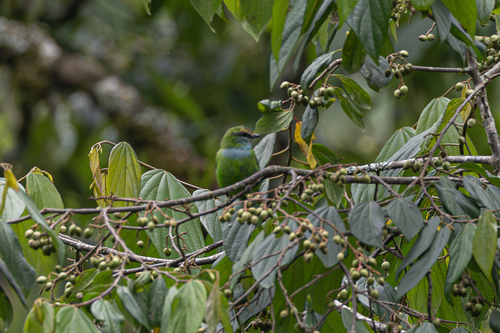
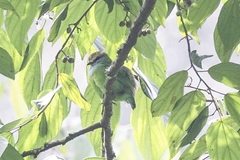

Grauer's Broadbill

Grauer's Broadbill

Pseudocalyptomena graueri

Silhouette: Sheatherius · PhyloPic

LCNTVUVulnerableENCR
Daily sighting probability ~10% · With luck
at Bwindi Impenetrable National Park

In 3 days ~30% in a week ~50%

218 Verified sightings at Bwindi Impenetrable National Park From 2019 to 2026
218 In 1 park
May Best month
☀️ Diurnal When it's spotted

About the Grauer's Broadbill

Grauer's broadbill (Pseudocalyptomena graueri), also known as the African green broadbill, is a species of bird in the family Eurylaimidae, and is monotypic within the genus Pseudocalyptomena. Its name commemorates the German zoologist Rudolf Grauer who collected natural history specimens in the Belgian Congo.

Baron Walter Rothschild, who described this species, considered it to be a flycatcher only superficially similar to the Asian broadbills of the genus Calyptomena, hence the name pseudo- or "false" Calyptomena. It is currently regarded as an actual broadbill, one of only a few African representatives of a primarily Asian family.

It is bright green with a blue throat and vent and a small bill, quite unlike those of other broadbill species. Adults have finely black-streaked buff crowns and narrow black eyestripes. It occurs in tropical moist montane forest, and is endemic to the Albertine Rift Mountains of the Democratic Republic of Congo and Uganda. In Uganda it is a rare resident at 2,100 to 2,200 metres in the Bwindi Impenetrable Forest. Density is probably less than one individual per km2.

Grauer... Wikipedia →

Sounds

Call0:27

Uganda · 2015

© Martin St-Michel · XC237577 · CC BY-NC-SA 4.0

Call0:09

Uganda · 2018

© Alwin van Lubeck · XC524372 · CC BY-NC-SA 4.0

Global Distribution

Parks Where Found

# Park Country Daily sighting probability
1 Bwindi Impenetrable National Park 🇺🇬 Uganda
~10%

More parks will be added in future updates.

Before you go

What are the chances of seeing a Grauer's Broadbill in Bwindi Impenetrable National Park?

With luck

About 10% of wildlife watchers report a Grauer's Broadbill sighting in Bwindi Impenetrable National Park on a given day, based on 218 verified sightings from GBIF citizen-science data from 2019 to 2026. It is the 139th most-seen of the 400 birds we can rate there. Over three days the chance rises to about 30%, and over a week to about 50%, if each day is a fresh chance.

When is the best time to see a Grauer's Broadbill in Bwindi Impenetrable National Park?

May and July

In those months about 20% of wildlife watchers report a Grauer's Broadbill in Bwindi Impenetrable National Park on a given day, against under 5% in February, September and November–December, the lowest months.

What time of day is best to see a Grauer's Broadbill?

Between 9 am and noon

Across all the parks we cover, that three-hour window holds the most Grauer's Broadbill sightings with a recorded time, and about 8 in 10 of them come between 6 am and 6 pm: it is a daytime animal.

Where else can you see a Grauer's Broadbill?

Only Bwindi Impenetrable National Park, in our data

Bwindi Impenetrable National Park is the only park on Wallace's Line with enough records to rate Grauer's Broadbill sightings: about 10% of wildlife watchers there report one on a given day.

Where does the Grauer's Broadbill sighting chance come from?

GBIF citizen-science records

It is estimated from how often the Grauer's Broadbill is recorded against all the birds logged in Bwindi Impenetrable National Park (218 verified sightings from 2019 to 2026), calibrated against known sighting rates. Figures are rounded to the nearest 10% because citizen-science data supports honest approximations, not decimals, and months with records from fewer than five people show "—". How it works.

← Back to Bwindi Impenetrable National Park