
African Broadbill

African Broadbill

Smithornis capensis

Silhouette: Sheatherius · PhyloPic

LCLeast ConcernNTVUENCR
Daily sighting probability ~10% · With luck
at Bwindi Impenetrable National Park

In 3 days ~30% in a week ~50%

183 Verified sightings at Bwindi Impenetrable National Park From 2019 to 2026
378 In all 11 parks
December Best month
☀️ Diurnal When it's spotted

About the African Broadbill

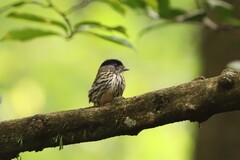
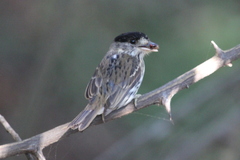
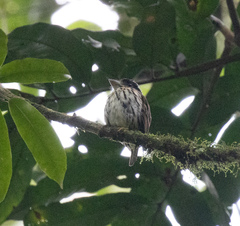
The African broadbill (Smithornis capensis), also known as the black-capped broadbill or Delacour's broadbill, is a species of bird in the suboscine family Calyptomenidae. The African broadbill is a boldly streaked, largely brown, stocky, flycatcher-like bird. They have dark crowns, which are black in the males and grey in the females of the eastern subspecies, and blackish in both sexes of the subspecies S.c. meinertzhageni. The upperparts are mainly olive-brown with black streaks, the bases of the feathers on the lower back and rump are white and are hidden when the bird is at rest. The underparts are buff or creamy-white with black streaks on the flanks and the breast. There is subspecific variation with S.c. meinertzhageni and S.c. suahelicus being whiter below with thicker streaks than, for example S.c. medianus. It measures 12–14 cm (4.7–5.5 in) in length and in South Africa males weighed 21–26.9 g (0.74–0.95 oz) and females 17.4–27.5 g (0.61–0.97 oz).

The African broadbill produces a very loud sound which has been compared to an old-fashioned car horn. It is loud, vibrating "Prrrrup" which is produced during a display flight, and it may... Wikipedia →

Sounds

Call0:38

Tanzania · 2026

Kileo Jumah · XC1149007 · CC0

Song0:04

Zambia · 2023

© Dries Van de Loock · XC791464 · CC BY-NC-ND 4.0

Wingnoise0:40

Zambia · 2019

© Peter Boesman · XC509134 · CC BY-NC-ND 4.0

Global Distribution

Parks Where Found

# Park Country Daily sighting probability
1 Bwindi Impenetrable National Park 🇺🇬 Uganda
~10%
2 uMkhuze Game Reserve 🇿🇦 South Africa
<5%
3 Kafue National Park 🇿🇲 Zambia
<5%
4 Mana Pools National Park 🇿🇼 Zimbabwe
<5%
5 Gonarezhou National Park 🇿🇼 Zimbabwe
<5%
6 iSimangaliso Wetland Park 🇿🇦 South Africa
<5%
7 Arusha National Park 🇹🇿 Tanzania
<5%
8 Gorongosa National Park 🇲🇿 Mozambique
<5%
9 Ngorongoro Conservation Area 🇹🇿 Tanzania
<5%
10 Nyungwe National Park 🇷🇼 Rwanda
<5%
11 Kibale National Park 🇺🇬 Uganda
<5%

Cities Where Found

# City Country Daily sighting probability
1 Kampala 🇺🇬 Uganda
<5%

Before you go

What are the chances of seeing an African Broadbill in Bwindi Impenetrable National Park?

With luck

About 10% of wildlife watchers report an African Broadbill sighting in Bwindi Impenetrable National Park on a given day, based on 183 verified sightings from GBIF citizen-science data from 2019 to 2026. It is the 147th most-seen of the 400 birds we can rate there. Over three days the chance rises to about 30%, and over a week to about 50%, if each day is a fresh chance.

When is the best time to see an African Broadbill in Bwindi Impenetrable National Park?

December

In that month about 20% of wildlife watchers report an African Broadbill in Bwindi Impenetrable National Park on a given day, against under 5% in June, the lowest month.

What time of day is best to see an African Broadbill?

Between 7 and 10 am

Across all the parks we cover, that three-hour window holds the most African Broadbill sightings with a recorded time, and about 8 in 10 of them come between 6 am and 6 pm: it is a daytime animal.

Is Bwindi Impenetrable National Park the best place to see an African Broadbill?

Yes

Of the 11 parks where we can rate African Broadbill sightings, Bwindi Impenetrable National Park has the highest daily chance: about 10%. Next come uMkhuze Game Reserve (South Africa, under 5%) and Kafue National Park (Zambia, under 5%).

Where does the African Broadbill sighting chance come from?

GBIF citizen-science records

It is estimated from how often the African Broadbill is recorded against all the birds logged in Bwindi Impenetrable National Park (183 verified sightings from 2019 to 2026), calibrated against known sighting rates. Figures are rounded to the nearest 10% because citizen-science data supports honest approximations, not decimals, and months with records from fewer than five people show "—". How it works.

← Back to Bwindi Impenetrable National Park